Best Tippet for Trout (2026) and What Size to Use
Use 5X tippet for most trout fishing: it measures 0.006 inches and suits size 14 to 20 flies. Go to 4X for size 12 to 16 nymphs and 6X for tiny dries on flat water. The best all round trout tippet is RIO Powerflex Strong in 5X. To size any fly, divide the hook size by four for a starting X, and remember X converts to diameter by subtracting it from 0.011 inches.
Tippet is the cheapest item in fly fishing and the one that decides most outcomes. It is the final section of leader between you and the fly, and it is simultaneously the thing the trout looks at and the thing that breaks. The X rating is a legacy scale where the number subtracted from 0.011 inches gives the diameter in inches, so 5X is 0.006 and 7X is 0.004. Everything else on this page follows from that one sentence. Picks are graded on published diameters and breaking strengths read against verified owner reviews.
What is tippet and why is it separate from the leader?
A tapered leader steps down from a thick butt section to a fine point, transferring the energy of the cast from a heavy fly line into something thin enough that a trout does not see it. The tippet is that final fine section. It is sold separately on spools because it is the part that gets consumed.
Every fly change costs two to four inches. Every wind knot costs a rebuild. Over a day the tapered point of a leader gets shorter and, critically, thicker, because you are cutting back into the taper. Once the business end of a 9 foot 5X leader has been cut back six inches you are no longer fishing 5X, you are fishing something closer to 4X with a short, stiff point that lands hard. Tie fresh tippet on and the leader is restored.
A standard trout leader runs 9 feet at roughly 60 percent butt, 20 percent mid taper and 20 percent tippet, which is about 18 to 22 inches of tippet on a fresh leader. Add tippet before you run out, not after. The leader and tippet calculator gives you the exact sections for any length and target X.
How does the X rating convert to a real diameter?
Subtract the X number from 0.011 inches. That is the whole formula, and it holds across every brand because X is a diameter scale, not a strength scale. What varies by brand and material is the breaking strength at that diameter, which is why you should read the spool rather than assume.
| X rating | Diameter, in | Diameter, mm | Fly sizes | Typical use |
|---|---|---|---|---|
| 0X | 0.011 | 0.28 | 2 to 1/0 | Big streamers, bass, pike shock sections |
| 1X | 0.010 | 0.25 | 4 to 8 | Large streamers, heavy water |
| 2X | 0.009 | 6 to 10 | 6 to 10 | Streamers, big stoneflies |
| 3X | 0.008 | 0.20 | 8 to 14 | Weighted nymph rigs, hoppers |
| 4X | 0.007 | 0.18 | 12 to 16 | General nymphing, larger dries |
| 5X | 0.006 | 0.15 | 14 to 20 | The default trout size |
| 6X | 0.005 | 0.13 | 16 to 22 | Flat water, spring creeks, refusals |
| 7X | 0.004 | 0.10 | 20 to 26 | Midges, technical tailwaters |
| 8X | 0.003 | 0.08 | 24 and smaller | Specialist, very fragile |
Breaking strength is deliberately absent from that table, because quoting one number for an X size across all brands would be wrong. As a working range, 5X nylon from mainstream brands tends to test somewhere between roughly 4 and 6 pounds, and 4X between roughly 6 and 8. Where a specific figure exists it is worth naming: RIO publishes RIO Fluoroflex Strong Tippet, 7.3lb 30yd at 0.007 inches and 7.3 pounds, which is a strong 4X. Read the spool, not the internet. The tippet size chart holds the full reference version.
How do you pick a tippet size for a given fly?
Start with the rule of four: divide the hook size by four and use the result as your starting X. A size 16 fly divided by four is 4X. A size 20 gives 5X. A size 12 gives 3X.
It is a starting point, not a law, and there are two consistent adjustments. On flat, clear, slow water, go one size lighter than the rule says, because presentation and drift matter more than strength and a thinner tippet drifts more naturally. In wind, or with a weighted rig, go one size heavier, because a tippet too fine to turn over the fly leaves it in a pile.
The other constraint the rule ignores is the hook eye. A size 22 midge has an eye that 4X will not pass through cleanly, and forcing thick tippet through a small eye leaves a knot that will not seat. That is a practical floor on how heavy you can fish small flies. The fly size to hook size chart shows where those limits fall.
Nylon or fluorocarbon: which should you buy?
Both, eventually, for different jobs. The differences are physical and measurable rather than marketing.
Nylon is roughly neutrally buoyant and sits in the surface film. It stretches more, which cushions a hookset on light tippet, it knots easily, and it is much cheaper. It degrades under ultraviolet light, so old spools lose strength. It is the correct choice for dry flies, because a floating tippet does not pull the front of the fly under.
Fluorocarbon is denser than water so it sinks, resists abrasion against rock better, has a refractive index closer to water, and is far more stable in storage. It stretches less, which transmits a strike better but gives you less cushion. It costs roughly twice as much. It is the correct choice for nymphs, streamers and any rig dragging across rock.
The full head to head, including the knot behaviour differences that matter when you join the two materials, is in nylon against fluorocarbon tippet. The short version: buy RIO Powerflex Strong Tippet, 5X 30yd first, add RIO Fluoroflex Strong Tippet, 7.3lb 30yd when you start nymphing seriously.
Best trout tippet, by tier

RIO Powerflex Strong Tippet, 5X 30yd
The one spool to own if you only own one. 5X nylon at 0.006 inches matches a size 16 to 20 dry fly and a small bead head nymph, which is the majority of trout fishing, and 30 yards is enough for a full season of fly changes.
Best for: Dry flies, general nymphing, and rebuilding a leader that has been cut back by fly changes.
Nylon tippet spools in 4X, 5X and 6X
Three spools covering 4X at 0.007 inches, 5X at 0.006 and 6X at 0.005. That range covers a size 10 streamer down to a size 22 midge, and having the next size down on your chest is what lets you drop a size when fish refuse.
Best for: A second season angler who has started getting refusals on flat water.

RIO Fluoroflex Strong Tippet, 7.3lb 30yd
Fluorocarbon at 0.007 inches, published by RIO at 7.3 pounds, which is a genuinely strong 4X. It is denser than nylon so it sinks, more abrasion resistant against rock, and has a refractive index closer to water.
Best for: Nymphing, streamers, clear tailwaters and anywhere the tippet drags across rock.
Skip it if: Dry fly fishing and tight budgets. Fluorocarbon sinks, which pulls the front of a dry fly under, and it costs roughly twice as much per yard for an advantage most anglers will never measure.
Specs are the manufacturer's published figures. Prices and stock change constantly, so confirm on the retailer page. We earn commissions from Backcountry and from qualifying Amazon purchases.
How do you tie tippet to a leader without losing strength?
Two knots cover it. A double surgeon's knot is the fast one: lay the tag ends alongside each other, tie an overhand knot with both, pass through a second time, lubricate, pull all four ends. It is quick with cold hands and forgiving of a size mismatch. A blood knot is neater and passes through guides more cleanly, and it wants the two diameters to be within about one X of each other.
Lubricate every knot before you seat it. This is the single most consequential habit on this page. As a knot tightens, the material slides against itself and generates friction heat, and a dry knot in fine nylon can fail dramatically below its rated strength. Wet it, pull it slowly and steadily, and check the seated knot visually before you fish it.
Knot strength is expressed as a percentage of the line's rated breaking strength, and published figures vary widely because test protocols differ. Treat them as ranges rather than facts. The knot strength chart gives typical retention ranges, the knot strength calculator converts a percentage into real pounds for your tippet, and the essential knots guide covers the tying steps.
One more rule that saves fish: never step down more than two X sizes in a single knot. Joining 3X to 6X leaves the thin side cutting into the thick side under load. Step 3X to 4X to 5X to 6X and every joint holds.
What else belongs in a tippet kit?
Three things, and all of them are cheap enough that going without is a false economy.
What goes with the tippet

Tippet Spool Ring and Tender Set, 4 pack
Four spools held in order on one ring, with tenders that stop the tag end unravelling in a pack. The cheapest fix for the single most annoying problem in fly fishing.

Fly Fishing Nippers with Retractor and Knot Tool
Tippet has to be cut square and close to the knot. Teeth crush it, nail clippers leave a ragged end that will not thread a size 20 hook eye, and both cost you fish.
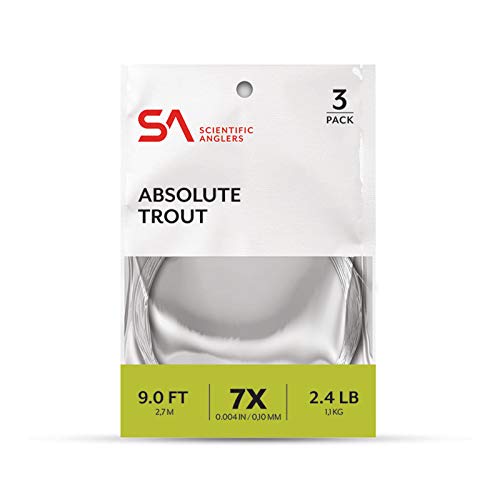
Scientific Anglers Absolute Trout Leader, 9ft 5X
Tippet is added to a leader, not used instead of one. A 9 foot 5X tapered leader is the base you build on, and three to a pack lasts most of a season.
Specs are the manufacturer's published figures. Prices and stock change constantly, so confirm on the retailer page. We earn commissions from Backcountry and from qualifying Amazon purchases.
A tippet ring is worth mentioning even though it is not on this list. It is a tiny welded metal ring tied to the end of the leader's taper, and every subsequent tippet change is tied to the ring rather than cutting back into the leader. That turns a 9 foot leader from a consumable into something that lasts a season. It is the highest-value 3 dollar purchase in the sport.
When should you replace tippet rather than reuse it?
Replace the working section after any fish over about 14 inches, after any snag you had to pull free, and at the start of every day. Those three habits cover nearly all avoidable break-offs.
Run the last two feet between your fingers periodically. Nicks and rough patches are how abrasion announces itself, and abraded tippet fails at a fraction of its rated strength. This is especially true on rocky freestone rivers, and it is the strongest practical argument for fluorocarbon on a nymph rig.
Check the age of the spool too. Nylon left in sunlight or heat degrades invisibly. Pull a foot between your hands: sound nylon stretches noticeably then breaks with a snap, degraded nylon parts with no stretch at all. If in doubt, a new spool costs less than a lost fish is worth.
Tippet, leaders, flies and floatant are the consumables that keep a season running, and it pays to check them all at once rather than discover a gap on the bank. The restock checklist is the two minute version, and pairing a fresh spool with the flies in the dry fly roundup is how most anglers actually shop. If you are still assembling the whole system, the beginner setup build has the running total, and a box like the Bead Head Prince Nymph Assortment, 12 flies plus one spool of 5X is a complete afternoon.
Frequently asked questions
What tippet size should I use for trout?
Start at 5X for general trout fishing. The X rating converts to diameter by subtracting the X number from 0.011 inches, so 5X is 0.006 inches. That is fine enough to be invisible to most trout and strong enough to land fish up to about 18 inches in normal current. Move to 4X for streamers and weighted rigs, and to 6X for flat water, spring creeks and flies smaller than size 20.
What does the X in tippet mean?
It is a legacy scale from the days when gut leaders were drawn through progressively smaller dies, and each pass got an X. Today the conversion is arithmetic: subtract the X number from 0.011 inches to get the diameter. 0X is 0.011, 3X is 0.008, 5X is 0.006 and 7X is 0.004. Note that X describes diameter only. Breaking strength varies by material and brand, so always read the spool.
How do I match tippet to fly size?
Use the rule of four: divide the hook size by four to get a starting X. A size 16 fly divided by four gives 4X, a size 20 gives 5X. It is a starting point rather than a law. On flat, clear water the right adjustment is almost always to go one size lighter than the rule suggests, and on windy water with weighted flies you go one size heavier so the leader turns over.
Is fluorocarbon tippet worth the extra money?
For subsurface fishing, often yes. Fluorocarbon is denser than nylon so it sinks rather than sitting in the surface film, it resists abrasion against rock better, and its refractive index is closer to water. For dry flies it is a poor choice for the same reason it is good for nymphs: it sinks, and it pulls the leading edge of a dry fly under. Most anglers should carry nylon for dries and fluorocarbon for nymphs.
How long does tippet last on the spool?
Nylon degrades with ultraviolet exposure and heat, so a spool left on a car dashboard for a summer can lose meaningful strength while looking perfect. Stored in a pack away from sunlight, nylon is reliable for roughly two to three years. Fluorocarbon is far more stable and lasts longer. If a spool is of unknown age, pull a foot between your hands: sound tippet stretches then breaks cleanly, degraded tippet snaps with no give.
How much tippet do I actually use in a season?
More than new anglers expect. Every fly change costs you two to four inches, and a typical day involves six to a dozen changes, plus rebuilding after wind knots and snags. A 30 yard spool covers a moderate season of one size, which is why most anglers carry two or three sizes and replace at least one spool each year. That repeat purchase is why tippet belongs in a restock routine rather than a one-off shopping list.
How we choose: we compare published manufacturer specifications, line and leader standards, and verified owner reviews across retailers. We do not test gear in person, and every diameter, grain weight and breaking strength quoted here is the manufacturer's published figure unless we say otherwise, so check the spool label before you trust a number. Nothing here is professional instruction. Wading moving water is the real hazard in this sport: wear a snug wading belt, know the water temperature, and turn back rather than push through a crossing you are unsure of.