Knot Strength Chart for Fly Fishing
Knot strength is expressed as a percentage of the line's rated breaking strength, and a well tied fly fishing knot typically retains 80 to 95 percent of it: an improved clinch runs roughly 85 to 95 percent, a double surgeon's 85 to 95 percent, a blood knot 75 to 90 percent. Published figures vary by test protocol, so treat all of them as ranges, and lubricate every knot before seating it because a dry knot fails far below its rating.
Knot strength is expressed as a percentage of the line's rated breaking strength, and every knot costs you some of it. That percentage is called knot efficiency, and a well tied fly fishing knot in good condition typically retains somewhere between 80 and 95 percent. The lost fraction is not waste you can eliminate. A knot works by turning a straight pull into a series of tight bends and friction points, and bending a monofilament sharply is exactly what weakens it.
One warning belongs above every figure on this page. Published knot strength data varies substantially between sources because test protocols vary substantially, so every number here is a range. Anyone quoting you a single clean figure such as "the improved clinch is 95 percent" is quoting one test on one material at one pull speed, and there is a good chance the knot was tied by someone who ties them for a living. Ranges are the honest form.
What is the typical strength of each fly fishing knot?
The table below gives the band each knot usually falls into when it is correctly tied, lubricated and seated. The pound columns work those percentages against a 5X tippet at a typical 5.0 lb rating, so you can see the loss in the unit you actually feel.
| Knot | What it joins | Typical efficiency | 5.0 lb becomes | Pounds lost | Notes |
|---|---|---|---|---|---|
| Improved clinch | Tippet to hook eye | 85 to 95% | 4.3 to 4.8 lb | 0.3 to 0.8 lb | The default fly knot. Loses strength quickly on heavy or stiff material, where the wraps do not bed properly |
| Non-slip mono loop | Tippet to hook eye, as an open loop | 80 to 95% | 4.0 to 4.8 lb | 0.3 to 1.0 lb | Leaves a loop so the fly swings freely. Wrap count changes with diameter, and getting that wrong is the usual cause of a weak one |
| Double surgeon's | Tippet to leader, line to line | 85 to 95% | 4.3 to 4.8 lb | 0.3 to 0.8 lb | The easiest reliable line to line knot, and the most forgiving of cold hands. A triple surgeon often tests slightly higher |
| Blood knot | Leader section to leader section | 75 to 90% | 3.8 to 4.5 lb | 0.5 to 1.3 lb | Neater and slimmer than a surgeon knot, and noticeably weaker when the two diameters differ by much |
| Perfection loop | A loop in the leader butt | 85 to 95% | 4.3 to 4.8 lb | 0.3 to 0.8 lb | Sits straight in line with the leader, which is why it is the standard loop for a leader butt |
| Nail knot | Leader butt to fly line | 85 to 95% | 4.3 to 4.8 lb | 0.3 to 0.8 lb | Rarely the weak link because the material at that end of the system is heavy. Smooth through the guides when trimmed and coated |
| Arbor knot | Backing to reel spool | 50 to 70% | 2.5 to 3.5 lb | 1.5 to 2.5 lb | Efficiency is close to irrelevant here. If a fish reaches this knot the fight was lost several problems ago |
| Loop to loop | Fly line loop to leader loop | 70 to 90% | 3.5 to 4.5 lb | 0.5 to 1.5 lb | A connection rather than a knot. Strength depends entirely on how the two loops themselves were made and whether they are seated square |
Read the arbor knot row and then forget about it. Its efficiency of roughly 50 to 70 percent looks alarming until you notice where it sits: joining backing to the reel spool. A fish that has reached that knot has taken all your fly line and all your backing, and the fight was lost several problems earlier. Knot efficiency matters in proportion to how likely that knot is to be the weakest point in the system, and the tippet end is almost always where that is.
The loop to loop row deserves a second look for the opposite reason. It is not really a knot at all, it is a connection between two loops, and its strength is entirely inherited from how those loops were made. A perfection loop in the leader butt joined to a welded loop on a good fly line is very strong. The same connection seated crooked, so the loops pinch each other rather than sitting square, is much weaker and it will fail at the worst possible moment.
Why do published knot strength figures disagree?
Because there is no shared protocol for testing them, and the protocol choices each move the result. This is the part most charts leave out, and it is the part that decides how much you should trust any number, including ours.
| Protocol factor | Effect on the result | Rough size of the effect |
|---|---|---|
| Wet or dry testing | Nylon absorbs water and tests lower wet than dry | Several percent |
| Pull speed | A slow steady pull gives higher figures than a sudden shock load | Large, often 10 percent or more |
| Whether the knot was lubricated | A dry seated knot is damaged before the test even starts | Very large, sometimes half the rating |
| Mean or minimum reported | Reporting the average of ten pulls flatters a knot against reporting the worst | Moderate |
| Who tied it | Hand tied knots vary between tiers far more than between knot types | Large |
| Material and brand | Stiff fluorocarbon and supple nylon do not behave the same in the same knot | Moderate to large |
| Diameter tested | A knot that tests well at 0.011 in can test poorly at 0.005 in | Large at the fine end |
| Rated against actual break | Some tests use the labelled rating, others measure the unknotted line first | Moderate |
Add two or three of those together and a knot honestly reported at 95 percent by one source and 75 percent by another can be the same knot tested differently, with neither source doing anything wrong. That is why comparing knots across sources is close to meaningless and why the useful comparison is between knots tested in the same way.
It is also why the practical ranking of fly fishing knots is not the same as their laboratory ranking. The knot you can tie correctly, in the cold, in poor light, with wet hands, on 6X, is the strongest knot you own, whatever a chart says about its theoretical efficiency. A double surgeon's knot tied properly beats a blood knot tied badly every single time, and the surgeon's is far easier to get right when your fingers have stopped cooperating.
What does a knot actually cost you in pounds?
Percentages are hard to feel. The table below converts efficiency into pounds across four common tippet ratings so the loss becomes concrete. These are typical ratings for those diameters rather than any one brand's published figure, because breaking strength varies by material and brand.
| Efficiency | 4X at 7.0 lb | 5X at 5.0 lb | 6X at 4.0 lb | 7X at 2.8 lb | Lost on the 5X |
|---|---|---|---|---|---|
| 100% | 7.0 lb | 5.0 lb | 4.0 lb | 2.8 lb | 0.0 lb |
| 95% | 6.6 lb | 4.8 lb | 3.8 lb | 2.7 lb | 0.3 lb |
| 90% | 6.3 lb | 4.5 lb | 3.6 lb | 2.5 lb | 0.5 lb |
| 85% | 6.0 lb | 4.3 lb | 3.4 lb | 2.4 lb | 0.8 lb |
| 80% | 5.6 lb | 4.0 lb | 3.2 lb | 2.2 lb | 1.0 lb |
| 70% | 4.9 lb | 3.5 lb | 2.8 lb | 2.0 lb | 1.5 lb |
| 60% | 4.2 lb | 3.0 lb | 2.4 lb | 1.7 lb | 2.0 lb |
| 50% | 3.5 lb | 2.5 lb | 2.0 lb | 1.4 lb | 2.5 lb |
Two things fall out of that table. First, the absolute loss is small at the fine end and it still matters enormously, because the total is small too. Half a pound lost from a 2.8 lb 7X tippet is a fifth of everything you had. Second, the difference between a 90 percent knot and an 80 percent knot on 5X is half a pound, which sounds trivial and is exactly the margin between landing a good fish and telling a story about one.
The knot strength calculator will run these numbers against whatever figure is actually printed on your spool, which is more useful than a generic table because the printed figure is the only one specific to the material in your hand. The tippet size chart covers why those printed figures vary so much in the first place.
Why does lubricating a knot matter so much?
Because friction heat damages the material as the knot draws tight, and the damage happens before you have made a single cast. When you pull a knot closed, the wraps slide against each other under load. Dry, that sliding generates heat concentrated in exactly the places the knot will later be stressed. The polymer is weakened locally, invisibly, and the knot then fails somewhere below its rating on a fish rather than on the bench where you would have learned something.
Fluorocarbon is less forgiving here than nylon. It is a stiffer, harder material with a slicker surface, so the wraps bed less readily and the friction is more concentrated when they finally do. If you fish RIO Fluoroflex Strong Tippet, 7.3lb 30yd or any other fluorocarbon, treat lubrication as mandatory rather than good practice, and seat the knot slowly with steady pressure rather than a sharp pull.
What actually improves your knots

RIO Powerflex Strong Tippet, 5X 30yd
Nylon in 5X, which is the diameter most of the worked numbers on this page are built around. Nylon stretches more than fluorocarbon, which forgives a hard hookset and seats knots more easily on a cold morning.
Best for: General trout fishing, and for learning knots on material that is easy to work with.

RIO Fluoroflex Strong Tippet, 7.3lb 30yd
Fluorocarbon at 0.007 inches, published at 7.3 lb. It resists abrasion far better than nylon, which matters because abrasion is a quieter cause of failure than knots are.
Best for: Nymph and streamer rigs that drag over rock all day.
Skip it if: Anyone still learning to seat a knot. Fluorocarbon is less forgiving and lubrication is not optional with it.

Fly Fishing Nippers with Retractor and Knot Tool
A clean cut matters more than it sounds. Scissors and teeth crush the end of the material, and a crushed end is harder to thread and starts a knot badly. The knot tool on the back helps with cold hands.
Best for: Every angler, on every trip.
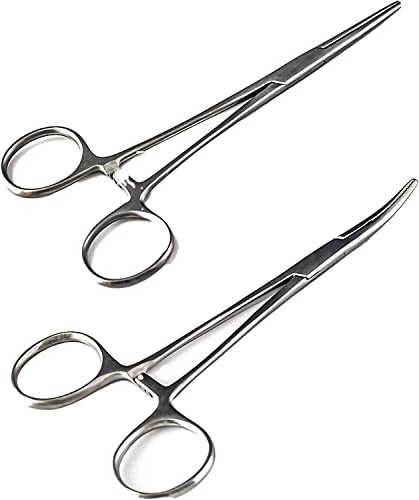
Fishing Forceps, 5in curved and straight pair
Forceps hold a small fly steady while you thread it, which is the difference between tying a good size 20 knot and tying a rushed one that fails on the first fish.
Best for: Small fly fishing, and removing hooks without handling the fish.
Skip it if: Anyone who only ever fishes size 10 and larger, where fingers do the job fine.
Specs are the manufacturer's published figures. Prices and stock change constantly, so confirm on the retailer page. We earn commissions from Backcountry and from qualifying Amazon purchases.
Which habits move the numbers most?
Knot choice is the part anglers argue about and the smallest lever available. Everything in the table below moves the result more than swapping one 90 percent knot for another 90 percent knot.
| Habit | Size of the gain | Why |
|---|---|---|
| Lubricate before seating | The single biggest factor on this page | Friction heat inside a dry knot damages the polymer as it draws tight |
| Seat slowly and firmly | Large | A jerked knot can burn even when wet, and it can also fail to bed the wraps evenly |
| Trim the tag close but not flush | Moderate | A tag cut absolutely flush can let the knot slip. Leave roughly a millimetre |
| Check the knot after every fish | Large over a day | A knot that has taken a hard fight is not the knot you tied |
| Cut out wind knots immediately | Very large | An overhand knot in the standing tippet can cost roughly half the rated strength |
| Retie after abrasion on rock | Large | The last few inches take all the damage, and damage is invisible on monofilament |
| Match the knot to the material | Moderate | Stiff heavy material needs fewer wraps, fine supple material needs more |
The trimming note is worth expanding because it is counterintuitive. It is tempting to cut the tag end absolutely flush for a tidy knot, and a few knots will slip if you do. Leave roughly a millimetre. A good pair of Fly Fishing Nippers with Retractor and Knot Tool makes that easy and, more importantly, cuts cleanly: scissors and teeth crush the end of monofilament, and a crushed end is harder to thread through a small hook eye, which is where rushed knots come from in the first place.
Checking after every fish is the habit most people skip and most regret. The knot you tied and the knot you now have are different objects once a fish has pulled on it. Run the last few inches of tippet between your fingers. If it feels rough, ridged or dull, cut it back and retie. Monofilament hides abrasion damage almost perfectly, so feel is the only test available on the water.
Which knot suits which material and diameter?
Knot efficiency is not a fixed property of a knot, it is a property of a knot tied in a specific material at a specific diameter. The same knot that performs at the top of its range in supple 3X nylon can perform near the bottom of it in stiff fluorocarbon or in 7X. That is one of the larger reasons published tables disagree, and it is also actionable, because the adjustment is usually just a turn or two.
| Material and diameter | Knot that suits it | Turns or passes | Why |
|---|---|---|---|
| Nylon, 4X and heavier | Improved clinch or non-slip loop | 5 turns on the clinch | Supple and forgiving. Almost any knot performs near the top of its range |
| Nylon, 5X to 6X | Improved clinch | 5 to 6 turns | Fine material needs an extra turn to bed properly, and lubrication becomes important rather than optional |
| Nylon, 7X and finer | Improved clinch or a Davy style knot | 6 turns, seated very slowly | At this diameter the seating technique matters more than the knot choice |
| Fluorocarbon, any diameter | Improved clinch or non-slip loop | 5 to 6 turns | Stiffer and slicker, so the wraps bed less readily. Lubricate and seat slowly, always |
| Tippet to leader, similar diameters | Blood knot or double surgeon's | 5 turns each side on a blood knot | A blood knot is slimmer, a surgeon knot is easier in the cold and slightly stronger |
| Tippet to leader, very different diameters | Double or triple surgeon's | 2 or 3 passes | A blood knot loses efficiency badly when the two diameters differ by much |
| Leader butt to fly line | Nail knot, or loop to loop | 6 to 8 turns on a nail knot | Heavy material at this end, so this connection is rarely the weak point |
Wrap count is the adjustment people most often get wrong. The general principle is that finer and more supple material wants more turns, and heavier or stiffer material wants fewer. Too few turns on fine tippet and the knot slips before it breaks. Too many turns on heavy material and the wraps cannot bed down against each other, so the knot ends up bulky and weak at the same time. If a knot is failing repeatedly in one specific material, try changing the turn count by one before you change knots entirely.
The line to line row is worth reading twice. A blood knot is neater, slimmer and passes through guides better, and it loses efficiency noticeably when the two diameters being joined are very different, which is exactly the situation you are usually in when adding tippet to a tapered leader. A double or triple surgeon's knot handles mismatched diameters far better and is much easier to tie with cold hands. That combination is why the surgeon's knot has quietly become the default on the water while the blood knot remains the one in the illustrations.
How many knots do you actually need to know?
Four, and you can fish anywhere with them.
An improved clinch ties tippet to the fly. It runs 85 to 95 percent, it is fast, and it works in the dark once you have tied a few hundred.
A double surgeon's knot ties tippet to leader. At 85 to 95 percent it is as strong as anything you need and it is far easier to tie in the cold than a blood knot. It is slightly bulkier and it collects a little more weed, which is a fair trade.
A perfection loop puts a loop in the leader butt so you can connect loop to loop with a welded fly line loop, which means you never need to tie a nail knot on the water.
A non-slip mono loop ties tippet to the fly when you want the fly to swing freely, which is most streamers and many larger dries. Wrap count changes with diameter and getting that wrong is the usual reason someone reports it as weak.
Add a nail knot only if you own a fly line without a welded loop, and an arbor knot once, when you first load the reel. The knot tying guide walks through each of them step by step, and the rod setup guide shows where each one sits in the finished rig.
Where do these numbers stop being reliable?
In four places worth naming before you quote any of them.
They assume the knot was tied correctly. A published efficiency figure describes a knot with the right number of wraps, seated evenly, with the tag in the right place. The most common real world failure is not an inefficient knot, it is a wrong one, and no chart captures that.
They assume undamaged material. Abrasion on rock, a wind knot in the standing line, UV degradation on a spool that lived on a dashboard, and simple age all lower the starting figure that the percentage is applied to. The percentage is honest and the base number might not be.
They assume a steady pull. Almost all published testing pulls slowly and evenly. A hookset on a fast rod at 30 feet is closer to a shock load, and shock loading gives lower figures across the board. This is also the argument for nylon over fluorocarbon on light tippet, because nylon's greater stretch absorbs some of that spike.
They tell you nothing about the drag. A knot only fails when it is loaded past its limit, and a properly set drag is what stops that happening. If you are breaking off on the strike, the answer is more likely a drag set too tight or a hookset that is too violent than a knot problem. The tippet roundup covers materials, and the honest summary of this page is shorter than the page: lubricate everything, tie fewer knots better, and check them after every fish.
Frequently asked questions
How strong is an improved clinch knot?
Typically somewhere between 85 and 95 percent of the material rated breaking strength when it is well tied, well lubricated and seated slowly. Published figures vary substantially because test protocols vary, so treat that as a band rather than a number. It loses efficiency on heavy or stiff material, where the wraps cannot bed properly, which is why heavier tippet often calls for a different knot.
Why do published knot strength figures disagree so much?
Because there is no shared test protocol. Different sources pull wet or dry, fast or slow, report the mean or the worst of a series, use different brands and diameters, and above all differ in whether the knot was lubricated before seating. Any of those can move a result by ten percent and lubrication can move it by far more, so a single figure quoted without a protocol tells you very little.
Does lubricating a knot really make a difference?
Yes, and it is the largest single factor an angler controls. Drawing a knot tight dry generates friction heat inside the wraps that damages the polymer before you have even cast, and the knot then fails well below its rating, usually on a fish rather than on the bench. Saliva or river water is enough. Wet it, seat it slowly, and the same knot performs at the top of its published range.
What is the strongest knot for tying tippet to a fly?
For most trout fishing the improved clinch is the practical answer at 85 to 95 percent, because it is fast, reliable and easy to tie in poor light. A non-slip mono loop tests in a similar band and gives the fly freedom to swing, which is worth more than a percentage point on streamers and larger dries. The knot you can tie correctly in the cold beats the knot with the better laboratory figure.
How much strength does a wind knot cost me?
A great deal. An overhand knot accidentally cast into the tippet can cost roughly half the rated breaking strength, which turns a 5 lb 5X tippet into something closer to 2.5 lb. It is also invisible until you look for it. Check your tippet after any cast that felt like it collapsed, and cut the section out and retie rather than fishing on and hoping.
Does the arbor knot strength matter?
Almost never. It joins backing to the reel spool, and its published efficiency of roughly 50 to 70 percent sounds alarming until you consider where it sits. If a fish has taken all your fly line and all your backing to the spool, the outcome was decided long before the knot was reached. Tie it neatly, seat it, and spend your attention on the tippet end instead.
How we choose: we compare published manufacturer specifications, line and leader standards, and verified owner reviews across retailers. We do not test gear in person, and every diameter, grain weight and breaking strength quoted here is the manufacturer's published figure unless we say otherwise, so check the spool label before you trust a number. Nothing here is professional instruction. Wading moving water is the real hazard in this sport: wear a snug wading belt, know the water temperature, and turn back rather than push through a crossing you are unsure of.