How to Set Up a Fly Rod, Step by Step
A fly rod is rigged thickest to thinnest in five connections: backing to reel arbor, fly line to backing, leader to fly line, tippet to leader, fly to tippet. A standard trout setup is roughly 100 yards of 20 pound dacron backing, 90 feet of weight forward floating line, and a 9 foot tapered leader ending at 5X.
Rigging a fly rod is a single idea repeated five times: every connection steps down in diameter, so the casting energy stored in the heavy fly line hands off smoothly through the leader and arrives at a fly that weighs almost nothing. Get the order right and the setup is twenty minutes of work you will do once and then only maintain. Get it wrong and the rod feels broken when it is not.
A complete outfit like the one above arrives with the backing, line and leader already installed, which removes the two connections most likely to be done badly. If you bought the pieces separately, work through the sections below in order.
What are the five connections in a fly fishing setup?
From the reel outward: backing, fly line, leader, tippet, fly. Each has a job, and the jobs are genuinely different rather than decorative.
| Component | Typical trout spec | Length | What it does | Knot to the next piece |
|---|---|---|---|---|
| Backing | 20 lb dacron | 100 yd | Fills the spool, raises arbor diameter, reserve for a long run | Arbor knot to spool |
| Fly line | WF5F | 90 ft | The casting weight, 140 grains in the first 30 feet | Albright or loop to loop |
| Leader | 9 ft, 5X taper | 9 ft | Converts line energy into a soft, straight turnover | Loop to loop or nail knot |
| Tippet | 5X, 0.006 in | 18 to 30 in | The sacrificial, replaceable end | Double surgeon's or blood knot |
| Fly | Size 14 to 18 | n/a | The point of the whole exercise | Improved clinch |
How do you put backing on a fly reel?
First, set the retrieve direction. Nearly every modern reel converts between left hand and right hand wind by pulling the spool and flipping the drag clutch over, and doing this after you have spooled 100 yards of backing is a miserable job. Decide now.
Tie the backing to the spool arbor with an arbor knot: an overhand knot around the arbor, a second overhand knot in the tag end as a stopper, then pull the standing line so the stopper jams against the first knot. It only has to hold under load once in a decade, but it costs nothing to tie properly. A single 100 yard spool of 20 pound dacron backing fills a standard 5/6 trout reel.
Wind the backing on under light tension, laying it evenly across the spool rather than piling it in one place. The real target is not a yardage figure, it is a fill level: with the fly line also on, the outermost wraps should sit about an eighth of an inch below the spool rim. Too full and the line binds against the frame. Too empty and the fly line coils like a spring because it has been stored on a small diameter.
How do you attach fly line to backing?
Two honest options. If your fly line has a welded loop at the back end, and many do, tie a Bimini or a simple double surgeon's loop in the backing and connect them loop to loop. If it does not, the Albright knot is the standard join between two lines of very different diameter, and a nail knot works too. Whichever you use, coat the finished knot with a drop of flexible cement so it does not catch on the stripping guide during a long run.
Check which end of the fly line goes on first. Fly line spools are labelled, and the tag usually says "this end to reel". Winding a weight forward line on backwards puts the heavy head inside the spool and the thin running line at the tip, which makes the rod feel dead and is a genuinely common mistake. A line such as the Orvis Clearwater Fly Line, WF floating ships with a welded loop at the front, which is the tell for which end faces out.
How do you attach a leader to fly line?
If the fly line has a welded loop at the tip, and a looped leader such as the SF Pre-Tied Loop Tapered Leaders, 9ft 5X 6 pack , this is a loop to loop connection and takes about five seconds. Pass the leader loop through the line loop, then pass the whole leader through its own loop and seat the two so they form a square handshake rather than a girth hitch. A girth hitch cuts into the line coating over time.
If there is no welded loop, tie a nail knot. It seats the leader butt against the fly line coating in a smooth, tapered wrap that passes through the guides without ticking. A nail knot tool or the barrel of a ballpoint pen makes it far easier than the name suggests. Some anglers instead nail knot a 12 inch butt section of stiff 20 pound nylon to the line permanently, put a perfection loop in the end, and go loop to loop from there. That is the setup that survives an entire season of leader changes without touching the fly line.
A standard trout leader is 9 feet, tapered, and built roughly 60 percent butt, 20 percent mid taper and 20 percent tippet. The butt section should be about two thirds the diameter of the fly line tip, which is what stops the connection hinging. Our leader formula chart gives the section lengths if you want to build your own, and the leader and tippet calculator sizes the tippet to the fly you plan to fish.
How do you add tippet to the leader?
Tippet is the level, replaceable section at the very end. It exists so that a season of fly changes eats a cheap spool rather than eating your tapered leader: every fly you cut off shortens the leader, and once you have cut back into the taper the leader stops turning over.
Tippet X rating is a legacy scale where the X number subtracted from 0.011 inches gives the diameter. 0X is 0.011 inches, 3X is 0.008, 5X is 0.006, 7X is 0.004. Breaking strength varies by material and brand, so quote it from the spool label rather than from a universal table. A spool of RIO Powerflex Strong Tippet, 5X 30yd handles most trout dry fly and nymph work, and a fluorocarbon spool like the RIO Fluoroflex Strong Tippet, 7.3lb 30yd is the subsurface choice because it is denser, more abrasion resistant and harder to see underwater.
Join tippet to leader with a double surgeon's knot if you want speed and a blood knot if you want a slimmer profile that collects less weed. Both are strong enough when wet before seating. Add 18 to 30 inches to start. The tippet size chart lists every diameter, and nylon versus fluorocarbon tippet covers which material belongs where.
How do you tie the fly on?
The improved clinch knot handles almost everything: five turns around the standing line, back through the loop at the hook eye, then through the big loop you just formed, wet it, and seat it with steady pressure rather than a jerk. For heavier tippet from 0X to 2X, the non slip loop knot is better because it lets a streamer or a large dry swing freely instead of being held rigid.
Trim the tag end close with proper nippers such as the Fly Fishing Nippers with Retractor and Knot Tool rather than your teeth. A long tag on a dry fly collects weed and catches the leader on every other cast. Percentage figures for each knot are gathered in the knot strength chart, and the knot strength calculator converts a percentage into the pounds you actually have at the fly.
How do you assemble the rod itself without damaging it?
Join the sections with the guides offset by about a quarter turn, then twist them into alignment as you push them together. That seats the ferrule under friction rather than under compression and it is far less likely to leave a section stuck. Do not push a ferrule fully home dry and cold on a hot day: graphite expands, and a jammed ferrule is a workshop job.
Thread the line, not the leader, through the guides. Fold the fly line into a loop and feed the loop up: if you let go, the loop catches on a guide instead of the whole line sliding back down to the ground. Miss a guide and the rod loads unevenly and casts badly, so count them on the way up. Finally, hook keeper or stripping guide for the fly, and a light tension on the reel so nothing unspools in the car.
What can go wrong, and how do you tell?
| Symptom | Most likely cause | Fix |
|---|---|---|
| Leader lands in a pile | Leader cut back into the taper, or tippet too heavy for the fly | Rebuild the tippet section, drop one X size |
| Line ticks through the guides | Bulky leader to line knot | Re-tie as a nail knot or loop to loop |
| Rod feels dead at short range | Line under-loading a fast blank | Try a line built a half size heavy |
| Line coils badly off the reel | Not enough backing, small effective arbor | Add backing to fill within 1/8 in of the rim |
| Breaking off on the strike | Dry knot seated hot, or old nylon | Wet knots, replace nylon tippet each season |
If the rod still feels wrong after all of that, check the line against the rod with the line weight calculator before assuming the blank is at fault. A mismatch of one line size is the usual culprit, and it is a $50 fix rather than a $500 one.
Complete outfits that arrive already rigged

Maxcatch Extreme Fly Fishing Combo Kit, 9ft 5wt 4pc
Everything matched for less than the price of a premium fly line on its own. The reel is die-cast rather than machined and the blank is unremarkable, but it casts and it is spooled correctly out of the box.
Best for: A first rod where the goal is to find out whether the sport sticks.
Skip it if: Anyone who wants a rod they will still be fishing in five years.
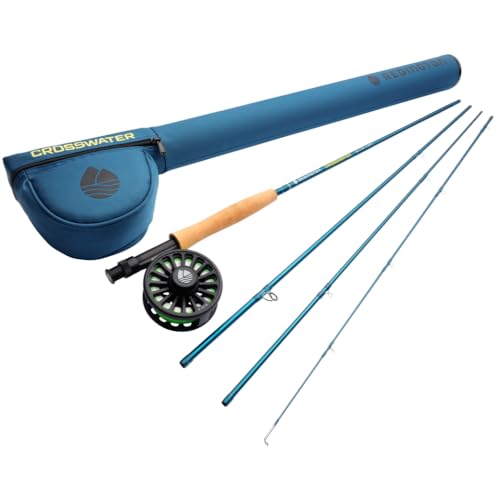
Redington Crosswater Fly Fishing Outfit, 9ft 5wt 4pc
A medium-fast graphite blank, a real branded line and a case. Medium-fast is the forgiving end of the action range, which matters far more when you are learning than any spec on the box.
Best for: The outfit most people should actually buy first.
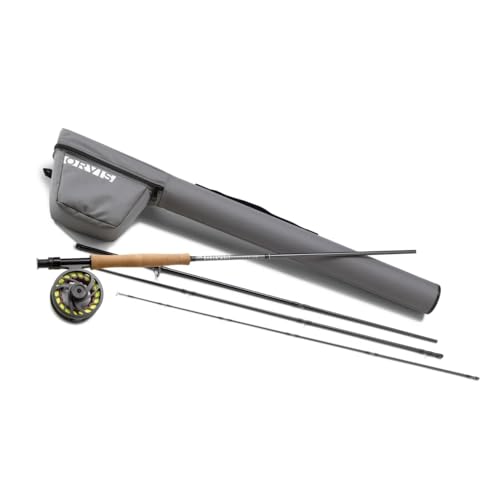
Orvis Clearwater Fly Rod Outfit, 8'6" 5wt 4pc
An 8'6" 5 weight with ceramic stripping guides, a proper reel seat, a rod tube and the 25 year Orvis rod guarantee that covers breakage from a car door.
Best for: Buying once, and never thinking about the rod again.
Skip it if: Anyone still learning a casting stroke. The extra money buys durability and finish, not fish.
Specs are the manufacturer's published figures. Prices and stock change constantly, so confirm on the retailer page. We earn commissions from Backcountry and from qualifying Amazon purchases.
Once the rod is built, the next two things worth learning are the casting stroke in fly casting basics and the three knots in essential fly fishing knots. Everything else on this site assumes the rig above.
Frequently asked questions
What order do you rig a fly rod in?
Thickest to thinnest, always: backing to the reel arbor, fly line to the backing, leader to the fly line, tippet to the leader, fly to the tippet. Each step steps down in diameter so casting energy transfers smoothly from the heavy line into the nearly weightless fly. Skipping the leader and tying a fly straight to the fly line does not work, because the line lands on top of the fish.
How much backing goes on a 5 weight reel?
Roughly 100 yards of 20 pound dacron on a standard 5/6 large arbor reel, though the honest answer is to fill the spool so the loaded fly line sits about an eighth of an inch below the rim. Backing on a trout reel is mostly there to increase the arbor diameter, which reduces line memory and speeds retrieve, rather than to give a trout somewhere to run.
Which way should the fly reel handle face?
Whichever hand you want to wind with, and most anglers wind with their non casting hand. Nearly every modern reel converts from left hand to right hand retrieve by removing the spool and flipping the drag clutch, and the manual shows the direction. Get this right before you spool line on, because reversing it afterwards means stripping the line off and respooling it.
Do I need to tie a nail knot to attach the leader?
Not on most modern lines. Nearly every fly line made in the past two decades ships with a welded loop at the tip, and a loop to loop connection with a looped leader takes seconds and passes through the guides cleanly. Learn the nail knot anyway for lines without a loop and for rebuilding a butt section, but do not let it stop you rigging up.
How long should the leader be?
Nine feet is the default for trout, tapering to 4X or 5X. Shorten to 7.5 feet on small brushy streams where turnover matters more than stealth, and extend to 12 feet or more on flat spring creeks and stillwater where a leader landing near the fish spooks it. The taper should run roughly 60 percent butt, 20 percent mid and 20 percent tippet.
How do I stop the leader from twisting during setup?
Unroll a packaged leader rather than pulling it out of the coil, and stretch it gently between your hands to relax the memory set by the packet. Wet the material before seating any knot: a dry knot fails well below its rated strength because friction heat damages the nylon. If a leader corkscrews on the water, it is usually the fly spinning in the air rather than the leader itself.
How we choose: we compare published manufacturer specifications, line and leader standards, and verified owner reviews across retailers. We do not test gear in person, and every diameter, grain weight and breaking strength quoted here is the manufacturer's published figure unless we say otherwise, so check the spool label before you trust a number. Nothing here is professional instruction. Wading moving water is the real hazard in this sport: wear a snug wading belt, know the water temperature, and turn back rather than push through a crossing you are unsure of.