Tippet Size Chart: X to Diameter to Strength
Tippet X rating is a legacy diameter scale where the X number subtracted from 0.011 inches gives the diameter in inches. So 5X is 0.006 inches, or about 0.152 mm, and typically breaks somewhere between 4 and 6.5 lb depending on the material and the brand. Match the tippet to the fly with the rule of four: divide the hook size by 4, so a size 16 fly starts at 4X.
Tippet X rating is a legacy diameter scale where the number subtracted from 0.011 inches gives the diameter. That single sentence is the whole convention. 5X is 0.011 minus 0.005, which is 0.006 inches, or about 0.152 millimetres. The scale runs backwards from intuition, so a bigger X number means thinner material, and 8X is the finest tippet in normal production while 0X is the heaviest thing still called tippet rather than leader butt.
What the X scale does not tell you is breaking strength, and that is the point most charts get wrong. X is a diameter standard. It is not a strength standard. Two spools both marked 5X can differ by a couple of pounds because the polymer, the drawing process and the quality control differ between manufacturers. That is why every strength figure on this page is a range, and why the only number you should truly trust is the one printed on the spool in your hand.
What is the tippet X to diameter conversion?
The conversion is arithmetic rather than a lookup, which is why it is worth learning once instead of carrying a card. Take 0.011 inches, subtract the X number expressed in thousandths, and the result is the nominal diameter. 3X is 0.011 minus 0.003, giving 0.008 inches. 7X is 0.004 inches. The scale is a survival from the era when leaders were drawn from silkworm gut and sized by how many times they had been pulled through a drawing plate, and it stuck because diameter is the property that governs how a leader turns over, how it drags in current, and how visible it is.
| X | Inches | Millimetres | Nylon, typical lb | Fluorocarbon, typical lb | Common use |
|---|---|---|---|---|---|
| 0X | 0.011 | 0.279 | 12 to 16 | 12 to 17 | Bass bugs, pike leaders, big streamers, steelhead |
| 1X | 0.010 | 0.254 | 10 to 14 | 10 to 15 | Large streamers, bass poppers, saltwater class tippet |
| 2X | 0.009 | 0.229 | 8.5 to 12 | 9 to 13 | Weighted streamers, hoppers, size 6 to 10 flies |
| 3X | 0.008 | 0.203 | 7 to 10 | 7.5 to 10.5 | Size 10 to 14 nymphs and larger dries |
| 4X | 0.007 | 0.178 | 5.5 to 8 | 6 to 8.5 | Size 14 to 16 dries and nymphs, the workhorse size |
| 5X | 0.006 | 0.152 | 4 to 6.5 | 4.5 to 7 | Size 16 to 20 dries, the single most used tippet in trout fishing |
| 6X | 0.005 | 0.127 | 3 to 5 | 3.2 to 5.5 | Size 20 to 22 dries, flat water, wary fish |
| 7X | 0.004 | 0.102 | 2 to 3.5 | 2.2 to 3.8 | Size 22 to 24 midges and Tricos on glassy water |
| 8X | 0.003 | 0.076 | 1.4 to 2.5 | 1.5 to 2.8 | Size 24 and smaller, spring creeks, a specialist size |
Those strength columns are ranges on purpose. Published figures for nominally identical sizes vary by brand, by product line within a brand, and by whether the manufacturer quotes a dry laboratory break or a wet knotted one. When we can attribute a specific figure we do: the RIO Fluoroflex Strong Tippet, 7.3lb 30yd is published at 7.3 lb at a diameter of 0.007 inches, which is 4X, and that is a genuinely strong figure for that diameter in fluorocarbon. What you should not do is take a single brand figure and treat it as the definition of the size.
What tippet size do I use for a size 16 dry fly?
4X, and the reason is a piece of arithmetic simple enough to do on the bank. The rule of four says to divide the hook size of the fly by four, and use the result as your starting tippet X. A size 16 fly divided by four is four, so 4X. A size 20 gives 5X. A size 12 gives 3X.
| Hook size | Divided by 4 | Starting tippet |
|---|---|---|
| 2 | 0.50 | 0X or 1X |
| 4 | 1.00 | 1X |
| 6 | 1.50 | 1X or 2X |
| 8 | 2.00 | 2X |
| 10 | 2.50 | 2X or 3X |
| 12 | 3.00 | 3X |
| 14 | 3.50 | 3X or 4X |
| 16 | 4.00 | 4X |
| 18 | 4.50 | 4X or 5X |
| 20 | 5.00 | 5X |
| 22 | 5.50 | 5X or 6X |
| 24 | 6.00 | 6X |
| 26 | 6.50 | 6X or 7X |
The rule is a starting point rather than a law, and it is worth understanding what it is actually approximating. A tippet that is too heavy for the fly makes the fly behave stiffly: it hinges at the knot, it does not swing freely in the film, and it does not sink at the same rate as a lighter connection would. A tippet that is too light for the fly cannot turn it over, so the leader collapses in a heap and the fly lands nowhere near where you aimed. The rule of four finds the middle of that window for a normally proportioned fly.
Where it breaks down is where the fly is not normally proportioned. A size 10 bead head nymph with a tungsten bead is much heavier than a size 10 dry fly, and it wants heavier tippet than the arithmetic suggests. A size 8 foam hopper is very light for its hook size but hugely wind resistant, so it also wants a heavier tippet. Weighted or bulky flies go up a size. Flat, slow, clear water goes down a size. The fly size to hook size chart has the dimensions if you want to reason it through rather than apply the rule blindly.
| Fly | Tippet | Why that size |
|---|---|---|
| Size 2 to 4 pike fly or large streamer | 0X to 1X | Stiffness to turn the fly over matters more than breaking strength here |
| Size 4 to 6 articulated or conehead streamer | 1X to 2X | A heavy fly on light tippet hinges and tangles the leader on every cast |
| Size 6 to 10 hopper or foam terrestrial | 2X to 3X | Bulk and wind resistance, plus fish eating hoppers are rarely leader shy |
| Size 10 to 14 bead head nymph | 3X to 4X | Enough diameter to hold a snagged fly straight and to survive rock abrasion |
| Size 14 to 16 dry fly | 4X | The rule of four exactly. Size 16 divided by 4 is 4X |
| Size 16 to 18 dry fly | 4X to 5X | Drop to 5X the moment drag becomes visible on the water |
| Size 18 to 20 dry fly or emerger | 5X | The most used trout tippet size on the continent |
| Size 20 to 22 midge | 6X | A stiff 5X will not let a size 22 fly move naturally in the film |
| Size 22 to 24 Trico or micro midge | 6X to 7X | Past this point the tippet is a presentation tool, not a strength component |
Nylon or fluorocarbon, and does it matter?
Both, and yes, but not for the reason it is usually sold on. Nylon monofilament and fluorocarbon are different polymers with genuinely different physical properties, and the differences that matter most on the water are density and stretch rather than visibility.
| Property | Nylon | Fluorocarbon |
|---|---|---|
| Density relative to water | About 1.14, sinks very slowly | About 1.78, sinks readily |
| Refractive index | About 1.53 | About 1.42, closer to water at about 1.33 |
| Stretch before failure | High, roughly 20 to 30 percent | Low, roughly 15 to 20 percent |
| Abrasion resistance | Moderate | Noticeably better on rock and on teeth |
| Water absorption | Absorbs water, loses strength when soaked | Effectively none |
| UV and age degradation | Degrades in sunlight, replace spools each season or two | Very stable, but still worth replacing |
| Knot behaviour | Forgiving, seats easily | Less forgiving, lubrication is not optional |
| Typical cost per spool | Lowest | Roughly two to three times nylon |
Read the density row again, because it decides most rigs. Fluorocarbon sinks and nylon effectively does not, so fluorocarbon belongs on nymph and streamer rigs and nylon belongs on dry flies. A dry fly tied to fluorocarbon gets pulled down through the surface film by its own tippet, which is exactly the failure mode you spent money on floatant to avoid. Meanwhile a nymph on nylon takes longer to reach depth and hangs above where you want it.
The stretch row decides the other half. Nylon's higher stretch is a shock absorber, which is genuinely valuable at 6X and 7X where a hard hookset on a heavy fish is the most common way tippet fails. Fluorocarbon's lower stretch transmits a take more crisply, which is why nymph anglers like it, and it also means you must set the hook more gently. Our nylon against fluorocarbon comparison goes through the trade off in more depth than a chart page can.
Tippet and leaders worth stocking, by tier

RIO Powerflex Strong Tippet, 5X 30yd
Nylon in 5X, which is the single most used tippet size in trout fishing. Nylon stretches more than fluorocarbon, which forgives a hard hookset on light diameter, and a 30 yard spool lasts most anglers a full season of dry fly work.
Best for: Dry flies and general trout fishing on a 9 foot 5X leader.

RIO Fluoroflex Strong Tippet, 7.3lb 30yd
Fluorocarbon at 0.007 inches, which is 4X, published at 7.3 lb. Fluorocarbon sinks, resists abrasion better than nylon and has a refractive index closer to water, which is why it lives on nymph and streamer rigs rather than on dry flies.
Best for: Subsurface work: nymph droppers, streamers, and anywhere the tippet drags over rock.
Skip it if: Dry fly fishing. It sinks, so it pulls the fly down through the film and drowns it.
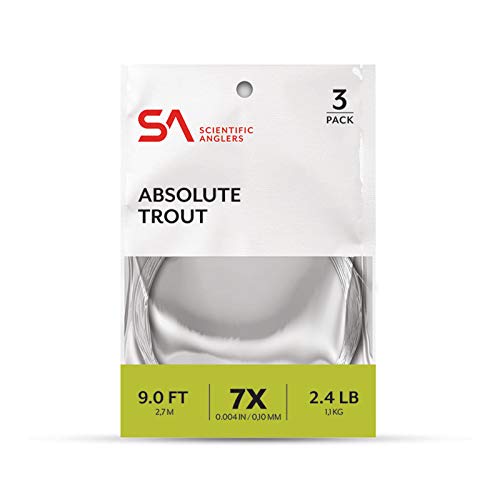
Scientific Anglers Absolute Trout Leader, 9ft 5X
The tapered leader that the tippet gets tied onto. A 9 foot 5X knotless leader is the default trout rig, and three to a pack means you are not rebuilding a leader on the bank with cold hands.
Best for: A ready made front end so your tippet spools do all the adjusting.

Tippet Spool Ring and Tender Set, 4 pack
Spool tenders hold four spools in order and stop tippet unravelling in a pack. This is the accessory that stops a vest from becoming a nest of loose monofilament.
Best for: Anyone carrying three or more X sizes on the water.
Skip it if: A one spool angler. If you only ever fish 5X, this is solving a problem you do not have.
Specs are the manufacturer's published figures. Prices and stock change constantly, so confirm on the retailer page. We earn commissions from Backcountry and from qualifying Amazon purchases.
How much does a knot cost you in tippet strength?
A great deal, and this is where the numbers in the first table stop being the numbers you actually fish. Knot strength is expressed as a percentage of the material's rated breaking strength, and every knot costs you some of it. A well tied, well lubricated knot might retain 90 to 95 percent. A rushed one might retain 70. A knot seated dry, where friction heat has damaged the polymer as it drew tight, can fail at half of the rating or worse.
| Knot efficiency | Description | 5X at 5.0 lb becomes | 6X at 4.0 lb becomes |
|---|---|---|---|
| 95% | Excellent knot, well lubricated and seated | 4.8 lb | 3.8 lb |
| 90% | Good knot, correctly tied | 4.5 lb | 3.6 lb |
| 80% | Average knot, a little rushed | 4.0 lb | 3.2 lb |
| 70% | Poor seating or a partly dry knot | 3.5 lb | 2.8 lb |
| 50% | A dry knot burned during seating, or a wind knot in the tippet | 2.5 lb | 2.0 lb |
The knot strength chart carries the typical retention ranges by knot type, and the knot strength calculator will do the arithmetic for whatever figure is printed on your spool. The important habit is the mental one: when you tie 6X to a fly, do not think of it as four pounds of tippet. Think of it as three pounds after the knot, and less again after any abrasion.
How long should the tippet section be?
Tippet length is a presentation control, not just a consumable. A longer, finer tippet lands with more slack in it, and slack is what delays drag. Drag, not tippet diameter, is what causes most refusals on moving water.
| Situation | Length | Why |
|---|---|---|
| Standard dry fly fishing on moving water | 18 to 24 in | Long enough to give the fly a hinge point, short enough to turn over |
| Flat, slow, clear water with wary fish | 30 to 48 in | A long light tippet buys slack and delays drag, which is what refusals are usually about |
| Indicator nymphing | 18 to 30 in below the last knot | Enough to let the fly sink independently of the stiffer leader above it |
| Streamer fishing | 12 to 24 in | Short and heavy, because turnover and abrasion matter more than delicacy |
| Windy conditions, any fly | 12 to 18 in | Shorten before you go heavier. A shorter tippet straightens far better in wind |
Every fly change costs you a couple of inches of tippet, and a knotless tapered leader gets shorter and heavier at the tip as the day goes on. That is exactly what the tippet spool is for: you add material back at the diameter you want rather than cutting into the taper of a Scientific Anglers Absolute Trout Leader, 9ft 5X until it is a 7 foot 3X. A cheaper multi pack such as the SF Pre-Tied Loop Tapered Leaders, 9ft 5X 6 pack makes it easier to start each session with a fresh taper rather than nursing an old one. A standard trout leader runs roughly 60 percent butt, 20 percent mid taper and 20 percent tippet, and once a leader has drifted far from those proportions it is easier to replace than to rescue.
Which X sizes should you actually carry?
Three spools cover the great majority of trout fishing, and the temptation to carry nine is a tax on your pack rather than an improvement in your fishing.
5X nylon is the anchor. It matches a size 16 to 20 dry fly, which is the bulk of what rises to a fly in a trout river, and its stretch protects a light hookset. A spool such as the RIO Powerflex Strong Tippet, 5X 30yd in 30 yards is enough for a heavy season.
4X fluorocarbon is the subsurface half. It sinks, resists abrasion on rock, and at 0.007 inches it turns over a bead head nymph without hinging. The RIO Fluoroflex Strong Tippet, 7.3lb 30yd is the example with a published figure attached to it.
6X nylon is the insurance policy for the day the fish are on size 22 midges on flat water and everything heavier is refused. You will use it rarely and be very glad of it when you do.
Beyond that, add 3X if you fish streamers, 2X if you fish hoppers or bass, and 0X or 1X only if you fish genuinely large flies. A Tippet Spool Ring and Tender Set, 4 pack keeps them in order in a pack, which sounds trivial until a spool unspools itself into a sling and you spend ten minutes of a hatch untangling it. The tippet roundup covers the specific spools worth buying, and the leader and tippet calculator will build a complete rig for a given fly and water type.
Where does this chart stop being reliable?
In four specific places, all of which are worth knowing before you quote a number from it.
Diameter tolerance is real. The X figure is nominal. Manufacturers hold diameter to a tolerance, and a spool measured with a micrometer will often read a thousandth away from the label. Over a whole leader that is invisible, but it does explain why two 5X spools from different brands can feel and behave differently.
Some brands label in pounds rather than X. Saltwater and bass tippet material is frequently sold as a pound test with a diameter printed alongside, and the X label disappears entirely. Convert with the diameter, not the pounds, because the pound rating is the part that varies between brands.
Wet nylon is weaker than dry nylon. Nylon absorbs water, and a spool that has been fished all day is not at its label figure. The effect is modest but it is real, and it is another reason to treat the printed number as a ceiling rather than a promise.
A wind knot changes everything. An overhand knot accidentally cast into the tippet can cost roughly half the rated strength, and it is the reason for far more lost fish than any decision about brand or material. If you find one, cut the section out and retie. That takes two minutes and no amount of buying better tippet substitutes for it.
Frequently asked questions
What does the X in tippet mean?
X is a legacy diameter scale, not a strength scale. Subtract the X number from 0.011 inches and you have the diameter: 5X is 0.011 minus 0.005, which is 0.006 inches, or about 0.152 mm. The scale runs backwards from what people expect, so a larger X number means thinner material. It comes from an old drawn gut sizing system and survived because diameter, not stated pounds, is what fish actually respond to.
How do I convert tippet X to pounds?
There is no fixed conversion, and that is the honest answer. Diameter is defined by the X scale but breaking strength depends on the polymer, the manufacturing process and the brand, so 5X can be anywhere from roughly 4 to 6.5 lb depending on which spool you pick up. Read the pound figure printed on the spool label rather than trusting a chart, including this one, for a specific number.
What is the rule of four for tippet?
Divide the hook size of the fly by four and use that number as your starting tippet X. A size 16 fly divided by four gives 4X, a size 20 gives 5X, and a size 12 gives 3X. It is a starting point rather than a law. On flat water or with drag showing, go one size lighter. With weighted or wind resistant flies, go one size heavier so the leader still turns over.
Is fluorocarbon really less visible than nylon underwater?
Its refractive index is closer to water, roughly 1.42 against water at about 1.33, while nylon sits near 1.53. That does make it optically less obtrusive in theory. In practice, drag on the fly and the shadow the tippet casts on the bottom probably matter more than the material. The stronger reasons to fish fluorocarbon are that it sinks and that it resists abrasion better.
How much tippet should I tie on?
Between 18 and 24 inches is the standard for dry fly fishing on moving water, extending to 3 or 4 feet on flat, slow, clear water where delayed drag is what wins refusals. For streamers, 12 to 24 inches is plenty. In wind, shorten the tippet before you go up in diameter, because a short tippet straightens far more reliably than a long one does.
How often should I replace tippet spools?
Nylon degrades in sunlight and absorbs water, so replace nylon spools every season or two and keep them out of a hot car and out of direct sun. Fluorocarbon is far more stable and can be kept longer. Whatever the material, cut back and discard any section that has been through a wind knot, because a knot in the standing tippet can cost roughly half the rated strength.
How we choose: we compare published manufacturer specifications, line and leader standards, and verified owner reviews across retailers. We do not test gear in person, and every diameter, grain weight and breaking strength quoted here is the manufacturer's published figure unless we say otherwise, so check the spool label before you trust a number. Nothing here is professional instruction. Wading moving water is the real hazard in this sport: wear a snug wading belt, know the water temperature, and turn back rather than push through a crossing you are unsure of.