Fly Size to Hook Size Chart
Fly hook size is an inverse scale: the larger the number, the smaller the hook, running from about size 2 down to size 32. Above size 1 the scale flips to the aught numbering, 1/0 through 6/0, where larger means larger. A size 16 dry fly hook has a typical gape of roughly 4.3 to 5 mm, and hook sizes are not standardised between manufacturers, so every dimension here is typical rather than exact.
Fly hook size is an inverse numbering scale, where a larger number means a smaller hook. A size 22 is much smaller than a size 12, and the scale continues down to size 32 at the far end of midge fishing. Then, above size 1, it reverses: hooks larger than that are written on the aught scale, 1/0 through 6/0, spoken as "one aught" and so on, and there a larger number means a larger hook. Almost everything that confuses people about hook sizing comes from those two facts sitting next to each other.
This page gives typical dimensions for each size, what each size is normally imitating, and how to pick a tippet to match. It carries one honest caveat that belongs at the top rather than in a footnote. Hook sizes are not standardised between manufacturers. There is no governing specification the way there is for fly line grain weight, so a size 16 from one maker genuinely can measure closer to a 14 or an 18 from another. Every figure below is a typical range for a standard length, standard wire trout hook, and it is labelled as a range because that is what the honest answer looks like.
What are the actual dimensions of each hook size?
Two dimensions describe a hook usefully. The gape, sometimes written gap, is the distance from the point to the shank, and it is the dimension the size number is really tracking. The overall length is the shank plus the bend, and it is what people unconsciously compare when they look at flies in a box. Both are given below because a fly tied on a long shank hook looks a size or two larger than its gape says it is.
| Size | Gape, mm | Gape, inches | Overall length, mm | Typically imitates |
|---|---|---|---|---|
| 2 | 14 to 16 | 0.55 to 0.63 | 35 to 40 | Large streamers, salmonflies, bass bugs |
| 4 | 12 to 14 | 0.47 to 0.55 | 30 to 34 | Streamers, big stoneflies, crayfish |
| 6 | 10 to 12 | 0.39 to 0.47 | 25 to 29 | Woolly Buggers, large hoppers, sculpins |
| 8 | 8.5 to 10 | 0.33 to 0.39 | 21 to 25 | Golden stoneflies, hoppers, small streamers |
| 10 | 7 to 8.5 | 0.28 to 0.33 | 18 to 21 | Green Drakes, large caddis, stonefly nymphs |
| 12 | 6 to 7 | 0.24 to 0.28 | 15 to 18 | Large caddis, Prince nymphs, beetles, scuds |
| 14 | 5 to 6 | 0.20 to 0.24 | 13 to 15 | Caddis, Hares Ear nymphs, Sulphurs, ants |
| 16 | 4.3 to 5 | 0.17 to 0.20 | 11 to 13 | Pale Morning Duns, caddis, Pheasant Tails |
| 18 | 3.6 to 4.3 | 0.14 to 0.17 | 9 to 11 | Blue Winged Olives, small caddis, ants |
| 20 | 3.0 to 3.6 | 0.12 to 0.14 | 7.5 to 9 | Small Blue Winged Olives, midge pupae |
| 22 | 2.6 to 3.0 | 0.10 to 0.12 | 6.5 to 7.5 | Midges, Tricos, tiny olives |
| 24 | 2.2 to 2.6 | 0.09 to 0.10 | 5.5 to 6.5 | Tricos, midge adults, spinners |
| 26 | 1.9 to 2.2 | 0.07 to 0.09 | 4.5 to 5.5 | Micro midges on spring creeks |
| 28 | 1.6 to 1.9 | 0.06 to 0.07 | 4.0 to 4.5 | The specialist end of midge fishing |
| 32 | 1.2 to 1.5 | 0.05 to 0.06 | 3.0 to 3.5 | The smallest hooks in commercial production |
Look at the step between sizes and something useful emerges. Between size 12 and size 14 the gape changes by roughly a millimetre, which is a change of about 15 percent. Between size 22 and 24 the change is a few tenths of a millimetre, which is a similar percentage but an almost invisible absolute difference. That is why size changes at the small end matter less to a fish than anglers assume, and why size changes at the large end matter more. Going from a size 8 to a size 6 streamer is a real change in profile. Going from a size 22 to a size 24 midge is mostly a change in how much fine motor control you need on a cold day.
The other lesson in that table is about tippet. A hook gape sets a floor on how thick a tippet can sensibly be tied to it, because the knot has to sit in the eye without crowding it. At size 22, with a gape near 3 mm, a heavy tippet physically dominates the fly. The tippet size chart gives the diameters, and the two tables are meant to be read together.
How does the aught scale work for bass and saltwater hooks?
Once a hook is larger than size 1, the numbering restarts on a separate scale written with a slash and a zero. 1/0 is the smallest of these, and each step up, 2/0, 3/0 and so on, makes the hook larger. There is no size 0: the scale runs down to size 1 on the ordinary numbering and then picks up at 1/0. In practice, trout anglers almost never touch this scale while bass, pike and saltwater anglers rarely leave it.
| Size | Gape, mm | Gape, inches | What is tied on it |
|---|---|---|---|
| 1/0 | 16 to 18 | 0.63 to 0.71 | Bass poppers, redfish crabs, small tarpon flies |
| 2/0 | 18 to 20 | 0.71 to 0.79 | Large bass bugs, pike flies, permit crabs |
| 3/0 | 20 to 23 | 0.79 to 0.91 | Pike and musky flies, tarpon patterns |
| 4/0 | 23 to 26 | 0.91 to 1.02 | Tarpon, musky, large baitfish patterns |
| 5/0 | 26 to 29 | 1.02 to 1.14 | Big game saltwater, large offshore patterns |
| 6/0 | 29 to 32 | 1.14 to 1.26 | The heaviest saltwater and musky work |
Saltwater hooks in these sizes carry a second consideration that trout hooks do not: corrosion resistance. A Clouser Minnow Saltwater Assortment, 12 flies assortment tied on tinned or stainless saltwater hooks survives a season of salt exposure that would turn a plain trout hook to rust in a week. If you buy flats flies, check what the hooks are, because a rusted point on a permit fly is a wasted trip.
What does the X on a hook mean, and why is it different from tippet X?
This is a genuine trap, because the letter X does two unrelated jobs in fly fishing. On tippet, X is a diameter scale where the number subtracted from 0.011 inches gives the diameter. On a hook, X is a proportion modifier that says the shank or the wire has been taken from a hook a stated number of sizes away. They have nothing to do with each other, and a great many people learn one and then misread the other.
| Designation | What it means | Where it is used |
|---|---|---|
| 1X long | Shank length of the next size up | Nymphs and hoppers that need a longer body on the same gape |
| 2X long | Shank length of the hook two sizes larger | Stonefly nymphs, Woolly Buggers, damsel nymphs |
| 3X long | Shank length of the hook three sizes larger | Streamers and long bodied nymphs |
| 1X short | Shank length of the next size down | Emergers and short compact patterns |
| 1X fine | Wire diameter of the next size down | Dry flies, where wire weight is what sinks a fly |
| 2X heavy | Wire diameter of the hook two sizes larger | Nymphs and streamers that need to sink and to resist opening out |
Wire diameter is the modifier that catches people out most often on the water. A dry fly hook is usually 1X fine, because wire mass is the main thing that sinks a small dry fly, and a nymph hook is often 2X heavy because you want it to sink and you want it to resist opening out under a hard hookset. If your dries keep drowning after a couple of fish, wire weight is a more likely culprit than floatant. The dry fly guide covers the rest of that problem.
Does a size 16 dry fly hook match a size 16 nymph hook?
Not visually, and this is where the numbering stops being a straightforward description of a physical object. The size number tracks the gape, and everything else about the hook is set by the style rather than by the number. A size 16 dry fly hook, a size 16 curved scud hook and a size 16 3X long streamer hook all share roughly the same gape and look like three different sizes on a table.
| Style | Typical wire | Typical shank | Eye | Why it is built that way |
|---|---|---|---|---|
| Dry fly | 1X fine, sometimes 2X fine | Standard length | Turned down, occasionally turned up on small sizes | Wire mass is the main thing that sinks a small dry fly, so the wire is as light as it can be while still holding a fish |
| Nymph | 1X to 2X heavy | Standard to 2X long | Turned down | Heavier wire helps the fly sink and resists opening out under a hard hookset on a tight line |
| Scud and curved emerger | Standard to 2X heavy | Curved, effectively shorter | Turned down | The curve sets the body shape, which is why a size 16 scud hook looks smaller than a size 16 dry fly hook |
| Streamer | Standard to heavy | 3X to 6X long | Straight or turned down | Length carries the body and the wing, and the gape stays modest so the fly still hooks cleanly |
| Jig | Heavy | Standard | Angled at 60 or 90 degrees | The angled eye rides the hook point up, which cuts snags dramatically on rocky bottoms |
| Saltwater | Heavy, stainless or tinned | Standard to 2X long | Straight or ringed | Corrosion resistance and strength are the whole design brief, because a bent hook is the usual failure on a big fish |
Wire is the practical consequence for anyone buying flies rather than tying them. A dry fly on a heavy wire hook will sink no matter how much floatant you apply, and a nymph on fine dry fly wire will straighten under a hard hookset with a heavy fish on the end of it. If your dries keep drowning after two or three fish, or your nymph hooks keep opening out, the wire specification is a far more likely explanation than anything you are doing wrong.
The curved styles produce the other common surprise. A curved scud or emerger hook has its bend distributed along the shank rather than concentrated at the rear, so the finished fly is noticeably shorter than a straight shank hook of the same number. That is why a size 16 scud genuinely does imitate a smaller natural than a size 16 mayfly nymph, and it is a reason to buy flies by looking at them rather than by reading the label alone.
Jig hooks deserve one specific note because they have changed a lot of nymph fishing. An eye angled at 60 or 90 degrees, combined with a slotted bead, makes the hook ride point up, which dramatically reduces how often you snag the bottom. That is a genuine functional gain rather than a fashion, and it matters most on exactly the rocky freestone water where you most want to fish a heavy nymph close to the bed.
What natural insect does each fly size imitate?
Size is the single most important variable in fly selection on pressured water, ahead of pattern and usually ahead of colour. A trout eating size 20 Blue Winged Olives will frequently ignore a beautifully tied size 16 imitation of the same insect. That is why the sizes below are worth knowing as a rough map rather than the pattern names.
| Natural | Hook sizes | When it matters | Note |
|---|---|---|---|
| Midges, adults and pupae | 18 to 28 | All year, dominant in cold water | The most consistently available food in most tailwaters |
| Blue Winged Olives (Baetis) | 16 to 22 | Cool, overcast days spring and autumn | The classic bad weather hatch, and often the smallest fly worth carrying |
| Tricos | 20 to 24 | Late summer mornings | Spinner falls in enormous numbers, which is why size matters more than pattern |
| Pale Morning Duns | 14 to 18 | Early summer | The size that made 16 the default dry fly hook |
| Sulphurs | 14 to 18 | Early summer evenings | Similar sizing to Pale Morning Duns, different colour |
| Caddis, adults | 12 to 20 | Spring through autumn | A very wide size range, which is why an Elk Hair Caddis box spans several sizes |
| Green Drakes | 8 to 12 | Early summer | Large mayflies that pull big fish up, and the reason 3X tippet exists on a dry rig |
| Golden stoneflies | 6 to 10 | Early summer | Nymphs crawl to the bank, so the nymph fishes better than the dry most days |
| Salmonflies | 2 to 6 | Runoff and just after | The largest common trout insect in western rivers |
| Grasshoppers and crickets | 6 to 12 | Warm months, grassy banks | Terrestrials, so wind matters more than any hatch chart |
| Ants and beetles | 12 to 22 | Warm months | Underrated. A size 18 ant catches fish when nothing is hatching |
| Scuds and sowbugs | 12 to 18 | All year in tailwaters and spring creeks | Not insects, but the same size logic applies |
| Sculpins and baitfish | 2 to 8 | All year, best in cold and coloured water | Streamer sizing follows the baitfish, not the trout |
Two habits follow from that table. First, when fish are rising and refusing, drop a size before you change pattern. Second, carry your confidence patterns in three sizes rather than three patterns in one size. A box of Pheasant Tails in 14, 16 and 18 answers more days than a box with one of everything, which is the argument for a curated set such as the Umpqua Signature Master Trout Assortment Fly Box or, for a first box, a focused assortment like the Bead Head Prince Nymph Assortment, 12 flies that spans sizes 12 to 18 in one pattern family.
Flies and boxes across the size range

Bead Head Prince Nymph Assortment, 12 flies
Bead head nymphs in sizes 12 to 18, which is the exact band that covers caddis pupae, mayfly nymphs and general searching patterns. A dozen flies in the sizes you will actually lose is a better first purchase than a boxed collection you will not.
Best for: Learning what a size 14 against a size 18 actually looks like in the hand.

Woolly Bugger Streamer Assortment, 24 flies with box
Streamers on long shank hooks, usually size 6 to 10 in 2X or 3X long, which is the clearest illustration on this page of why shank length is quoted separately from gape.
Best for: Cold or coloured water, and anyone learning to strip a fly.
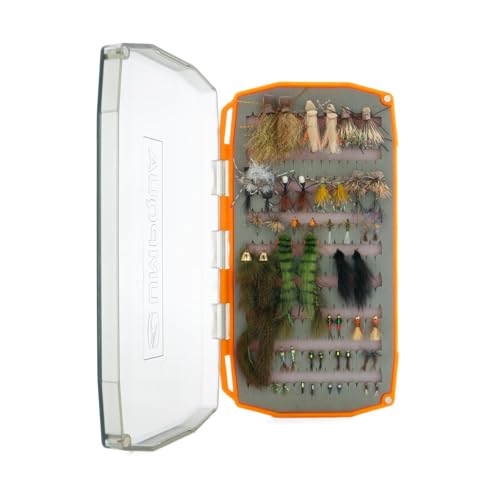
Umpqua Signature Master Trout Assortment Fly Box
A boxed assortment spanning most of the size range in this chart at once, from large attractors down to small dries, sorted and ready.
Best for: Filling a box across sizes in one purchase rather than fifteen.
Skip it if: A first season angler. Most of these patterns solve problems you have not met yet, and a dozen well chosen flies catch more than a hundred unfamiliar ones.

SF Waterproof Slit Foam Fly Boxes, 2 pack
Slit foam holds small hooks without bending the points, and a clear lid means you can size a fly without opening the box in the rain.
Best for: Keeping sizes 16 to 22 organised, where a jumbled box is genuinely hard to sort.
Specs are the manufacturer's published figures. Prices and stock change constantly, so confirm on the retailer page. We earn commissions from Backcountry and from qualifying Amazon purchases.
How do I match tippet to fly size?
With the rule of four. Divide the hook size of the fly by four and use the result as your starting tippet X. A size 16 fly divided by four is four, so 4X. A size 20 gives 5X. It is a starting point rather than a law, and the adjustments are predictable: lighter on flat slow water where drag is the problem, heavier when the fly is weighted or wind resistant and turnover is the problem.
| Hook size | Divided by 4 | Starting tippet | Diameter, inches |
|---|---|---|---|
| 4 | 1.00 | 1X | 0.010 |
| 6 | 1.50 | 1X or 2X | 0.009 to 0.010 |
| 8 | 2.00 | 2X | 0.009 |
| 10 | 2.50 | 2X or 3X | 0.008 to 0.009 |
| 12 | 3.00 | 3X | 0.008 |
| 14 | 3.50 | 3X or 4X | 0.007 to 0.008 |
| 16 | 4.00 | 4X | 0.007 |
| 18 | 4.50 | 4X or 5X | 0.006 to 0.007 |
| 20 | 5.00 | 5X | 0.006 |
| 22 | 5.50 | 5X or 6X | 0.005 to 0.006 |
| 24 | 6.00 | 6X | 0.005 |
In practice most trout anglers live in a very narrow slice of that table. A RIO Powerflex Strong Tippet, 5X 30yd spool in 5X nylon handles sizes 16 through 20, which is the bulk of dry fly fishing, and a RIO Fluoroflex Strong Tippet, 7.3lb 30yd spool at 0.007 inches handles sizes 12 through 16 subsurface where abrasion and sink rate matter. That is two spools covering most of a season. The leader and tippet calculator will build the whole rig if you would rather not do the arithmetic on the bank.
Where does hook sizing stop being reliable?
In three places, and the first one is the important one.
There is no standard, so brands differ. Hook sizing is a convention that grew out of manufacturing practice rather than a written specification with tolerances. A size 16 from one maker measured against a size 16 from another can differ by enough to look like a full size, and the differences are largest at the small end where a few tenths of a millimetre is a large percentage. If you tie your own flies, buy hooks from one maker for a given pattern and stay with them, because that is the only way to keep your own sizing consistent.
Shank modifiers make visual comparison useless. A size 10 3X long streamer hook and a size 6 standard hook have similar overall lengths and very different gapes. If you are matching a natural by eye, match the body length of the fly rather than the number printed on the hook packet, because the number is describing the gape.
Barbless and competition hooks change the geometry. Many barbless hooks are made with a slightly different bend and a wider gape for the same nominal size, partly to improve hold without a barb. That is a real difference and a helpful one, and it is another reason the dimensions here are given as ranges. Whatever hooks you use, pinching a barb down improves release survival and makes removing a hook from your own hand far less memorable.
If you are still building a first box rather than settling a sizing argument, the dry fly roundup covers the patterns worth having in each size, and the rod weight by species chart explains why the largest sizes on this page force a heavier line class whether you want one or not.
Frequently asked questions
Does a bigger fly hook number mean a bigger hook?
No, it is the reverse, and this is the single most confusing thing about hook sizing. As the number goes up the hook gets smaller, so a size 22 is much smaller than a size 12. The scale runs from about size 2 down to size 32 at the smallest. Once hooks get larger than size 1 the numbering flips to the aught scale, written 1/0 through 6/0, where a larger number now means a larger hook.
Are hook sizes the same across manufacturers?
No, and it is important to say so plainly. There is no enforced standard for hook sizing, so a size 16 from one maker can measure noticeably different from a size 16 from another, particularly in gape. Differences of a size are common between brands and between models within a brand. Treat every dimension on this page as typical rather than exact, and compare hooks side by side when it matters.
What does 2X long mean on a hook?
It means the shank is as long as the shank of a hook two sizes larger, while the gape stays that of the stated size. So a size 10 2X long hook has a size 10 gape and a size 6 shank. The same convention applies to wire: 2X heavy means wire from a hook two sizes larger. This X is a completely different convention from the X used for tippet diameter.
What tippet do I use for a size 18 fly?
Start at 5X, which is 0.006 inches. The rule of four divides the hook size by four, so a size 18 lands between 4X and 5X, and on the flat, slow water where size 18 dry flies matter most the lighter option usually fishes better. Move up to 4X if the fly is a weighted nymph rather than a dry, because a heavier fly needs more diameter to turn over without hinging.
What size flies should a beginner carry?
Sizes 12 through 18 cover most trout fishing on most rivers, and a beginner is better served by three patterns in four sizes than twelve patterns in one size. Add a size 8 or 10 streamer for coloured water and a size 20 or 22 midge for tailwaters. That range fits in one box and answers the great majority of days without demanding you carry a catalogue.
What are the smallest and largest fly hooks made?
Commercially, size 32 is about the smallest hook in normal production, with a gape near 1.2 to 1.5 mm, and it is a genuine specialist item for spring creek midge fishing. At the other end, 6/0 covers the heaviest saltwater and musky work with a gape over an inch. The overwhelming majority of trout fishing happens between size 8 and size 22.
How we choose: we compare published manufacturer specifications, line and leader standards, and verified owner reviews across retailers. We do not test gear in person, and every diameter, grain weight and breaking strength quoted here is the manufacturer's published figure unless we say otherwise, so check the spool label before you trust a number. Nothing here is professional instruction. Wading moving water is the real hazard in this sport: wear a snug wading belt, know the water temperature, and turn back rather than push through a crossing you are unsure of.