Nylon vs Fluorocarbon Tippet
Fish nylon on top and fluorocarbon underneath. Nylon stretches roughly 20 to 30 percent and has a density near 1.14 g/cc, so it floats in the surface film and absorbs a hard hookset. Fluorocarbon stretches roughly 5 to 15 percent, sits near 1.78 g/cc so it sinks, and its refractive index of about 1.42 is far closer to water at 1.33 than nylon's 1.53. Most trout anglers carry both and pay about twice as much per yard for the fluorocarbon.
The short version, and it is a genuine verdict rather than a shrug: nylon on top, fluorocarbon underneath, and most anglers who fish more than a dozen days a year end up carrying both. That is not fence sitting. The two materials differ in four measurable ways, and each difference points at a specific job. Buy nylon first, because if you fish dry flies at all it will be the spool you empty fastest.
A definition before the argument. Tippet X rating is a legacy scale where the number subtracted from 0.011 inches gives the diameter in inches. So 5X is 0.006 inches, 4X is 0.007 inches, and 6X is 0.005 inches. The X number describes diameter and nothing else. It does not describe material, breaking strength or brand, which is exactly why the nylon against fluorocarbon question exists: two spools of 5X from different materials are the same diameter and behave completely differently. The tippet size chart has the full scale, and the leader and tippet calculator works out which size belongs on which fly.
What are the four differences that actually matter?
Stretch. Nylon elongates roughly 20 to 30 percent before it parts. Fluorocarbon elongates roughly 5 to 15 percent. That is the largest practical difference between the two and the one anglers notice first without knowing why. Nylon is a shock absorber: a hard hookset on 6X is spread over the stretch of the material and the bend of the rod, and the fly stays attached. Fluorocarbon transmits far more of that impulse straight to the hook, which is why it sets small hooks better on a long nymph rig and why it breaks off more when you strike a rising trout like you mean it.
Density. Water is 1.00 g/cc. Nylon is about 1.14 g/cc. Fluorocarbon is about 1.78 g/cc, which makes it roughly 1.56 times as dense as nylon. Nylon is only slightly denser than water, and at fine diameters surface tension usually holds it in the film, so a dry fly sits where you want it. Fluorocarbon sinks steadily and pulls the tippet down, dragging the fly with it or at the very least dragging the leader below the film where takes become hard to see. That single figure is most of the reason for the verdict on this page.
Refractive index. This is the property that fluorocarbon is sold on and the one most exaggerated. Water refracts light at about 1.33. Nylon sits near 1.53, a mismatch of 0.2. Fluorocarbon sits near 1.42, a mismatch of 0.09. The fluorocarbon mismatch is therefore about 55 percent smaller, which is a real reduction in how much the material disturbs light. It is not invisibility. A mismatch of 0.09 still refracts, the material still throws a shadow on a bright bottom, and diameter still matters more than material to a fish that has seen tippet before.
Abrasion resistance. Fluorocarbon has a harder surface and generally survives contact with rock, submerged wood, shell and fish teeth better than nylon of the same diameter. That advantage is worth having on a streamer swung through structure, on a nymph bounced along a cobble bottom, and anywhere a fish will run you into cover. On a dry fly presented over open water, abrasion resistance is a property you never call upon.
| Property | Nylon | Fluorocarbon | Practical consequence |
|---|---|---|---|
| Stretch to break | 20 to 30% | 5 to 15% | Nylon absorbs a hard set, fluorocarbon sets small hooks at range |
| Density | 1.14 g/cc | 1.78 g/cc | Water is 1.00, so nylon rides the film and fluorocarbon sinks |
| Refractive index | 1.53 | 1.42 | Water is 1.33, so the fluorocarbon mismatch is about 55% smaller |
| Abrasion resistance | Good | Better | Matters on rock, wood and teeth, not on open water dries |
| Water absorption | Absorbs | Near zero | Soaked nylon loses some strength, fluorocarbon does not |
| Ultraviolet stability | Degrades | Very stable | Replace nylon each season, fluorocarbon keeps for years |
| Knot friction | Low | High | Lubricate both, and fluorocarbon punishes a dry knot harder |
| Budget per 30 yd spool | Under $25 | Under $25 | About 2.1 times the cost for the same length |
Which one goes on a dry fly?
Nylon, and it is not close. Three of the four properties point the same way at the surface.
The density figure does most of the work. At 1.78 g/cc, fluorocarbon wants to be below the surface, and a fine tippet dragging downward pulls the hook shank of a small dry fly through the film so it fishes drowned instead of dressed. Anglers then blame the fly, the floatant or the fish. On the same water, 1.14 g/cc nylon at 5X or 6X sits in the film and leaves the fly where you put it.
Stretch does the rest. A trout eating a dry fly is usually close, often visible, and almost always struck too hard. That impulse arrives at 0.005 inches of material with no slack line to soften it, and the 20 to 30 percent stretch of nylon is the difference between a hooked fish and a snapped tippet. If you fish 6X and 7X to selective fish on flat water, this is the reason to be firm about material rather than casual.
The visibility argument is the one people use to justify fluorocarbon on dries, and it is the weakest one. A dry fly is fished at the surface, where the tippet is lying in the film with the fish looking up at it against the sky. A floating tippet leaves a very different signature from a submerged one, and a nylon tippet degreased and lying flat in the film is far less conspicuous than a sinking fluorocarbon one cutting down through it. Fluorocarbon buys you refraction and costs you position, and position wins at the surface.
A 30 yard spool of nylon 5X at under $25 is the single most used consumable in trout fishing, and 5X is the right first size because it matches a size 16 to 20 dry fly under the rule of four, which divides hook size by four to get a starting X. It is a starting point rather than a law, and flat water usually pushes you one size finer.
Which one goes on a nymph or a streamer?
Fluorocarbon, for exactly the reasons it fails on top. Below the surface, everything reverses.
Sinking is now an advantage. A nymph rig has to get down through moving water in the seconds between the cast and the drift, and a tippet that sinks rather than resisting the surface film helps the flies reach depth sooner. Over a long drift that shortens the distance between the fly and the fish's feeding lane, and the difference compounds over a day.
Low stretch is now an advantage too. A nymph take at 25 feet on a long drifting leader with an indicator has slack in the system by definition. Nylon stretch adds more slack precisely when you need the set to reach the hook, so a low-stretch tippet converts more takes into hooked fish on a subsurface rig. That is the same property that costs you fish on a dry fly at close range.
Abrasion resistance is the third argument, and it is worth real money on streamers. A fly swung past a log or stripped along a rock shelf drags the tippet across abrasive surfaces, and a fish that eats a streamer usually has its teeth on the tippet rather than the leader. In a full nymph rig, the fluorocarbon usually starts at the end of the tapered leader and runs from there to the point fly, which keeps the expensive material where the wear happens.
The RIO Fluoroflex Strong Tippet, 7.3lb 30yd at under $25 is 0.007 inches, which is 4X, and 4X is the workhorse nymph and small streamer size. Fish it off a nylon tapered leader rather than buying a full fluorocarbon leader, which is both cheaper and easier to adjust.
What does each material cost across a season?
This is where the honest answer stops being about physics and starts being about money. On the same 30 yard spool, fluorocarbon costs roughly 2.1 times what nylon does for the same length of material.
Scale that to a real season. An angler fishing regularly will get through something like 4 spools of the size they use most, plus part spools of two or three other sizes. At 4 spools, nylon stays under $50 and fluorocarbon runs under $100, about twice as much. That is not ruinous, but it is real, and it is why the sensible pattern is nylon in the sizes you burn through and fluorocarbon in the one or two sizes you fish subsurface.
Shelf life pushes back the other way. Nylon absorbs water and degrades under ultraviolet light, so a spool that spent a summer in a truck window is not the spool you bought. Replace nylon annually. Fluorocarbon is very stable and a spool genuinely lasts several seasons, so the higher purchase price is amortised over more fishing than the sticker suggests. If you are building a restock routine rather than buying reactively, the consumables restock guide puts the whole repeat purchase list on one page.
Do knots behave differently, and what should you tie?
Yes, and this is where more tippet is lost than to any property in the table above. Knot strength is expressed as a percentage of the line's rated breaking strength, published figures vary by test protocol, and every one of them assumes a properly lubricated, properly seated knot.
Lubricate every knot before you seat it. Saliva or water, then pull steadily rather than snapping it tight. A dry knot generates friction heat as the coils slide, and that heat damages the material so the knot fails well below its rating. Fluorocarbon is harder and stiffer than nylon, so it generates more friction and punishes a dry pull more severely. If you have ever had fluorocarbon break at the knot on a fish you should have landed, this is usually why rather than any defect in the material.
Practical adjustments that work. Add a turn to a clinch knot in fluorocarbon, so an improved clinch that takes five turns in nylon takes six. Prefer a double surgeon knot over a blood knot when joining fluorocarbon to nylon, because a surgeon knot tolerates the stiffness mismatch better. Keep the diameter step across a join to about 0.001 inches, which is one X size, so the two materials seat against each other evenly. The knot strength calculator shows what each knot costs you in retained strength, which is the honest way to compare them.
What is the verdict, and when is the losing material still right?
Verdict: nylon is the tippet to own if you own one. Fish it on every dry fly, every dry dropper and every soft hackle in the film. Add fluorocarbon in one or two sizes for nymph droppers and streamers, where sinking, low stretch and abrasion resistance all point the same way. Two spools of nylon and one of fluorocarbon covers most trout fishing properly.
Now the case for the material that loses the headline, because it wins more often than the verdict suggests. Fluorocarbon is the right first and only choice in these situations.
- You fish nymphs almost exclusively. If your season is indicator rigs and tight line nymphing, the surface behaviour that decides the dry fly argument never applies to you, and every property of fluorocarbon works in your favour.
- You fish streamers through structure. Wood, rock and toothy fish are exactly what the harder surface is for, and a streamer angler goes through less tippet per day than a dry fly angler, so the cost difference matters less.
- You fish clear tailwaters with heavily pressured fish. Where fish have refused a well presented fly on nylon repeatedly, the reduced refraction is worth trying before you go down another X size, because dropping diameter costs you breaking strength and fluorocarbon does not.
- You fish rarely and want one spool to keep. Fluorocarbon does not degrade in storage the way nylon does, so an angler who fishes a handful of days a year and leaves gear in a garage is better served by fluorocarbon that will still be at rating in three years.
- You fish saltwater or warmwater with abrasive species. Anything with teeth, gill plates or a habit of running into oyster and shell tips the abrasion argument decisively.
And the reverse, stated plainly: skip fluorocarbon entirely if you fish dry flies most of the time, if you fish small streams with short casts, or if you are in your first season. You will pay roughly 2.1 times as much for a material that pulls your fly under and breaks off more on the strike. Spend the difference on more nylon and more flies.
Tippet and leaders worth restocking

RIO Powerflex Strong Tippet, 5X 30yd
The default nylon spool. Nylon stretches roughly 20 to 30 percent before it parts, which is the shock absorber that keeps a size 18 dry fly attached when you set too hard, and 5X at 0.006 inches is the size most trout anglers burn through fastest.
Best for: Dry flies, dry dropper rigs, and everything fished in or on the surface film.

SF Pre-Tied Loop Tapered Leaders, 9ft 5X 6 pack
Six tapered nylon leaders for the price of one premium leader. A tapered leader is not optional terminal tackle, it is the part that converts line energy into a straight turnover, and going through them is normal rather than careless.
Best for: Stocking the pack so a wind knot never ends a session.
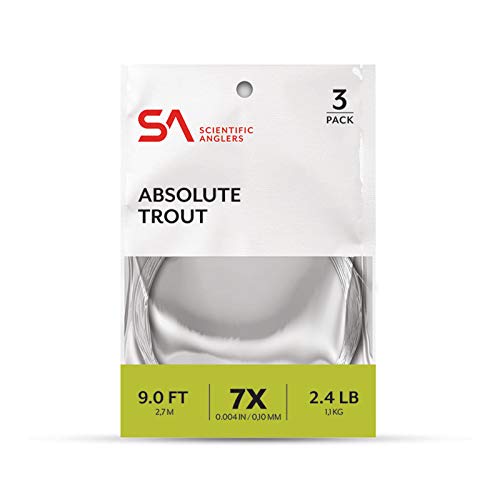
Scientific Anglers Absolute Trout Leader, 9ft 5X
A better taper and a more consistent diameter than budget leaders, in the standard 9 foot 5X trout size, three to a pack. The butt runs about two thirds of the fly line tip diameter, which is why it turns over rather than piling.
Best for: Anglers who have noticed their leader landing in a heap and want the taper to stop being the problem.

RIO Fluoroflex Strong Tippet, 7.3lb 30yd
Fluorocarbon at about 1.78 g/cc against nylon at 1.14, so it sinks rather than hanging in the film, and its refractive index sits closer to water. That combination is worth real money on subsurface rigs and worth nothing at all on a dry fly.
Best for: Nymph droppers, streamers, and clear tailwater fish that have refused nylon.
Skip it if: Anyone who fishes dry flies most of the time. You are paying roughly twice as much per yard for a material that drags your fly under.

Tippet Spool Ring and Tender Set, 4 pack
Spool tenders stop a stack of tippet turning into a bird nest in a pack, and they let you pull a tag off the right spool without unclipping anything. A small thing that removes a genuine daily annoyance.
Best for: Anyone carrying more than three spools, which is anyone carrying both materials.
Specs are the manufacturer's published figures. Prices and stock change constantly, so confirm on the retailer page. We earn commissions from Backcountry and from qualifying Amazon purchases.
How should you actually carry both?
Keep it to a system rather than a collection. Three spools of nylon in 4X, 5X and 6X covers the surface and most of the dry dropper work, which is 0.007, 0.006 and 0.005 inches. Two spools of fluorocarbon in 4X and 5X covers nymphing and small streamers. That is five spools, and it is enough for the overwhelming majority of trout fishing across a whole season.
Label them so you can tell them apart on the water, because the spools look identical in a pack and a nylon dropper on a nymph rig is an easy mistake to make in poor light. A Tippet Spool Ring and Tender Set, 4 pack keeps the stack ordered and stops the tags tangling into each other, which is a genuine daily annoyance rather than a luxury.
Build the rig from a nylon tapered leader in both cases. A Scientific Anglers Absolute Trout Leader, 9ft 5X in 9 foot 5X is the standard trout leader, with roughly 60 percent butt, 20 percent mid taper and 20 percent tippet, and the butt sized around two thirds the diameter of your fly line tip. For dry flies, add nylon tippet to the end. For nymphs, add fluorocarbon tippet to the same leader. One leader, two materials, changed in under a minute at the water. The tapered leader roundup covers which leaders hold their taper, and the trout tippet roundup lists the current spools by size.
One habit worth adopting whatever you fish: check the last two feet of tippet with your fingers after every fish and after every snag. Both materials nick, both fail at the nick rather than along the length, and a fingertip finds a rough spot faster than a fish does.
Frequently asked questions
Is fluorocarbon really invisible underwater?
No, and the claim is overstated. Fluorocarbon has a refractive index near 1.42 against water at 1.33, while nylon sits near 1.53. That makes the fluorocarbon mismatch roughly 55 percent smaller, so it disturbs light less, but a mismatch of 0.09 is not zero and the material still casts a shadow and reflects at angles. Diameter and drag matter more to a wary trout than material does.
Does fluorocarbon sink and nylon float?
Broadly yes. Fluorocarbon has a density near 1.78 g/cc against water at 1.00, so it sinks steadily. Nylon at about 1.14 g/cc is only slightly denser than water and surface tension usually holds a fine diameter in the film. That is the practical reason nylon goes on top for dry flies: fluorocarbon pulls the tippet, and often the fly, down through the surface film where you cannot see the take.
Which is stronger for the same diameter?
They are closer than marketing suggests, and it varies by brand more than by material. Fluorocarbon usually holds a small advantage in abrasion resistance against rock, wood and teeth, while premium nylons often post higher straight-pull breaking strengths at the same diameter. Because published figures depend on the test protocol, compare the printed pound rating on the two specific spools you are choosing between rather than trusting a general rule.
Does tippet go off, and how fast?
Nylon does. It absorbs water and degrades with ultraviolet light and heat, so a spool left on a dashboard through a summer can lose meaningful strength in a single season. Replace nylon annually and sooner if it has lived in sunlight. Fluorocarbon absorbs almost no water and is very stable in ultraviolet, so a spool lasts for years. That longevity offsets part of the higher purchase price.
Do knots behave differently in fluorocarbon?
Yes. Fluorocarbon is stiffer and has a harder surface, so knots seat with more friction and are less forgiving of a rushed pull. Lubricate every knot before seating it, because a dry knot generates friction heat and fails well below its rated strength, and fluorocarbon punishes that more than nylon does. Many anglers switch to a knot with an extra turn, or to a double surgeon rather than a blood knot, when joining fluorocarbon.
Can I tie nylon to fluorocarbon?
Yes, and it is completely normal. A tapered nylon leader with a fluorocarbon tippet section is the standard nymphing setup. Join them with a double surgeon knot or a blood knot, keep the diameter step to about 0.001 inches, and lubricate before seating. The join is a little less forgiving than nylon to nylon because of the stiffness difference, so check it after a snag rather than trusting it blindly.
How we choose: we compare published manufacturer specifications, line and leader standards, and verified owner reviews across retailers. We do not test gear in person, and every diameter, grain weight and breaking strength quoted here is the manufacturer's published figure unless we say otherwise, so check the spool label before you trust a number. Nothing here is professional instruction. Wading moving water is the real hazard in this sport: wear a snug wading belt, know the water temperature, and turn back rather than push through a crossing you are unsure of.