Best Tapered Leaders for Fly Fishing (2026): Trout Picks
The best tapered leader for most trout fishing is a 9 foot 5X knotless nylon leader, and our top pick is the Scientific Anglers Absolute Trout Leader in 9 ft 5X. A tapered leader is thick at the fly line and thin at the fly, so the cast keeps unrolling and the fly lands ahead of the line: roughly 60 percent butt, 20 percent mid taper and 20 percent tippet, with 5X at 0.006 inches.
The leader is the least glamorous item in fly fishing and the one that decides whether your cast works. A tapered leader is a length of monofilament that starts thick where it joins the fly line and finishes thin at the fly, so the energy of the cast keeps travelling forward and the fly turns over instead of collapsing in a pile. A level piece of monofilament tied to a fly line does not do that, and no rod on the market fixes it. This page covers what taper proportions actually mean, how the X scale works, which length to pick, when nylon beats fluorocarbon, and the far more useful skill of rebuilding a leader with tippet instead of buying a new one every trip.
How is a tapered leader actually built?
A leader has three functional parts, and the proportions between them are close to a standard. A 9 foot trout leader is roughly 60 percent butt section, 20 percent mid taper and 20 percent tippet. On a 9 foot leader that is about 5.4 feet of butt, 1.8 feet of mid taper and 1.8 feet of tippet.
| Section | Share | Length | Job it does |
|---|---|---|---|
| Butt | 60% | 5.4 ft | Carries the cast's energy out of the fly line, stiff and thick |
| Mid taper | 20% | 1.8 ft | Steps the diameter down quickly so the loop keeps unrolling |
| Tippet | 20% | 1.8 ft | Fine, near invisible, and flexible enough to let the fly drift freely |
One more number decides whether the whole thing works: the butt diameter should be about two thirds the diameter of the fly line tip. Too thin a butt and the energy dies at the junction, so the leader never straightens. Too thick and the transition is a hinge that kicks the fly sideways. Commercial leaders are built to that ratio for standard trout lines, which is one of the quiet reasons a bought leader outperforms a home-made one until you have practice. If you want to tie your own, the leader formula chart has the section lengths and diameters written out.
What does the X number mean, and what diameter is it?
Tippet X rating is a legacy scale where the X number subtracted from 0.011 inches gives the diameter in inches. It dates from the era of drawn silkworm gut, where each pass through a drawing plate reduced the diameter one step, and the number of passes became the X number. It survives because it is short and everyone uses it.
So 4X is 0.007 inches, 5X is 0.006 inches and 6X is 0.005 inches. Nothing about the X rating tells you the breaking strength, and this is the point people get wrong constantly. Strength depends on the material and the manufacturing, so a fluorocarbon 5X and a nylon 5X of the same diameter can differ by pounds. Read the spool label, and treat any strength quoted without a brand name as decoration.
| X rating | Diameter (in) | Fly size | Typical use |
|---|---|---|---|
| 0X | 0.011 | 2 to 6 | Large streamers, bass bugs, pike |
| 2X | 0.009 | 6 to 10 | Streamers, big hoppers, heavy nymph rigs |
| 3X | 0.008 | 10 to 14 | Attractors, dry dropper anchors |
| 4X | 0.007 | 12 to 16 | The general purpose trout size |
| 5X | 0.006 | 14 to 18 | The default dry fly size, and the most used spool |
| 6X | 0.005 | 16 to 22 | Flat water, selective fish, small olives |
| 7X | 0.004 | 20 to 24 | Spring creeks and midge fishing only |
The quick way to pick without the table is the rule of four: divide the fly hook size by 4 and that is a starting tippet X. A size 16 fly gives 4X. It is a starting point rather than a law, and on flat clear water one size lighter usually gets more takes. The full scale with typical strength ranges is on the tippet size chart, and the leader and tippet calculator works the whole rig out including the tippet length to add.
Do you want a 7.5, 9 or 12 foot leader?
Length trades turnover against stealth, and the choice is genuinely situational rather than a matter of skill level.
A 7.5 foot leader turns over heavy things. Short leaders transmit energy more directly, so weighted nymphs, indicators and small streamers straighten out instead of hinging. It is also the right length on brushy small streams where you are making short casts under branches and a long leader is simply more line to snag.
A 9 foot leader is the default because it balances turnover against putting some distance between the fly line and the fly. Unless you have a reason to change, this is the one to buy, and it is the length both leaders on this page come in.
A 12 foot leader buys stealth. On flat, clear, slow water, the splash and shadow of the fly line is what puts fish down, and pushing it three more feet away is the fix. The cost is turnover: a 12 foot leader needs a better cast to straighten, and in wind it will not.
| Situation | Length | Tippet X | Why |
|---|---|---|---|
| Brushy small stream, short casts | 7.5 ft | 4X | Less line to snag, easier turnover in tight quarters |
| Weighted nymph rig with indicator | 7.5 ft | 3X | Short leaders straighten heavy terminal tackle |
| General freestone river, dries and nymphs | 9 ft | 5X | The default, and what most leaders are sold as |
| Streamers on a sink tip | 7.5 ft | 0X to 2X | Short and heavy keeps the fly down and turning over |
| Flat spring creek, spooky fish | 12 ft | 6X | Distance between fly line and fly is the whole point |
| Stillwater from a bank or float tube | 12 ft | 5X | No current to hide the line, so length substitutes |
Nylon or fluorocarbon?
Nylon monofilament is a supple polyamide that is close to neutrally buoyant and stretches noticeably under load. Fluorocarbon is a denser polymer that sinks, stretches less, and resists abrasion better. Both are useful and the split is almost entirely about whether your fly is meant to float.
Use nylon for dry flies. It sits in or on the film, so it does not pull the back of the fly under, and its stretch acts as a shock absorber on a hookset with fine tippet, which matters a great deal at 6X. It is also roughly half the price, and a RIO Powerflex Strong Tippet, 5X 30yd spool is the one that empties first in most vests.
Use fluorocarbon for nymphs and streamers. It sinks, which gets a weighted fly down faster and keeps the connection direct, and it takes abrasion from rock, gravel and teeth far better. A RIO Fluoroflex Strong Tippet, 7.3lb 30yd at 0.007 inches is the workhorse size for subsurface trout fishing. The visibility argument, that fluorocarbon has a refractive index closer to water, is real but smaller than the marketing suggests, and it is not the reason to buy it. The nylon versus fluorocarbon comparison goes into the trade off in detail.
One practical warning: fluorocarbon and nylon knot to each other with less reliability than either does to itself, so lubricate every knot and check it. A dry knot fails well below its rating because friction heat damages the material as it seats.
Leaders and tippet worth buying

SF Pre-Tied Loop Tapered Leaders, 9ft 5X 6 pack
Six knotless tapered leaders with pre-tied loops for about the price of one premium leader, which is exactly what a first season needs. The nylon is not as consistent in diameter as the premium extrusions and the loops are bulkier, and neither of those things will cost you a trout.
Best for: A first season, and anyone who breaks off in trees often enough that leader cost is a real number.

RIO Powerflex Strong Tippet, 5X 30yd
A 30 yard spool of nylon tippet in the single most useful size for trout. Rebuilding the tippet section from a spool is what makes a leader last weeks instead of an afternoon, and this is the spool that gets used first.
Best for: Extending and rebuilding 9 foot leaders for general trout fishing.

Tippet Spool Ring and Tender Set, 4 pack
A ring that stacks several tippet spools together with a rubber band keeping each tag end trapped. It stops the specific annoyance of four loose spools rolling around a pack with their ends buried.
Best for: Anyone carrying more than two tippet sizes, which is everyone by the second season.
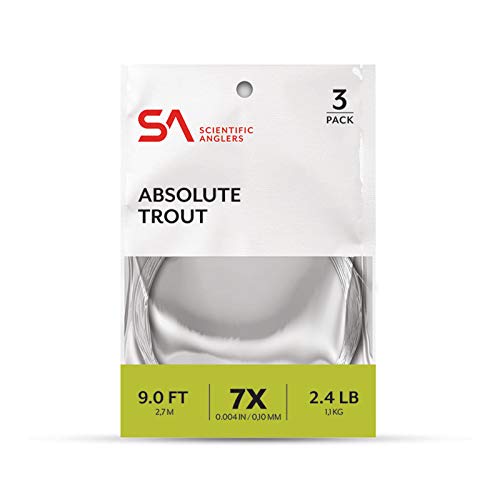
Scientific Anglers Absolute Trout Leader, 9ft 5X
The default trout leader. A knotless nylon taper in 9 foot 5X, supplied three to a pack, with the consistency in the taper that decides whether a leader turns over straight or piles in a heap. The taper, not the brand, is what you are paying for.
Best for: General trout fishing with dry flies and light nymph rigs, which is most of the season.

RIO Fluoroflex Strong Tippet, 7.3lb 30yd
Fluorocarbon at 0.007 inches, which is denser than nylon, sinks rather than floating in the film, and resists abrasion better against rock and teeth. It is the correct terminal material for nymphs and streamers.
Best for: Subsurface fishing, abrasive structure, and clear water where the lower visibility is worth the cost.
Skip it if: Dry fly fishing. Fluorocarbon sinks, so it drags the back end of a floating fly down and under, and it costs roughly twice as much as nylon to do a job nylon does better here.
Specs are the manufacturer's published figures. Prices and stock change constantly, so confirm on the retailer page. We earn commissions from Backcountry and from qualifying Amazon purchases.
Knotless, knotted or furled?
Three construction types exist and almost everyone should buy the first.
Knotless leaders are extruded as a single continuous strand whose diameter changes along its length. No knots means nothing to catch weed or algae, a smooth transfer of energy, and a leader that slides through the guides cleanly. This is what both the Scientific Anglers Absolute Trout Leader, 9ft 5X and the SF Pre-Tied Loop Tapered Leaders, 9ft 5X 6 pack are, and it is the default for good reason.
Knotted leaders are built from sections of decreasing diameter tied together. They are the traditional approach, they are fully customisable, and you can rebuild any part of one. The drawback is the knots themselves, which collect weed and drifting algae and give you several more failure points. Anglers who tie their own for specific water swear by them, and the formula chart exists to support that.
Furled leaders are braided from many fine strands twisted together. They are supple, they turn over very softly and they last a long time because you attach tippet to a ring at the end rather than cutting into the leader. They also hold water and spray it on the forward cast, and they are a niche preference rather than a general recommendation.
When should you add tippet instead of buying a new leader?
Almost always, and this is the single most useful habit on this page.
Every time you change a fly you lose an inch or two of tippet to the cut. Do that a dozen times and the tippet section, which started at roughly 1.8 feet, is down to a few inches. At that point you are effectively fishing a leader with no fine section at all, the fly lands hard, and drag sets in immediately. The instinct is to blame the drift. It is the leader.
The fix takes a minute. Tie an 18 to 24 inch section of fresh tippet to the end of the leader with a double surgeon's knot or a blood knot, matching or going one X finer than the leader's stated rating. Lubricate it before you seat it. The leader is now restored, and a single leader treated this way lasts weeks instead of an afternoon.
Replace the whole leader when one of three things has happened: the mid taper has been cut into, so the leader is now short and thick at the end; the butt section has a wind knot in it, since a knot in monofilament can cut its strength substantially; or the material has gone stiff and memory-coiled with age. Nylon degrades over years with heat and light, so a leader that has lived in a hot vehicle for two seasons is not the leader you think it is.
A realistic figure for a trout angler fishing twenty to thirty days is 10 leaders a season if you extend with tippet, and considerably more if you do not. At the multi pack price that is under $50 across the season, which is trivial next to the tippet spools you will empty. Both belong on one re-order list, and the consumables restock guide is where that list lives.
Loop to loop or nail knot?
This is the leader-to-fly-line connection, and both answers are correct in different circumstances.
Loop to loop is the practical default. Most modern fly lines ship with a welded loop at the tip and most leaders ship with a pre-tied perfection loop at the butt, so joining them takes five seconds with no tools and no knot skill. Changing leaders on the river is then instant, which matters when you want to swap from a 9 foot dry fly leader to a 7.5 foot nymphing leader mid session. Interlock the loops correctly, square rather than girth hitched, or the connection will cut itself under load.
A nail knot is smaller, smoother and permanent. It seats the leader butt against the fly line coating with a tight wrapped connection that passes through the tip guide without the small click a loop makes, which matters when a fish is running and the connection is inside the guides. It also cannot hinge. The cost is time and a tool, and that you must cut the line back to change it, which shortens the fly line over a season.
Use loop to loop unless you fish long leaders through the guides regularly. And whichever you use, lubricate every knot in the system before seating it. Published knot strength figures are a percentage of the line's rated breaking strength and they vary by test protocol, so treat them as ranges rather than promises. A dry knot fails far below any of them.
Put it together and the whole leader question collapses to one sentence: buy 9 foot 5X knotless nylon, carry 4X, 5X and 6X spools, add tippet rather than replacing, and lubricate every knot. Everything else on this page is the reasoning behind it.
Frequently asked questions
What is a tapered leader?
A tapered leader is a length of monofilament that starts thick where it joins the fly line and finishes thin at the fly, so the energy of the cast keeps travelling forward and the fly lands ahead of the line instead of piling on top of it. A standard trout leader is 9 feet long with roughly 60 percent butt, 20 percent mid taper and 20 percent tippet.
What does the X number on a leader mean?
X is a legacy scale where the number subtracted from 0.011 inches gives the tippet diameter in inches. So 4X is 0.007 inches, 5X is 0.006 inches and 6X is 0.005 inches. The X rating describes diameter only, not strength: breaking strength varies by material and by brand, so a fluorocarbon 5X and a nylon 5X can test several pounds apart.
Should I use a 7.5, 9 or 12 foot leader?
Nine feet is the default and covers most trout fishing. Drop to 7.5 feet on small brushy streams and when throwing weighted flies or an indicator rig, because a short leader turns over heavy terminal tackle far more reliably. Go to 12 feet on flat, clear, slow water and for spooky fish, where the extra length puts more distance between the fly line and the fly.
When should I add tippet instead of buying a new leader?
Almost always. Every fly change costs you a couple of inches, and once the tippet section is shorter than about 18 inches the leader turns over badly and the fly lands hard. Tie a fresh 18 to 24 inch tippet section to the end with a double surgeon or blood knot and the leader is restored. Replace the whole leader only when the mid taper has been cut back.
Nylon or fluorocarbon leader, which do I need?
Nylon for dry flies, fluorocarbon for subsurface. Nylon is more supple, has more stretch to absorb a hookset, floats or sits in the film, and costs about half as much. Fluorocarbon is denser so it sinks, resists abrasion better against rock and teeth, and is closer to water in refractive index. Most trout anglers carry a nylon leader and a fluorocarbon tippet spool.
How many leaders will I go through in a season?
Roughly eight to twelve for an angler fishing twenty to thirty days, assuming you extend with tippet rather than replacing the whole leader every time. Wind knots, break offs above the tippet knot, and leaders cut back too far into the taper are the three reasons a leader gets retired. Buying a multi pack rather than singles turns this from an irritation into a non issue.
How we choose: we compare published manufacturer specifications, line and leader standards, and verified owner reviews across retailers. We do not test gear in person, and every diameter, grain weight and breaking strength quoted here is the manufacturer's published figure unless we say otherwise, so check the spool label before you trust a number. Nothing here is professional instruction. Wading moving water is the real hazard in this sport: wear a snug wading belt, know the water temperature, and turn back rather than push through a crossing you are unsure of.