Leader Formula Chart: 60/20/20 in Inches
A tapered fly leader follows roughly a 60/20/20 proportion: 60 percent butt, 20 percent stepped mid taper, 20 percent level tippet. On a 9 foot leader that is about 65 inches of butt, 22 inches of mid taper and 22 inches of tippet. The butt should measure about two thirds the diameter of your fly line tip, so a 5 weight line with a 0.030 inch tip wants a butt near 0.020 inches.
A tapered leader is a length of monofilament that steps down in diameter from a thick butt to a fine tippet, so the energy travelling down the fly line unrolls smoothly instead of stopping dead at the connection. Get the proportions right and the leader straightens and the fly lands where you aimed. Get them wrong and no rod, no line and no amount of casting practice will fix it, which is why leader formula is the most useful thing on this site that almost nobody looks up until their third season.
The convention behind every commercial leader is simple enough to memorise. Roughly 60 percent of the total length is heavy butt, roughly 20 percent is a stepped mid taper, and roughly 20 percent is level tippet at the fine end. That is the 60/20/20 rule, and this page writes it out in inches for the three lengths that matter, matches the butt diameter to your fly line, and gives a worked hand tied formula you can actually build.
What is the 60/20/20 leader formula in inches?
Multiply the leader length in feet by twelve to get inches, then take 60 percent, 20 percent and 20 percent. The results below are the arithmetic, done for you.
| Leader | Total inches | Butt, 60 percent | Mid taper, 20 percent | Tippet, 20 percent | What it is for |
|---|---|---|---|---|---|
| 7.5 ft | 90 | 54.0 in (4.50 ft) | 18.0 in (1.50 ft) | 18.0 in (1.50 ft) | Small streams, brushy cover, wind, streamers and heavy nymph rigs |
| 9 ft | 108 | 64.8 in (5.40 ft) | 21.6 in (1.80 ft) | 21.6 in (1.80 ft) | The default for river trout fishing with dries and nymphs |
| 12 ft | 144 | 86.4 in (7.20 ft) | 28.8 in (2.40 ft) | 28.8 in (2.40 ft) | Flat, slow, clear water, spooky fish, and stillwater from a bank |
Those are proportions, not commandments. Real leaders, both commercial and hand tied, sit anywhere from about 50 to 65 percent butt, and the tippet section on a shop bought leader is usually a little shorter than 20 percent because the manufacturer expects you to add your own. What matters is the shape of the distribution: most of the length is stiff, a short middle steps the diameter down quickly, and the last fifth is fine and level.
Understanding why produces better decisions than memorising the numbers. The butt section is doing the work of carrying momentum out of the fly line, so it needs stiffness and mass. The mid taper is a diameter converter, and it needs to step down fast enough to reach tippet diameter but not so fast that it hinges. The tippet is the presentation section, and its job is to be invisible, to be flexible enough to let the fly move naturally, and to land with enough slack to delay drag.
How thick should the leader butt be for my fly line?
About two thirds the diameter of the fly line tip. That single ratio is the most useful number in leader building, and it explains the most common leader failure people meet: a leader that lands in a pile no matter how well they cast.
| Line class | Typical line tip, inches | Butt at two thirds | Practical butt range |
|---|---|---|---|
| 3 | 0.026 | 0.017 | 0.015 to 0.019 |
| 4 | 0.028 | 0.019 | 0.017 to 0.021 |
| 5 | 0.030 | 0.020 | 0.018 to 0.022 |
| 6 | 0.032 | 0.021 | 0.019 to 0.023 |
| 7 | 0.034 | 0.023 | 0.021 to 0.025 |
| 8 | 0.036 | 0.024 | 0.022 to 0.026 |
| 9 | 0.038 | 0.025 | 0.023 to 0.027 |
| 10 | 0.040 | 0.027 | 0.025 to 0.029 |
The line tip figures above are typical for floating trout lines and they do vary between families, so measure yours with a micrometer if you are building leaders seriously. A presentation taper has a finer tip than an aggressive distance taper in the same class, and that difference is enough to change which butt material you want. If a leader that worked on one line misbehaves on another in the same class, the tip diameter is the first thing to suspect.
What does a hand tied 9 foot 5X trout leader look like?
Here is one worked formula, section by section. There are dozens of published hand tied formulas and they differ from each other significantly, so treat this as a representative example rather than the definitive one. It follows two working conventions: no single step down should exceed about 0.002 inches until the final section, and the sections should shorten as the diameter drops.
| Section | Diameter, inches | X equivalent | Length, inches |
|---|---|---|---|
| Butt | 0.021 | Heavy butt material | 24 |
| Butt | 0.019 | Butt material | 14 |
| Butt | 0.017 | Butt material | 14 |
| Butt | 0.015 | Butt material | 13 |
| Mid taper | 0.013 | Step down | 8 |
| Mid taper | 0.011 | 0X | 8 |
| Mid taper | 0.009 | 2X | 6 |
| Tippet run | 0.008 | 3X | 6 |
| Tippet run | 0.007 | 4X | 6 |
| Tippet | 0.006 | 5X | 9 |
| Totals | 0.021 down to 0.006 | Butt 60%, mid 20%, tip 19% | 108 in, or 9.0 ft |
Read the totals row and you will see it lands close to 60/20/20 without being forced there. The butt runs to 65 inches, the mid taper to 22 inches and the fine end to 21 inches, for a total of 108 inches, which is exactly 9 feet. Sections are joined with blood knots or double surgeon's knots, and every one of them gets lubricated before it is seated. The knots guide covers both, and the knot strength chart covers what each one costs you.
Two variations are worth knowing. To convert this to a 6X leader, add a 0.005 inch section of about 6 inches after the 5X and shorten the 5X to compensate, keeping the total near 108 inches. To convert it to a 12 foot leader, lengthen the butt sections proportionally and add another 12 inches of tippet, since almost all of the added length should go into the two ends rather than into the mid taper.
Leaders and tippet, by tier
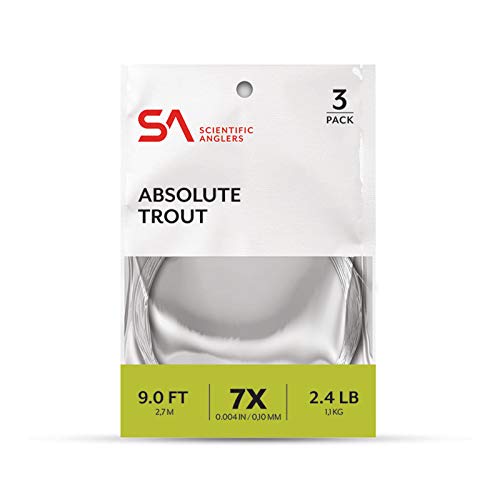
Scientific Anglers Absolute Trout Leader, 9ft 5X
A 9 foot 5X knotless tapered leader, which is the single most useful leader specification in trout fishing, and three to a pack so you are not rebuilding one on the bank in poor light.
Best for: General river trout fishing with dry flies and nymphs on a 4 to 6 weight.

SF Pre-Tied Loop Tapered Leaders, 9ft 5X 6 pack
Six pre tied loop leaders in the same 9 foot 5X specification for a fraction of the price. Loop to loop connection means you can change the entire front end in fifteen seconds without tying a knot.
Best for: Anyone who wants to start every session with a fresh taper rather than nursing an old one.
Skip it if: Anglers chasing the smoothest possible turnover on flat water, where a premium taper does measurably better.

RIO Powerflex Strong Tippet, 5X 30yd
The nylon tippet spool that keeps a 9 foot 5X leader at 9 foot 5X. Adding tippet back is what stops a knotless leader turning into a short heavy stub by the end of a day.
Best for: Restoring the final 20 percent of the taper after every few fly changes.

RIO Fluoroflex Strong Tippet, 7.3lb 30yd
Fluorocarbon at 0.007 inches, which is 4X, published at 7.3 lb. It sinks and resists abrasion, which is what you want below the taper on a nymph rig rather than on a dry fly.
Best for: Subsurface rigs where the tippet drags over rock all day.
Skip it if: Dry fly leaders. Fluorocarbon sinks, and it will pull your dry fly under with it.
Specs are the manufacturer's published figures. Prices and stock change constantly, so confirm on the retailer page. We earn commissions from Backcountry and from qualifying Amazon purchases.
When should I use a short leader instead of a long one?
Leader length is a control you should be adjusting far more often than you probably are. Most anglers buy 9 foot leaders, fish 9 foot leaders in every situation, and never discover that the two most common problems they have are both length problems.
| Length | When | Why it works | What it costs |
|---|---|---|---|
| 7.5 ft | Brushy small streams, casts under 25 feet | A short leader turns over in a confined space and under a canopy where a long one folds | Puts the fly line closer to the fish, which matters on clear flat water |
| 9 ft | General river trout fishing | The default. Long enough for separation from the line, short enough to turn over reliably | Nothing meaningful. This is the compromise everything else is measured against |
| 9 ft with 2 ft of tippet added | Slightly wary fish, moderate current | Extra tippet buys slack and delays drag without rebuilding the leader | Slightly less positive turnover on the delivery |
| 12 ft | Flat, slow, gin clear water and stillwater | Maximum separation between fly line and fly, and much more slack to delay drag | Hard to turn over in any wind, and hard to control on a short cast |
| 7.5 ft, heavy | Streamers and heavy weighted nymph rigs | Short and thick turns a heavy fly over instead of hinging under it | No delicacy at all, which does not matter with a streamer |
| 9 ft with a sink tip | Sinking or sink tip lines | Short leaders keep the fly near the depth the line has reached | A long leader on a sinking line lets the fly ride above the depth you worked to reach |
The sinking line row deserves emphasis because it is counterintuitive. On a floating line, a long leader gives separation between a visible line and a wary fish. On a sinking line, a long leader does the opposite of what you want: the line has done the work of getting down, and a long leader lets the buoyant fly ride back up above the depth you spent thirty seconds counting down to. Short leaders belong on sinking lines, usually between 3 and 6 feet. The same logic applies below a poly leader or a sink tip: keep the tippet short so the fly stays at the depth the line worked to reach.
Knotless, knotted or furled?
Three ways to build the same taper, with genuinely different trade offs and a fourth item that is not really a leader at all but sits in the same part of the rig.
| Type | How it is made | Advantages | Disadvantages | Who it suits |
|---|---|---|---|---|
| Knotless tapered | Extruded as one continuous piece with a machine controlled taper | No knots to catch weed or algae, consistent, cheap, available everywhere | Cannot be repaired, and it shortens and coarsens at the tip as you change flies | The default for almost everyone, almost always |
| Knotted, hand tied | Sections of level monofilament joined with blood knots or double surgeons knots | Fully customisable, repairable section by section, cheaper per leader once you have the spools | Every knot collects weed and algae, and every knot is a potential failure point | Anglers who fish a lot, tie their own, and want a specific taper |
| Furled | Multiple strands twisted into a tapered braid, usually with a tippet ring at the tip | Very supple, turns over softly, lasts seasons, forgiving of poor casting timing | Holds water and can spray on the pickup, and it is a bigger initial outlay | Dry fly specialists and small stream anglers who want a soft landing |
| Poly leader or versileader | A monofilament core coated in polymer, made in floating through fast sinking densities | Adds a controlled sinking or floating tip to any line without changing lines | Heavy and unsubtle, and it needs a tippet section added below it | Streamers, swinging flies, and getting a fly down without a full sinking line |
For the overwhelming majority of anglers, a knotless leader is the correct answer and the argument is practical rather than technical. Weed and algae hanging off a blood knot ruins a drift, and cleaning them off every third cast ruins a session. A Scientific Anglers Absolute Trout Leader, 9ft 5X or, at a lower price for the same specification, a SF Pre-Tied Loop Tapered Leaders, 9ft 5X 6 pack multi pack keeps a fresh taper in your pack for the cost of a coffee. The tapered leader roundup compares the options in detail.
Hand tying earns its place when you fish a lot and want something the shops do not sell: a specific stiff butt for turning big hoppers over, or a long soft front for spring creek work. Once you own the spools, each leader costs pennies, and you can repair a section rather than replacing the whole thing. The break even point is somewhere around a few dozen leaders a season.
How do I keep a leader in specification through a day?
You do not, not without intervention, and that is the point that turns this from a chart into a habit. Every fly change costs you a couple of inches from the finest end of the taper. Ten fly changes and a 9 foot 5X leader has become an 8 foot 4X leader that turns over more stiffly and presents less well, and the change happens so gradually that most people never notice it until nothing is rising to their fly any more.
The fix is a tippet spool and thirty seconds. Tie 18 to 24 inches of fresh RIO Powerflex Strong Tippet, 5X 30yd to the leader with a double surgeon's knot and the proportions are restored. For subsurface work, RIO Fluoroflex Strong Tippet, 7.3lb 30yd at 0.007 inches does the same job with a material that sinks and resists abrasion. A Tippet Spool Ring and Tender Set, 4 pack keeps the spools in order so you are not untangling a nest of monofilament during a hatch. The tippet size chart covers which X to add.
A tippet ring is the other option and it is underrated. A tiny welded metal ring tied into the leader at the end of the mid taper gives you a permanent attachment point, so you only ever cut tippet rather than eating into the tapered section. The ring is small enough that it does not affect turnover on a trout leader and it makes a knotless leader last many times longer.
How do I diagnose a leader that is not working?
Almost every leader problem shows itself in how the leader lands, and each symptom points to a specific section of the taper. Read the water in front of you rather than guessing.
| Symptom | Likely cause | Fix |
|---|---|---|
| Leader lands in a pile every cast | Butt section too light for the fly line tip, or leader far too long for conditions | Match the butt to roughly two thirds of the line tip diameter, or shorten the leader |
| Fly kicks over hard and lands with a splash | Tippet too short or too heavy for the fly | Add 12 to 18 inches of tippet, or drop one X size |
| Leader turns over but the fly drags immediately | Tippet too short and too stiff, so there is no slack in the system | Lengthen the tippet and consider a lighter X |
| Constant tangles around the fly line tip | A hinge where the leader butt meets a much thicker line tip | Step the butt up, or use a short intermediate section between line and leader |
| Leader keeps breaking at the fly | Knot seated dry, or tippet damaged by a wind knot | Lubricate every knot before seating it, and cut out any wind knot you find |
| Leader has become short and thick over a day | Normal. Every fly change eats a couple of inches of the taper | Add tippet back from a spool rather than cutting further into the taper |
Two notes on that table. A leader that lands in a pile is not always a fault: on flat water, deliberately landing a long leader with slack in it is a technique rather than a mistake, because slack is what buys a drag free drift. The difference between a controlled slack presentation and a collapsed leader is whether you chose it.
The second note is about knots, and it is the one worth carrying off this page. Lubricate every knot before you seat it. A knot drawn tight dry generates friction heat inside the wraps that damages the polymer, and the section then fails well below its rated strength, on a fish rather than on the bench. Saliva or river water is enough. It costs nothing and it is the highest value habit in leader building.
Where does this chart stop being reliable?
In three places. Commercial leader specifications are approximate. A leader sold as 9 foot 5X is manufactured to a taper the maker considers correct, and the actual butt diameter and section proportions differ between brands. If a particular leader turns over beautifully on your rod, buy that one again rather than reasoning from the label.
Line tip diameters vary more than the class number suggests. The figures in the butt matching table are typical for floating trout lines, and a specialist taper can sit well outside them. Measure if the connection is misbehaving.
Euro nymphing leaders ignore all of this. A tight line nymphing leader is a long level or very gently tapered system with a coloured sighter section, built to be held off the water rather than cast and turned over. The 60/20/20 rule describes a leader that must unroll in the air, and a euro leader is not doing that job at all. If that is your fishing, the nymph rigging guide is the right starting point, and the leader and tippet calculator will build a conventional rig for everything else.
Frequently asked questions
What is the 60/20/20 leader formula?
It is the standard proportion for a tapered trout leader: roughly 60 percent of the total length in the heavy butt section, 20 percent in the stepped mid taper, and 20 percent in the level tippet at the end. On a 9 foot leader that works out to about 65 inches of butt, 22 inches of mid taper and 22 inches of tippet. The proportions matter more than the exact inches, and every commercial knotless leader approximates them.
How thick should the butt of a leader be?
About two thirds the diameter of your fly line tip. A typical 5 weight floating line has a tip near 0.030 inches, so the leader butt wants to be roughly 0.020 inches, and anything from about 0.018 to 0.022 works. Too thin and the leader hinges at the connection and lands in a pile. Too thick and the transition is stiff and the leader kicks over hard.
When should I use a 12 foot leader instead of a 9 foot one?
On flat, slow, clear water where the fish have time to inspect everything, and on stillwater from a bank. The extra length puts more distance between the fly line and the fly and lands with more slack, which delays drag. The trade off is real: a 12 foot leader is much harder to turn over in wind and much harder to control on a short cast, so it is a tool rather than an upgrade.
Is a knotless leader better than a hand tied one?
For most anglers, yes, on practical grounds rather than performance grounds. A knotless leader has no knots to collect algae and weed, it is consistent from one to the next, and it costs a few dollars. A hand tied leader is customisable and repairable section by section, which is genuinely useful if you fish constantly and want a specific taper, but every knot in it is somewhere for river weed to hang.
How do I attach a leader to a fly line?
Most modern fly lines have a welded loop at the tip, and most leaders come with a loop already tied, so a loop to loop connection takes fifteen seconds and needs no knot. If your line has no loop, a nail knot is the traditional connection and it passes through the guides smoothly. Whichever you use, lubricate the knot before seating it, because a dry knot fails below its rating.
How long does a tapered leader last?
A knotless leader survives many sessions, but it shortens and coarsens every time you change a fly, because you are cutting into the fine end of the taper. Add tippet back from a spool once the tip has lost a few inches, and replace the whole leader when the proportions have drifted so far that it no longer turns over. Nylon also degrades in sunlight, so replace old spares each season or two.
How we choose: we compare published manufacturer specifications, line and leader standards, and verified owner reviews across retailers. We do not test gear in person, and every diameter, grain weight and breaking strength quoted here is the manufacturer's published figure unless we say otherwise, so check the spool label before you trust a number. Nothing here is professional instruction. Wading moving water is the real hazard in this sport: wear a snug wading belt, know the water temperature, and turn back rather than push through a crossing you are unsure of.