How to Tie Fly Fishing Knots: The 5 That Matter
Five knots cover all of fly fishing: the improved clinch for fly to tippet, the double surgeon's or blood knot for tippet to leader, the perfection loop for a leader loop, a nail knot or loop to loop for leader to fly line, and the arbor knot for backing to spool. Well tied and lubricated they hold roughly 90 to 95 percent of rated breaking strength. Lubricate every knot before seating it, because a dry knot generates friction heat and fails well below its rating.
You do not need twenty knots. You need five, and one habit. Knot strength is expressed as a percentage of the line's rated breaking strength, so a knot that tests at 90 percent on 6lb tippet gives you roughly 5.4lb of usable strength. Tie the same knot dry and badly seated and you can be down near 3.0lb, a loss of about 2.4lb with nothing visible to warn you. That single fact matters more than which knot you choose: lubricate every knot before you seat it, because a dry knot generates friction heat as it draws down and fails well below its rating.
Why does lubricating a knot matter so much?
When a knot tightens, the line slides against itself. On a fine tippet the contact pressures at those crossing points are high and the sliding distance is longer than it looks, because five wraps have to compress and stack in the space of a few millimetres. Dry, that produces friction heat and abrasion at exactly the points that will carry the load.
Nylon is a thermoplastic. It does not need to melt to be damaged, it only needs to be heated enough to change locally, and the result is a knot that looks perfect and breaks at a fraction of the strength you paid for. Fluorocarbon is harder and stiffer, which makes it less forgiving in a knot rather than more, so it wants lubrication even more than nylon does.
The fix costs nothing. Wet the knot in your mouth or in the river before you pull it tight, then seat it with a steady pull rather than a jerk. A steady pull lets the wraps settle against each other in order. A jerk makes one wrap bite before the others and that wrap becomes the point of failure. Then look at it. A good knot is neat, the wraps are parallel, and nothing is crossed over. If it looks wrong, cut it off. Tippet is the cheapest thing you own and retying takes twenty seconds.
What are the five knots that actually matter?
Each one exists to solve a specific joint in the system, working from the fly back to the reel. Between them they total 35 steps across all seven variants listed here, and the simplest is 3 steps. None of them is difficult. They are just unfamiliar until they are not.
Improved clinch knot, fly to tippet
Six steps. Pass the tippet through the hook eye, twist the tag around the standing line five times, pass the tag back through the small loop formed at the eye, then pass it again through the large loop you just created, lubricate, and seat with a steady pull on the standing line while holding the hook.
That final pass back through the large loop is the improvement. A plain clinch without it slips under load on slick modern tippet. Five wraps is the standard number on fine material, dropping to four on heavier tippet where five will not seat properly. The improved clinch loses efficiency on heavy monofilament above roughly 12lb, which is why saltwater anglers use different knots entirely, but for trout tippet in the 2X to 7X range it is the correct default.
Double surgeon's knot, tippet to leader
Four steps. Overlap the ends of the two sections by about six inches so they lie parallel, form a simple loop with both strands together, pass both ends through that loop twice, lubricate, then pull all four ends steadily at once.
Its great virtue is tolerance. A surgeon's knot holds well even when the two sections differ considerably in diameter, which is exactly the situation when you add 6X to the 4X end of a tired leader. It is also the easiest knot on this list to tie with cold hands in poor light, which is when you will most often need it. The cost is a slightly bulkier profile that sits at a small angle to the leader.
Blood knot, tippet to leader
Seven steps and the more elegant of the two. Cross the two sections, wrap one tag around the other five times, bring that tag back through the gap at the crossing point, repeat on the other side in the opposite direction, feed the second tag through the same gap from the opposite direction, lubricate, and draw both standing parts apart slowly.
A blood knot is slimmer than a surgeon's and it sits directly in line, so it slides through the guides cleanly and collects far less weed and algae. Published strength figures for the two are close enough that neither is meaningfully stronger. The practical split most anglers land on: surgeon's knots on the water, blood knots at the bench when building a leader from scratch.
Perfection loop, a loop in the leader butt
Five steps. Form a loop with the tag behind the standing line, form a second smaller loop in front of the first, bring the tag between the two loops, pass the second loop through the first, lubricate and seat.
The reason this beats a simpler loop knot is geometry: the finished loop sits perfectly in line with the standing part rather than at an angle. That keeps the leader straight through the connection so energy transfers instead of hinging. It is the loop to tie in a leader butt for a loop to loop connection to the fly line, and it is the loop to put on the end of a furled or hand tied leader.
Nail knot or loop to loop, leader to fly line
The nail knot is six steps and the hardest knot here. Lay the leader butt alongside the fly line with a small tube or nail against both, wrap the leader butt back over line, leader and tube six times working toward the line tip, pass the tag back through the tube, withdraw the tube, lubricate heavily, then tighten the wraps down onto the fly line coating a little at a time before pulling the leader tight.
It produces a slim, permanent connection that passes through the tip guide without catching, which matters if you routinely draw the leader inside the guides while netting fish. It is genuinely fiddly, and a nail knot tool is worth its small cost.
Most anglers never need it. Almost every modern fly line ships with a welded loop at the tip, and a loop to loop connection to a factory looped leader such as the Scientific Anglers Absolute Trout Leader, 9ft 5X takes three steps and about five seconds. Pass the leader loop through the line loop, pass the whole leader through its own loop, and draw the two loops together into a square. That last part matters: a loop to loop pulled up crooked forms a girth hitch that cuts into the line. It should look like two interlocking squares, never like a slipknot choking down on the loop.
Arbor knot, backing to spool
Four steps and the only knot on this page where strength is irrelevant. Pass the backing around the reel arbor, tie an overhand knot around the standing line, tie a second overhand knot in the tag itself as a stopper, lubricate and pull so the first knot slides down and jams against the stopper on the arbor.
It tests low, in the region of 60 to 70 percent, and that is fine. If a fish has taken the fly line, all your RIO Dacron Fly Line Backing, 20lb 100yd and reached this knot, the knot is no longer your problem. Its actual job is to stop the whole line assembly spinning uselessly on a slick arbor while you wind it on. If you want the full build sequence from bare reel to fishable rod, the fly rod setup guide walks through it in order.
How strong is each fly fishing knot?
The table below gives ranges, not single numbers, and that is deliberate. Published knot strength figures vary substantially between testers because the test protocol changes the answer: how fast the load is applied, whether the sample was lubricated, which brand of line was used, and whether the break point was recorded at the knot or elsewhere. Anyone quoting one exact percentage for a knot is reporting one lab's protocol as if it were physics.
| Knot | Joins | Steps | Typical strength | Difficulty |
|---|---|---|---|---|
| Improved clinch knot | Tippet to fly | 6 | 85 to 95% | Easy |
| Double surgeon's knot | Tippet to leader | 4 | 85 to 95% | Easy |
| Blood knot | Tippet to leader | 7 | 85 to 95% | Moderate |
| Perfection loop | Loop in the leader butt | 5 | 90 to 95% | Moderate |
| Nail knot | Leader to fly line | 6 | 90 to 95% | Hard |
| Loop to loop | Leader to fly line | 3 | 80 to 90% | Easy |
| Arbor knot | Backing to reel spool | 4 | 60 to 70% | Easy |
Read that table as a guide to which knot to learn for which job, not as a league table. The honest ranking is that a lubricated, well seated surgeon's knot beats a dry, jerked blood knot every time, and the difference between those two is far larger than the difference between the published figures for the knots themselves. To see what a given percentage means in pounds on your actual tippet, put the numbers through the knot strength calculator, and the knot strength chart lists the ranges alongside the diameters they apply to.
What you need to tie these well

Fly Fishing Nippers with Retractor and Knot Tool
A worn nipper crushes tippet instead of cutting it, and a crushed end will not thread a size 18 hook eye no matter how good your eyesight is. The knot tool on the back doubles as a nail knot aid.
Best for: Every angler, and the first thing to replace when threading a fly suddenly gets hard.

RIO Powerflex Strong Tippet, 5X 30yd
Nylon stretches more than fluorocarbon, which forgives the hard hookset that breaks light tippet. It is also the material every knot in this guide was designed around.
Best for: Learning knots at the vice and fishing dry flies on the water.
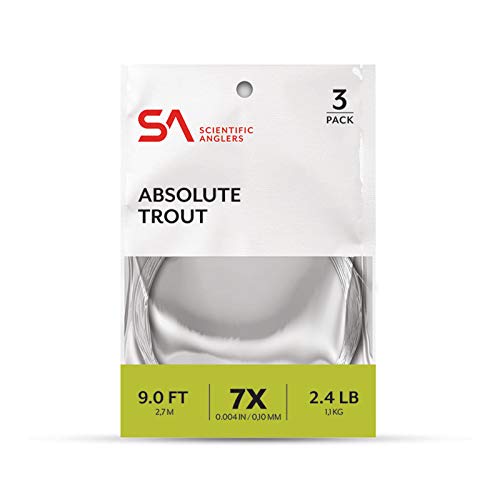
Scientific Anglers Absolute Trout Leader, 9ft 5X
A 9 foot 5X tapered leader with a factory loop, which means a loop to loop connection to the fly line and no nail knot required until you decide you want one.
Best for: Anyone who wants to skip the hardest knot on this page entirely.

RIO Fluoroflex Strong Tippet, 7.3lb 30yd
Fluorocarbon is stiffer and less forgiving in a knot than nylon, so it wants more wraps lubricated more carefully and seated more slowly. Worth knowing before you blame the knot.
Best for: Nymph droppers and abrasive water, once your knots are reliable.
Skip it if: Your first evening of knot practice. Learn on nylon, which is cheaper and more forgiving.

RIO Dacron Fly Line Backing, 20lb 100yd
Twenty pound Dacron is where the arbor knot lives. It is the only knot in fly fishing whose strength genuinely does not matter, because a fish that reaches it has already taken everything.
Best for: Filling a trout reel under the fly line.

Fly Fishing Zinger Retractors, 3 pack
A retractor keeps the nippers on your chest instead of in the river. Small, unglamorous, and the reason your knot tools are still with you at the end of the day.
Best for: Vests, slings and packs where tools otherwise migrate to the bottom of a pocket.
Specs are the manufacturer's published figures. Prices and stock change constantly, so confirm on the retailer page. We earn commissions from Backcountry and from qualifying Amazon purchases.
Which knot goes where in a trout rig?
Working from the reel outward, a complete trout outfit contains five knotted or looped joints and each one has an obvious answer.
- Backing to spool: arbor knot. Roughly 100 yards of 20lb Dacron under a trout line.
- Backing to fly line: a loop to loop into the welded rear loop, or an Albright style connection if the line has no rear loop.
- Fly line to leader: loop to loop with a welded front loop, or a nail knot if you want the slimmest possible profile.
- Leader to tippet: double surgeon's on the water, blood knot at the bench.
- Tippet to fly: improved clinch, five wraps on fine material.
A dropper for a two fly rig adds a sixth joint, and the simplest approach is to tie a surgeon's knot and leave the tag end of the upper section long, roughly 6 to 8 inches, then attach the second fly to that tag with an improved clinch. Working out how long each section should be is the job of the leader and tippet calculator, which sizes the tippet to the fly using the rule of four: divide the hook size by four to get a starting X. A size 16 fly divided by four gives 4X.
What goes wrong, and how do you tell?
Knot failures have signatures. Learning to read the tag end after a break tells you what actually happened, which is more useful than guessing.
A pigtail curl at the break point means the knot slipped. The line pulled out through the wraps rather than parting. Too few wraps, a tag trimmed so close it pulled back through, or a knot never fully seated in the first place. Add a wrap and seat harder.
A clean, square break at the knot means the knot was the weak point but held its shape. That is usually friction damage from seating dry, or a knot tied in tippet that was already abraded. Wet the next one and check the material by running it through your fingers.
A break somewhere out in the middle of the tippet means the material failed, not the knot. Look for a wind knot you did not notice, an abrasion point from rock, or nylon that is simply too old. Nylon degrades with ultraviolet exposure and repeated wetting, so a spool that has lived several summers on a sunny shelf is not what the label says it is.
A curly, corkscrewed tippet that will not straighten is memory from the spool rather than damage, and it costs you strikes because the fly drags. Stretch the section gently between your hands before you fish it.
How should you practise these knots?
Not on the river with cold hands and fading light. Sit at a table with a length of heavy monofilament, something around 20lb, because thick line shows you the structure of a knot that fine tippet hides. Tie each knot ten times in the heavy material until your hands know the sequence, then repeat in the tippet you actually fish.
Then test them destructively, which is the part almost nobody does and the part that teaches most. Tie the knot in a short piece of tippet, loop it around something fixed, and pull steadily until it breaks. Do it once dry and once lubricated, and pay attention to where it breaks and how the failed end looks. Ten minutes of that does more for your confidence in 6X than any amount of reading.
Keep a Fly Fishing Nippers with Retractor and Knot Tool on a retractor so your cutter is always in the same place, and keep the Fishing Forceps, 5in curved and straight pair handy because backing a hook out of a fish quickly is what stops you breaking a good knot for no reason. Carry at least two spools of RIO Powerflex Strong Tippet, 5X 30yd so that retying is never a decision about conserving material. The moment you start rationing tippet is the moment you start fishing a knot you do not trust, and that is the most expensive economy in the sport.
Frequently asked questions
Why do you have to wet a fishing knot before tightening it?
Because friction heat damages the material as the knot seats. Nylon and fluorocarbon slide against themselves while a knot draws down, and a dry knot generates enough heat and abrasion in that moment to weaken the line permanently. Saliva or water is enough lubricant. A lubricated knot seats smoothly and holds near its rated percentage, and a dry one can fail well below it with no visible sign of damage.
How many fly fishing knots do you actually need to know?
Two to fish, five to be self sufficient. The improved clinch attaches the fly and the double surgeon’s adds tippet, and those two alone will get you through a season. The perfection loop, the nail knot or a loop to loop connection, and the arbor knot let you build a whole outfit from a bare reel without help. Everything beyond those five is refinement rather than necessity.
What percentage of line strength does a good knot hold?
Well tied and properly lubricated, the common fly fishing connections hold somewhere around 85 to 95 percent of the line’s rated breaking strength. Published figures vary widely by test protocol, line material and how the knot was seated, so treat any single number with suspicion. The important comparison is not knot against knot, it is a lubricated knot against a dry one, where the gap is far larger.
Is a blood knot or a double surgeon’s knot better?
They test similarly, so choose on practicality. A double surgeon’s knot is faster, easier with cold hands, and tolerates a large diameter difference between the two sections. A blood knot is slimmer and sits straighter, so it passes through the guides more cleanly and picks up less weed. Most anglers tie surgeon’s knots on the water and blood knots at the bench when building leaders.
Why does my improved clinch knot keep slipping?
Usually one of three things. Too few wraps, since five is the standard on fine tippet and three is not enough. Skipping the final tuck back through the large loop, which is the improvement in improved clinch. Or seating the knot with a jerk rather than a steady pull, which lets the wraps stack unevenly. Trim the tag close, and check the wraps lie neatly against each other before you pull.
Do I need a nail knot if my fly line has a welded loop?
No. A welded loop plus a loop to loop connection is a legitimate permanent solution and it lets you change leaders in seconds without cutting anything. The nail knot is slimmer and passes through the tip guide more smoothly, which matters if you regularly draw the leader connection inside the guides. Most anglers with a modern line never tie a nail knot at all.
How we choose: we compare published manufacturer specifications, line and leader standards, and verified owner reviews across retailers. We do not test gear in person, and every diameter, grain weight and breaking strength quoted here is the manufacturer's published figure unless we say otherwise, so check the spool label before you trust a number. Nothing here is professional instruction. Wading moving water is the real hazard in this sport: wear a snug wading belt, know the water temperature, and turn back rather than push through a crossing you are unsure of.