Fly Fishing for Beginners: The Honest Starting Guide
A 9 foot 5 weight four piece rod, a matching weight forward floating line and a 9 foot 5X tapered leader cover roughly 80 percent of trout fishing in North America. A complete matched outfit that includes the rod, reel, line and backing starts under $100 and a serious one runs under $250.
Fly fishing looks harder than it is because the tackle is unfamiliar, not because the fishing is difficult. The one idea that makes everything else make sense is this: in fly fishing you cast the weight of the line, not the weight of the lure. A spinning angler throws a quarter ounce lure and the line follows it. A fly angler throws a line that weighs a measured number of grains, and a fly that weighs almost nothing goes along for the ride. Every gear decision below follows from that single fact.
This guide covers what to buy, what to skip, and the five skills that actually put fish in the net in a first season. It is researched from published manufacturer specifications, the AFFTA line standard and verified owner reviews, not from claimed personal testing.
What gear do you actually need to start fly fishing?
Six things. A rod, a reel with line and backing on it, a tapered leader, a spool or two of tippet, a small box of flies, and something to cut line with. Everything else on the wall at the fly shop is either a convenience or a later problem.
The rod is the decision that matters. A 9 foot 5 weight, four piece is the default for a reason: it is long enough to mend line on a medium river, short enough not to catch every branch, and the 5 weight line carries enough mass to punch a fly into a light breeze while still landing softly enough for a size 16 dry. Our rod weight by species chart lays out where the other weights belong, and the short version is that a 3 or 4 weight is a small stream specialist and a 6 weight is a streamer and big water tool. If you fish one rod, fish a 5.
The reel matters least of anything you will buy. On trout under about 18 inches the reel is a line holder with a brake on it, and most fish are landed by stripping line in by hand rather than by winding. Spend the money on the line instead, which is the component that most directly changes how the rod feels.
Should you buy a fly fishing combo or separate pieces?
Buy the combo. A combo, or outfit, is a rod, reel, fly line, backing and usually a leader sold matched in one box. It removes the two errors beginners actually make: putting the wrong line weight on the rod, and buying a reel whose arbor will not hold the line plus backing. The Maxcatch Extreme Fly Fishing Combo Kit, 9ft 5wt 4pc is the cheapest one worth owning, and the Redington Crosswater Fly Fishing Outfit, 9ft 5wt 4pc is the version most people should buy if the budget stretches, because the blank is medium-fast graphite and the line is a real RIO Mainstream rather than an unbranded coil.
Buying separately becomes the right call in your second season, once you know whether you prefer a rod that loads deep and slow or one that recovers fast. We compare the two paths in detail in outfit versus buying separately. For a first purchase, the matched box is not a compromise, it is the correct answer.
What does a fly fishing starter kit cost?
Here is the honest running total, built from current listed prices on the products this site has verified. The optional column is what you can genuinely leave until later.
| Item | Why it is on the list | Budget | Better |
|---|---|---|---|
| Complete outfit, 9ft 5wt | Rod, reel, line, backing, matched | Under $100 | Under $250 |
| Tapered leaders, 9ft 5X | Connects thick line to thin tippet | Under $25 | Under $25 |
| Tippet spool, 5X | Rebuilds the leader as you change flies | Under $25 | Under $25 |
| Fly assortment | A dozen proven patterns beats 200 random ones | Under $25 | Under $25 |
| Nippers | Teeth are not a tool | Under $25 | Under $25 |
| Forceps | Hook removal, barb crimping | Under $25 | Under $25 |
| Polarized sunglasses | Eye protection first, fish spotting second | Under $50 | Under $250 |
| Landing net | Shortens the fight, protects the fish | Under $50 | Under $50 |
| Budget, rounded up | Under $200 | Under $500 | |
Two of those lines are non negotiable for reasons that have nothing to do with catching fish. Polarized sunglasses such as the Flying Fisherman Sand Bank Polarized Sunglasses, amber are eye protection: a size 14 hook driven by a bad backcast travels at the height of your face (lens tints and upgrades are compared in the best polarized sunglasses for fly fishing). And a net like the SF Rubber Mesh Catch and Release Net, wood frame with a rubber bag shortens the fight, which is the single biggest factor in whether a released trout swims away. Our beginner setup page prices the whole thing as a buildable list.
How do you rig a fly rod for the first time?
The rigging order never changes, and it runs from thickest to thinnest: backing, then fly line, then leader, then tippet, then fly. Backing is thin braided dacron that fills the reel spool so the fly line sits on a large diameter and does not take a permanent coil. Fly line is the casting weight. The leader is a tapered monofilament section, normally 9 feet, that converts the thick line's energy into a soft turnover. Tippet is the level, replaceable end you tie flies to.
A tapered trout leader is built roughly 60 percent butt section, 20 percent mid taper and 20 percent tippet, and the butt should be about two thirds the diameter of the fly line tip so the energy transfers without a hinge. If you buy the SF Pre-Tied Loop Tapered Leaders, 9ft 5X 6 pack or the Scientific Anglers Absolute Trout Leader, 9ft 5X , that taper is already built for you. Add a spool of RIO Powerflex Strong Tippet, 5X 30yd and you can rebuild the business end all season. The full sequence, knot by knot, is in how to set up a fly rod.
What flies should a beginner carry?
Twelve patterns in three sizes beats two hundred patterns in one size. Trout eat mayflies, caddis, midges and things that look like small fish, and a handful of generic imitations covers all four. A bead head nymph selection such as the Bead Head Prince Nymph Assortment, 12 flies in sizes 12 through 18 will catch more trout than anything else you own, because trout feed subsurface the overwhelming majority of the time. Add a few Woolly Buggers from a Woolly Bugger Streamer Assortment, 24 flies with box pack for the days when nothing is hatching, and a small dry fly selection for evenings.
Fly size and tippet size are linked by the rule of four: divide the hook size by four to get a starting tippet X rating. A size 16 fly divided by four is 4X. It is a starting point rather than a law, and on flat clear water the right adjustment is almost always one size lighter. Our leader and tippet calculator does the arithmetic and the tippet size chart gives you the diameters.
What are the first skills to practise?
Casting first, but less of it than you think. The basic overhead cast is two stops, one back and one forward, with a pause between them that lasts exactly as long as the line needs to straighten. The most common beginner fault is not power, it is rushing that pause. Thirty feet of controlled line catches the large majority of trout in a river, and fly casting basics walks through the stroke and the four faults that produce a tailing loop.
Then drift. A fly moving at a different speed from the water it sits in looks wrong to a trout, and the fix is mending: flipping the belly of the line upstream after the cast so the current does not drag the fly. Then water reading, which is really just learning where a fish can hold without fighting the current while food goes past. That is covered in how to fish dry flies. Then knots, of which you need exactly three to fish competently.
What should a beginner know about wading safely?
Wading is the genuine hazard in this sport, and it deserves more respect than the casting does.
If you wear waders, a Smith Creek Wading Belt, universal goes on every single time, cinched snug at the waist. It does not make waders unsinkable, and no product makes wading safe. What a belt does is slow the flooding that makes swimming difficult, and it is the cheapest safety item in the sport. Cold water is a separate problem: cold shock on entry is the immediate danger rather than hypothermia, and fine motor control degrades within minutes, so getting out fast matters more than swimming well. The full picture is in the wading safety guide.
What do beginners waste money on?
Three things, consistently. A second rod bought before the first one is understood, because the problem is almost never the rod. An expensive reel on a trout outfit, because a trout rarely gets onto the reel at all. And an enormous fly selection, because a hundred unfamiliar patterns is worse than a dozen familiar ones. Nippers such as the Fly Fishing Nippers with Retractor and Knot Tool and a pair of Fishing Forceps, 5in curved and straight pair cost very little and get used on every single trip, which is a better test of value than price.
The money that is genuinely worth spending goes into the fly line and, if you are wading, into boots. Line is the part of the system you feel on every cast, and a good one lasts several seasons with cleaning. If you want to understand what you are paying for, read how to choose a fly line and check the rod against the line weight calculator before ordering.
How do you know if the outfit is matched correctly?
Read the rod blank just above the grip. It will say something like 590-4, which decodes as a 5 weight, 9 feet, 4 piece. The fly line box should say WF5F, meaning weight forward, 5 weight, floating. The reel box should list a line range such as 5/6. If those three agree, the outfit is matched.
| Marking | Where you find it | What it means |
|---|---|---|
| 590-4 | Rod blank above the grip | 5 weight, 9 feet, 4 piece |
| WF5F | Fly line box and spool | Weight forward, 5 weight, floating |
| 5/6 | Reel foot or box | Balances a 5 or 6 weight line |
| 9ft 5X | Leader packet | 9 foot taper ending at 0.006in |
| 20lb | Backing spool | Dacron backing breaking strength |
One nuance worth knowing early: many modern fly lines are built heavier than the AFFTA standard on purpose. The standard sets a 5 weight at 140 grains in the first 30 feet with a tolerance of plus or minus 6 grains, but a lot of lines marked 5 weight measure half a size to a full size over that, so they load fast rods at short range. If a new line feels heavy on an old rod, this is usually why, and it is not a defect.
Three starter outfits, by how sure you are about the sport

Maxcatch Extreme Fly Fishing Combo Kit, 9ft 5wt 4pc
The cheapest complete outfit worth owning. Rod, reel, line and backing arrive matched, which removes the single most common first-season mistake: buying a line that does not match the rod.
Best for: Someone who wants to find out whether they like fly fishing before spending real money.
Skip it if: Anyone who already knows they are staying with the sport. Buy once instead.
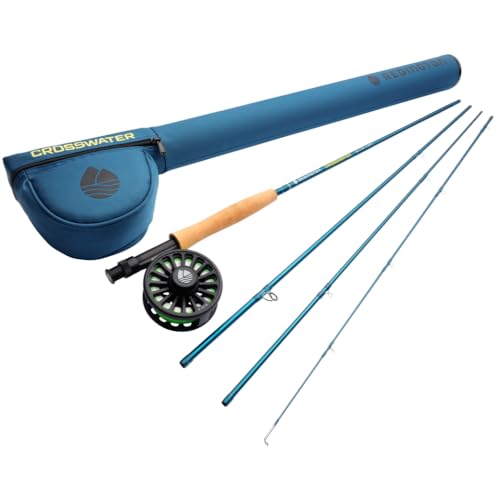
Redington Crosswater Fly Fishing Outfit, 9ft 5wt 4pc
A medium-fast graphite blank with a RIO Mainstream line already spooled on backing, plus a leader, in a zippered case. Medium-fast is the forgiving end of the action range and the right place to learn a casting stroke.
Best for: The first serious outfit, and a rod that stays in the quiver as a loaner for years.
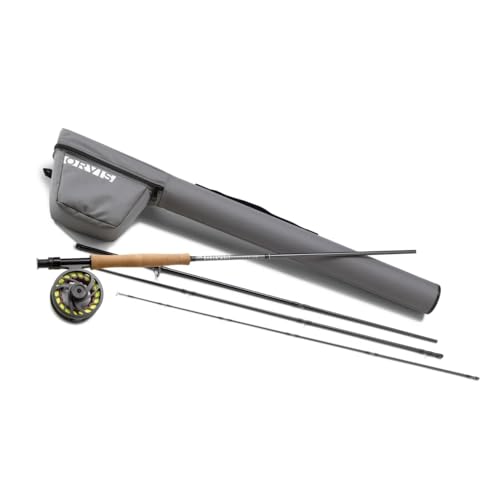
Orvis Clearwater Fly Rod Outfit, 8'6" 5wt 4pc
The buy-once outfit: black chrome blank, ceramic stripping guides, a machined reel seat, a rod tube and the 25 year Orvis rod guarantee that covers a door slam.
Best for: A beginner who is certain they are staying and would rather buy the last outfit first.
Skip it if: Anyone still unsure. Nothing about this rod catches a fish the cheap outfit cannot catch in your first season.
Specs are the manufacturer's published figures. Prices and stock change constantly, so confirm on the retailer page. We earn commissions from Backcountry and from qualifying Amazon purchases.
What does a good first season look like?
Fish one rod, one line and one box of flies until they are boring. Pick a single stretch of water within a short drive and fish it in every condition you can, because learning one piece of river properly teaches more than sampling ten. Expect the first two trips to produce nothing, expect the third to produce a fish you did not deserve, and expect to spend more time untangling leaders than you thought possible. All of that is normal.
When you are ready to spend again, the upgrade order that returns the most is line, then boots, then rod, then reel, and almost never in the opposite direction. Our intermediate setup is built around exactly that sequence.
Frequently asked questions
What rod weight should a complete beginner buy?
A 9 foot 5 weight, four piece rod. The 5 weight sits in the middle of the trout range, throws a size 16 dry fly and a small weighted nymph without complaint, and handles wind better than a 3 or 4 weight. Nine feet is the standard length because it balances casting distance, line mending and reach. A four piece breaks down short enough for a car boot or a pack.
Is a fly fishing combo kit worth buying, or should I buy pieces separately?
For a first outfit, the combo wins. It arrives matched, spooled with backing, and usually with a leader attached, which removes the two mistakes beginners actually make: mismatched line weight and a reel too small for the line. Buying separately makes sense once you know which action you like and want a specific line, which is usually a second season decision, not a first one.
How much does it cost to start fly fishing?
A workable kit lands between roughly 150 and 350 dollars. An entry outfit covers the rod, reel, line and backing for under $100. Add leaders and tippet, a starter fly assortment and forceps, each under $25, nippers under $25, and polarized sunglasses from under $50. Waders and boots are the expensive add and are genuinely optional on small summer water.
Do I need waders to start fly fishing?
No. On warm water in the warm half of the year, shorts and an old pair of trainers with a grippy sole work fine, and wet wading is more comfortable than waders in heat. Waders matter in cold water and in the shoulder seasons. When you do buy them, buy the wading belt at the same time and wear it cinched snug every single time.
What is the difference between a fly rod and a spinning rod?
A spinning rod casts a weighted lure and the light line follows it. A fly rod casts the weight of the line itself, and the nearly weightless fly goes along for the ride. That is why fly line weight and rod weight have to match: the rod is a spring tuned to load under a specific mass, which the AFFTA standard fixes as the grain weight of the first 30 feet of line.
How long does it take to learn to cast a fly rod?
Most people can put a fly 30 feet away with reasonable control inside two or three practice sessions on grass. Fishing well takes far longer, because casting is the smallest part of it. Reading water, choosing a fly and getting a drag free drift are the skills that actually catch fish, and they keep improving for decades. Thirty feet of control catches most trout.
How we choose: we compare published manufacturer specifications, line and leader standards, and verified owner reviews across retailers. We do not test gear in person, and every diameter, grain weight and breaking strength quoted here is the manufacturer's published figure unless we say otherwise, so check the spool label before you trust a number. Nothing here is professional instruction. Wading moving water is the real hazard in this sport: wear a snug wading belt, know the water temperature, and turn back rather than push through a crossing you are unsure of.