Fly Rod Outfit vs Buying Separately
Buy the boxed outfit for your first rod. It is not usually cheaper: an under-$250 outfit costs a little more than the same four parts bought separately. What it buys is a fly line already matched to the blank, which is the single most common first season failure. Switch to separates in your second season, because putting an under-$100 line on an under-$100 rod is the cheapest genuine performance upgrade in the sport.
Verdict: buy the outfit first, buy separates second. That is not a compromise, it is a sequence, and the reason is one specific failure mode. A boxed outfit arrives with the fly line already matched to the rod, and a mismatched line is the thing that convinces more new anglers they cannot cast than any other single factor. Once you know what you are doing, the arithmetic flips, and it flips for a reason worth understanding: separates let you put a good line on a modest rod, which is the cheapest real performance upgrade available.
A definition, because outfit, combo and kit are used loosely. A fly rod outfit is a rod, reel, backing, fly line and usually a tapered leader sold as one matched package, with the reel already spooled and the line already attached. A rod sold on its own is a blank with guides and a reel seat, and it will not fish until you have added three more purchases and made two knots.
What does an outfit actually save you?
Not much money, and that is the first honest thing to say. What it saves is the matching problem, and the matching problem is worth more than the money.
A fly rod is rated for the mass of line it is designed to carry, measured under the AFFTA standard as the weight in grains of the first 30 feet of line, excluding any level tip. A 5 weight line is 140 grains with a tolerance of plus or minus 6. Hang a line that is too light on a rod and it feels dead and lifeless at the distances people actually fish. Hang one that is too heavy and it feels sloppy and slow to recover. Either way the caster concludes that they are the problem.
That would be manageable if the label on the box were reliable, and it is not. Many modern lines are built deliberately over standard, half a size to a full size heavy, so that fast rods load at short range. A nominal 5 weight can measure closer to 150 grains than 140. That is a design decision rather than a defect, but it means a beginner choosing a line from a wall of boxes is making a decision with real consequences using information they do not have yet. If you are buying separately, put the numbers through the line weight calculator first, and read the guide to choosing a fly line before you spend anything.
An outfit removes that decision entirely. Somebody who understands the blank picked the line for it, spooled the backing, attached the line and tied on a leader. You take it out of the tube and fish.
What does each route cost, in real numbers?
Here it is priced both ways at two levels, using current listed prices. The separates column is a genuinely sensible build rather than the cheapest possible one.
| Item | Product | Budget |
|---|---|---|
| Rod | Redington Path, 9ft 5wt 4pc | Under $100 |
| Reel | Piscifun Sword, 5/6 | Under $100 |
| Line | Orvis Clearwater WF floating | Under $50 |
| Backing | RIO Dacron, 20lb 100yd | Under $25 |
| Leader | Tapered 9ft 5X, sold in packs | Under $25 |
| Separates total | Before the leader | Under $250 |
| Separates total | With a leader | Under $250 |
| Boxed outfit | Redington Crosswater, everything included | Under $250 |
The outfit costs a little more than the separates before you add a leader, and lands inside the separates range once you do. In other words the two routes cost effectively the same, and the outfit throws in a zippered case, a rod tube on some models, and the matching work. That is why the outfit wins for a first purchase: you are not paying a premium for convenience, you are getting the convenience roughly free.
The individual parts, if you want to build it yourself: the Redington Path Fly Rod, 9ft 5wt 4pc , the Piscifun Sword Fly Reel, 5/6 , the Orvis Clearwater Fly Line, WF floating and RIO Dacron Fly Line Backing, 20lb 100yd for the arbor. Add a tapered 9 foot 5X leader, which is the standard trout leader at roughly 60 percent butt, 20 percent mid taper and 20 percent tippet.
| Item | Product | Budget |
|---|---|---|
| Rod | Redington Classic Trout, 8ft 6in 5wt | Under $250 |
| Reel | Orvis Clearwater, 5 to 7wt | Under $250 |
| Line | RIO Premier Gold WF5F | Under $100 |
| Backing | RIO Dacron, 20lb 100yd | Under $25 |
| Separates total | Before the leader | Under $500 |
| Boxed outfit | Orvis Clearwater outfit, with rod tube | Under $500 |
| Difference | Outfit premium | A little more |
Same pattern at the higher level. The Orvis Clearwater Fly Rod Outfit, 8'6" 5wt 4pc costs a little more than a comparable set of Redington Classic Trout Fly Rod, 8'6" 5wt 4pc , Orvis Clearwater Fly Reel, 5-7wt and RIO Premier Gold Fly Line, WF5F , and adds a rod tube and a 25 year rod guarantee. That guarantee is worth more than the price difference, because rods break in car doors and under ceiling fans far more often than they break on fish.
The one place an outfit is genuinely much cheaper is the very bottom of the market. A Maxcatch Extreme Fly Fishing Combo Kit, 9ft 5wt 4pc costs less than half as much as the cheapest sensible separates build, because the maker is assembling their own low cost parts rather than buying them at retail. Every part of it is ordinary and every part of it is matched, which is exactly the right trade for somebody finding out whether they like the sport.
Boxed outfits by tier

Maxcatch Extreme Fly Fishing Combo Kit, 9ft 5wt 4pc
The cheapest complete outfit worth owning, and less than half the cost of assembling the cheapest sensible set of separates. The blank is unremarkable and the reel is die cast rather than machined, but every part is matched to every other part, which is the thing that decides a first season.
Best for: Finding out whether you like fly fishing before spending real money on it.
Skip it if: Anyone who already knows they will fish thirty days a year. You will replace all of it within two seasons and the money is better spent once.
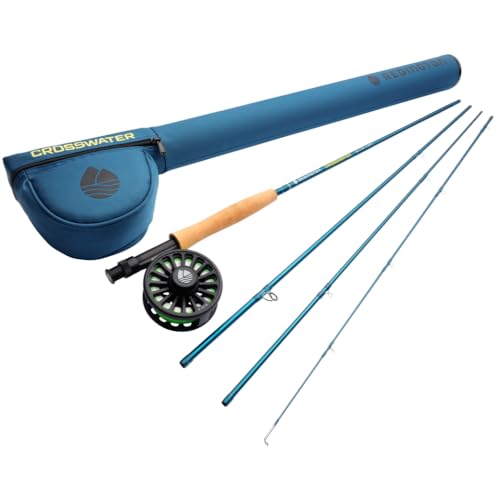
Redington Crosswater Fly Fishing Outfit, 9ft 5wt 4pc
Rod, reel, a RIO Mainstream WF5F line, backing and a leader, pre rigged in a case, for a little more than the same functions bought separately. The line is the part that matters: it is correctly matched to the blank before it reaches you.
Best for: The default first fly fishing purchase for trout, in the 9 foot 5 weight size.

Orvis Encounter Fly Rod Outfit, 9ft 8wt 4pc
The same logic in the saltwater and big streamer weight, with reel, line, backing and leader included and the Orvis 25 year rod guarantee behind it. Matching matters even more at 8 weight, because the line choices are less obvious.
Best for: A first saltwater, pike or big streamer outfit bought as one decision.
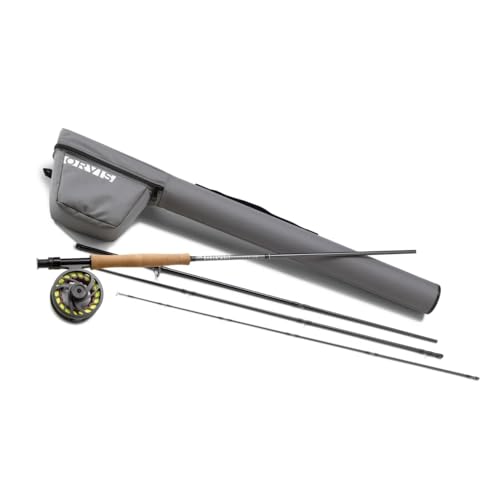
Orvis Clearwater Fly Rod Outfit, 8'6" 5wt 4pc
The buy once outfit, and the one that makes the separates arithmetic interesting: it costs a little more than an equivalent set of separates and adds a rod tube and a 25 year guarantee. Black chrome blank, ceramic guides and a proper reel seat.
Best for: Someone who already fishes, knows they will keep fishing, and wants to stop shopping.
Skip it if: A complete beginner. This is real money spent on refinements you cannot yet perceive, and the same budget buys a good outfit plus a season of lessons, flies and tippet.
Specs are the manufacturer's published figures. Prices and stock change constantly, so confirm on the retailer page. We earn commissions from Backcountry and from qualifying Amazon purchases.
When does buying separately start to win?
In your second season, and for one reason above all others. Separates let you put a genuinely good line on a modest rod, and that is the cheapest real performance upgrade in fly fishing.
Work through it with numbers. Take an under-$100 rod and hang an under-$100 line on it, for under $200 total. Now take the same money and put it into the blank instead: stepping up to a Redington Vice Fly Rod, 9ft 5wt 4pc at under $500 costs well over twice as much as the line upgrade did, and it will not improve your casting nearly as much, because the line is the mass that loads the spring and the rod is only the spring.
The reason this matters is that boxed outfits economise exactly where you would expect. The rod and reel in an outfit are usually decent for the money and the line is usually the weakest component, because it is the part a buyer does not see on the shelf. Replacing that line, and only that line, is the highest return purchase available to a second season angler. Everything in the trout fly line roundup is a bigger upgrade than a more expensive blank would be.
The second reason separates win later is fit to purpose. Once you know that you fish small brushy streams, you want a shorter, slower rod. Once you know you fish wind, you want a faster one. An outfit is built around the average angler on average water, and after a season you are no longer average, you are specific. The beginner rod roundup covers how action and length change what a rod does.
Which size outfit should you buy?
A 9 foot 5 weight in 4 pieces, unless you already know otherwise. Nine feet is the default rod length because it balances reach for mending, tip height to keep line off conflicting currents and enough leverage to cast without fatigue. Five weight is the widest useful compromise in the line standard: light enough to present a small dry fly, heavy enough to turn over a weighted nymph rig or a small streamer. Four pieces because modern ferrules cost you nothing measurable and a rod that fits in a car boot is a rod that comes with you.
Step up to a 6 weight only if wind, big water or streamers describe your actual fishing rather than your ambitions, and step up to an 8 weight outfit like the Orvis Encounter Fly Rod Outfit, 9ft 8wt 4pc for saltwater, pike or serious streamer work. Below a 5 weight, outfits get thin on the ground, because the market has correctly concluded that a 3 weight is a second rod rather than a first one.
What still has to happen before an outfit is fishable?
Less than with separates, but not nothing, and it is worth knowing what you are being spared. Assembling a fly outfit from parts means four connections, and two of them are knots that a beginner is tying for the first time on the day they most want to be fishing.
Backing to the arbor. An arbor knot around the spool, then roughly 100 yards of 20 pound dacron wound on under tension. Backing is not optional: it fills the spool so the fly line sits on a wide diameter, which means fewer coils, less memory and a much faster retrieve. A fly line wound straight onto a bare arbor comes off in tight springs.
Backing to fly line. Traditionally an albright knot or a nail knot, now usually a welded loop at the back of the line joined loop to loop. This is the connection people get wrong, because it has to pass through the guides smoothly when a fish runs.
Fly line to leader. A welded loop at the front of the line makes this trivial, and most modern lines have one at both ends. Without it, a nail knot.
Leader to tippet. A double surgeon knot or a blood knot, lubricated before you seat it, because a dry knot generates friction heat and fails well below its rated strength. This one you will be tying constantly whichever route you took, so learn it early.
An outfit arrives with the first three already done. That is perhaps forty minutes of fiddly work with fine material and small knots, and it is forty minutes at exactly the moment when your patience is lowest. A shop will do it for you if you buy the parts there, which is the honest third option that sits between the two routes on this page.
What is the honest upgrade order?
If you own an outfit and want to improve it, do it in this order. It is the reverse of what most people do, and it is the order that produces the most fishing improvement per dollar.
| Step | Upgrade | Typical cost | What changes |
|---|---|---|---|
| 1 | Fly line | Under $100 | Loop shape, distance, presentation, every cast |
| 2 | Leaders and tippet supply | $20 to $40 | Turnover and break offs, the two beginner killers |
| 3 | Casting lesson or lawn time | $0 to $100 | More than any equipment on this list |
| 4 | Reel with a better drag | Under $250 | Matters on big fish and running fish, rarely on trout |
| 5 | Second rod for specific water | $100 and up | Fit to your actual river, not general quality |
| 6 | Flagship rod | $800 plus | Swing weight and feedback, perceptible only to good casters |
Most anglers do this list backwards, starting at step six and never reaching step one. The result is an expensive rod casting a poor line through a leader that does not turn over, which casts worse than the outfit it replaced.
Who should ignore the verdict and buy separates first?
The outfit is the right first purchase for most people, but not everybody, and the exceptions are specific rather than vague.
- You already fly fish and are adding a line class. You know what action you want and which line family you like, so the matching problem is not a problem. Buy the rod you want and the line you already trust.
- You have a rod already, from a relative or a shed. Do not buy an outfit around it. Identify the line class stamped above the grip, buy a reel to match, spool it with backing and a good line, and you have a working outfit for the price of the missing pieces.
- You fish very specific water. Brushy small streams under 8 feet of rod length, or euro nymphing at 10 feet and over, are not what boxed outfits are built around. An outfit will sell you a 9 foot 5 weight, which is the right general answer and the wrong specific one.
- You want a rod with a lifetime service policy above all else. Some of the strongest guarantees sit on rods sold on their own through dealers rather than in boxed outfits, and if you break rods, that is a reasonable thing to optimise for.
- A shop will build it for you. A local fly shop that spools your reel, matches the line and rigs the leader has just given you every advantage of an outfit while letting you choose each part. That is the best of both routes and it is worth paying shop prices for.
And plainly the other way: buy the outfit if you have never fly fished, if nobody is going to spool your reel for you, or if you are buying a gift. A rod on its own is not a present, it is a homework assignment.
Whichever route you take, the rod is only part of the shopping. Flies, tippet, floatant, nippers, forceps, a net and polarised glasses all stand between the box and a fishable day, and the beginner setup build puts the whole list on one page with a banded total. The starter kit roundup compares the boxed outfits directly if you have already decided which way you are going.
If you have landed on the outfit side of this, three of them are reviewed here individually, and the differences are larger than the price gap suggests. The Redington Crosswater outfit at under $250 is a full 9 foot 5 weight, the Orvis Encounter outfit at under $250 is a 9 foot 6 weight for windier water, and the Orvis Clearwater outfit at under $500 is an 8 foot 6 inch 5 weight, which is a different rod rather than simply a nicer one.
Frequently asked questions
What does a boxed fly rod outfit actually include?
A rod, a reel, backing, a fly line and usually a tapered leader, with the reel already loaded and the line already attached, in a case or tube. The value is not the discount, which is modest. It is that the line is correctly matched to the blank before it reaches you, and that is the single most common first season failure when people assemble their own.
Is buying an outfit cheaper than buying separately?
Not usually, and that is the surprise. A budget outfit in the under-$250 tier costs a little more than the same four functions bought as separates, and a premium outfit runs a little over an equivalent build. The genuine saving is at the very bottom of the market, where a complete matched kit costs far less than any sensible set of individual parts.
What is the most common mistake when buying separately?
Hanging the wrong line on the rod. Line weight class, taper and head length all change how a blank loads, and many modern lines run half a size to a full size heavy, so a nominal 5 weight can measure closer to 150 grains than 140. A rod that feels dead or sloppy is usually a line mismatch, and beginners almost always blame their casting instead.
When should I stop buying outfits and buy separates?
In your second season, once you know what action you like and what water you fish. That is the point where separates win, because you can put a genuinely good line on a modest rod. Upgrading an under-$50 line to an under-$100 line on an existing rod changes casting more than spending well over twice as much on a better blank does.
Can I upgrade an outfit later, or is it a dead end?
You can upgrade every part of it, and the line first. Replace the line while keeping the rod and reel, then replace the reel when you want a better drag, then keep the original rod as a spare or a loaner. Nothing in a boxed outfit is proprietary, so there is no lock in. The rod is the last thing worth replacing, not the first.
Do I need to buy backing separately if I buy a rod and reel?
Yes, and a leader too. Backing is the thin dacron that fills the spool under the fly line, and 100 yards of 20 pound costs under $25. Without it the fly line coils tightly on a bare arbor and the reel retrieves very slowly. A shop will usually spool a reel for you if you buy the parts there, which removes the fiddliest job in the assembly.
How we choose: we compare published manufacturer specifications, line and leader standards, and verified owner reviews across retailers. We do not test gear in person, and every diameter, grain weight and breaking strength quoted here is the manufacturer's published figure unless we say otherwise, so check the spool label before you trust a number. Nothing here is professional instruction. Wading moving water is the real hazard in this sport: wear a snug wading belt, know the water temperature, and turn back rather than push through a crossing you are unsure of.