Best Fly Fishing Starter Kit
The best fly fishing starter kit for most people is the Redington Crosswater 9ft 5wt outfit at under $250, which includes the rod, reel, RIO Mainstream WF5F line, backing and a leader pre-rigged in a case. If you only want to find out whether you enjoy the sport, the Maxcatch Extreme combo at under $100 is the cheapest complete outfit worth owning.
A starter kit exists to solve one problem: matching. A fly rod, a fly line and a leader are a single mechanical system, and a mismatch in any one of them makes a competent caster look hopeless. Buy a boxed outfit and the matching is done for you, the reel arrives with backing and line already on it, and the only remaining decision is where to fish. Below are the outfits worth buying at each price level, compared on published specifications and verified owner reviews, plus the honest list of what these kits leave out and what that costs.
What exactly is in a fly fishing outfit?
An outfit is the industry term for a rod, a matched reel, a fly line, backing and a tapered leader sold together. That is five components, and the reason the term matters is that plenty of listings advertise a kit while shipping only a rod and reel. If backing and line are not named, they are not in the box.
The backing is 20 or 30 pound braided Dacron wound onto the arbor first. It does two jobs: it fills the spool so the fly line coils in a larger diameter and holds fewer memory kinks, and it gives you a reserve if a fish runs past the 90 feet of fly line. For trout you will use the second function roughly never and the first one every single trip.
The fly line is the part that actually gets cast. A rod does not throw a fly, it throws a line, and the fly goes along. That is why line quality matters more per dollar than blank quality, and why the difference between the outfits below is mostly a difference in line. An unbranded line in a budget kit will be stiffer, will retain coils longer, and will start sinking at the tip within a season. A named line like the RIO Mainstream in the Crosswater kit will not.
The leader is the tapered nylon section between line and fly. A standard trout leader is 9 feet, with roughly 60 percent butt, 20 percent mid taper and 20 percent tippet, and the butt section should be about two thirds the diameter of the fly line tip so energy transfers instead of stalling. Kits usually include one. You will want more, which is what the tapered leader roundup is for.
Which starter kit is the best value?
The Redington Crosswater Fly Fishing Outfit, 9ft 5wt 4pc at under $250. It is the cheapest outfit in which every one of the five components is a component you would choose on its own. The blank is a medium-fast 9 foot 5 weight in 4 pieces, which is the configuration that covers the most trout water in North America. The reel has an actual drag rather than a click pawl. The line is a RIO Mainstream WF5F, a real line with a real taper, not a generic coil.
Below that, the Maxcatch Extreme Fly Fishing Combo Kit, 9ft 5wt 4pc at under $100 is the honest floor. Nothing in it is remarkable. The reel is die-cast aluminium, which means it is cast in a mould rather than machined from bar stock, and die-cast reels are heavier and less precise but do not fall apart. The point of this outfit is that it removes the excuse. For less than the price of a decent line on its own, you can find out whether standing in a river appeals to you.
Above, the Orvis Clearwater Fly Rod Outfit, 8'6" 5wt 4pc at under $500 is the buy-once version at 8 feet 6 inches and 5 weight. What the extra money genuinely buys is a better blank, ceramic stripping guides that do not groove, a rod tube, and the Orvis 25 year rod guarantee. What it does not buy is more fish. Say that plainly to anyone who is still deciding whether they like the sport.
| Outfit | Price | Length | Weight | Reel type | Line |
|---|---|---|---|---|---|
| Maxcatch Extreme combo | Under $100 | 9'0" | 5 | Die-cast | Unbranded WF5F |
| Redington Crosswater outfit | Under $250 | 9'0" | 5 | Die-cast, disc drag | RIO Mainstream WF5F |
| Orvis Encounter outfit | Under $250 | 9'0" | 8 | Large arbor, disc | WF8F included |
| Orvis Clearwater outfit | Under $500 | 8'6" | 5 | Large arbor, disc | Clearwater WF5F |
The line column is the one to read closely. Two of these four outfits include a line you would otherwise pay 40 to 60 dollars for, and that alone accounts for a large share of the price gap. If you want to understand why one taper feels different from another, the fly line guide is the shortest route.
Best fly fishing starter kits, by tier

Maxcatch Extreme Fly Fishing Combo Kit, 9ft 5wt 4pc
The cheapest complete outfit worth owning. The blank is ordinary and the reel is die-cast rather than machined, but the rod, reel, line, backing and leader are matched to each other and the whole thing casts, which is the only thing that decides whether you keep fishing.
Best for: Finding out whether you like fly fishing before committing real money.
Skip it if: Anyone who already knows they are staying. You will outgrow the reel inside a season and end up paying twice.
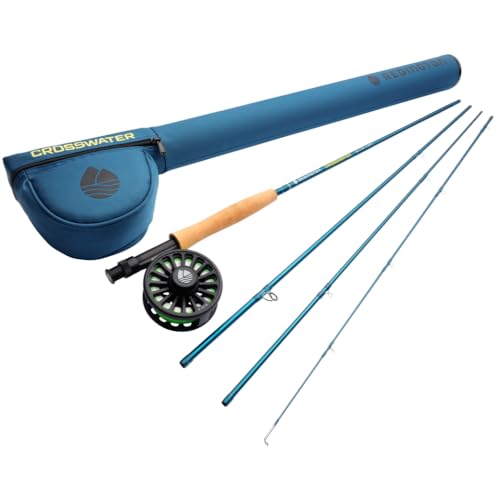
Redington Crosswater Fly Fishing Outfit, 9ft 5wt 4pc
The kit that stops being a compromise. A medium-fast 9 foot 5 weight, a Crosswater reel with a real drag, a RIO Mainstream WF5F line rather than an unbranded one, plus backing and a leader, pre-rigged in a zippered case.
Best for: A first outfit you will still be fishing in three seasons.
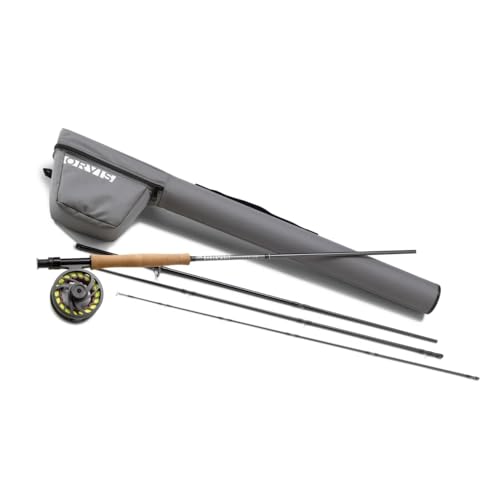
Orvis Clearwater Fly Rod Outfit, 8'6" 5wt 4pc
The buy-once outfit. Black chrome blank, ceramic stripping guides, a proper machined reel seat, a rod tube, and the Orvis 25 year rod guarantee, which means a car door ends an afternoon rather than the rod.
Best for: Someone who has fished before, knows they are committed, and wants to stop upgrading.
Skip it if: A curious beginner. Nothing here catches a fish the $229.99 outfit will not, and the difference in feel is one you cannot perceive until your loop is consistent.

Orvis Encounter Fly Rod Outfit, 9ft 8wt 4pc
The same idea moved up to 8 weight for bonefish, redfish, pike and big streamers. Reel, line, backing and leader included, and it carries the same 25 year rod guarantee, which is unusual at this price.
Skip it if: Trout fishing. An 8 weight throwing a 210 grain line at a 14 inch brown is a hammer looking for a thumbtack.
Specs are the manufacturer's published figures. Prices and stock change constantly, so confirm on the retailer page. We earn commissions from Backcountry and from qualifying Amazon purchases.
What does a starter kit not include?
This is where new anglers get caught out at the water. An outfit gets you to the river bank with a rod that will cast. It does not get you fishing. The second layer costs roughly 60 to 90 dollars and every item is genuinely necessary.
Flies. A boxed assortment is the efficient way in. The Bead Head Prince Nymph Assortment, 12 flies at under $25 covers subsurface fishing in sizes 12 to 18, and the Woolly Bugger Streamer Assortment, 24 flies with box at under $25 covers streamers, which is the easiest technique to catch a first fish on. Detail on why in the dry fly selection.
Tippet. The leader in the box will get shorter every time you change a fly. Tippet is what you add back. A spool of RIO Powerflex Strong Tippet, 5X 30yd at under $25 is the single most-used consumable in the sport.
Nippers and forceps. The Fly Fishing Nippers with Retractor and Knot Tool cut tippet cleanly, which teeth do not, and the Fishing Forceps, 5in curved and straight pair at under $25 back a hook out of a trout's jaw without a hand ever touching the fish.
Floatant. A dry fly stops floating once it is wet. A gel like Loon Outdoors Aquel Dry Fly Floatant, 1/2oz at under $25 keeps it riding.
A wading belt. The Smith Creek Wading Belt, universal at under $25 is the cheapest genuinely important item on this page, and it comes with waders rather than with an outfit. More on why below.
Should you buy an outfit or build one from parts?
Buy the outfit if this is your first rod. Build from parts if you already know what you like. The economics are close enough that the deciding factor is knowledge rather than money.
Building lets you make one deliberate trade that no outfit makes: putting an expensive line on an inexpensive rod. A Redington Path Fly Rod, 9ft 5wt 4pc at under $100, a Piscifun Sword Fly Reel, 5/6 at under $100 and a RIO Premier Gold Fly Line, WF5F at under $100 comes to under $250 and casts better than any boxed outfit in the same tier, because two thirds of the money went into the parts that determine how a cast feels. That trade is invisible to a beginner and obvious to anyone with a season behind them. The full argument, with running totals, is in outfit against buying separately.
The counter-argument is real too. Buying separately means choosing a line weight, checking that the reel is rated for that line plus backing, and either welding a loop or nail-knotting the line to the leader butt. None of it is hard, all of it is a place to get it wrong, and getting it wrong on the first attempt is how people quietly give up.
How do you set the outfit up when it arrives?
Assemble the rod by aligning the guides by eye, pushing each section together with a slight twist, and checking the guides line up in a single plane down the blank. Leave roughly a finger width of gap at each ferrule before the sections bottom out, because ferrules wear and seat deeper over time.
Seat the reel in the reel seat with the handle on the side you want. Reel hand is preference, not doctrine, and it is easier to swap now than later. Most reels change retrieve direction by flipping the spool or a small clutch bearing; the manual will say.
Thread the line through every guide, including the small one nearest the grip, which is the one everyone misses. Double the line over before you thread it, so if you let go the fold catches in a guide instead of the whole line sliding back out.
Attach the leader. If the line has a welded loop and the leader has a perfection loop, use a loop-to-loop connection, which takes ten seconds and is fully reversible. If not, a nail knot is the permanent version. Step by step, with pictures of what a bad loop-to-loop looks like, is in how to set up a fly rod.
What safety gear belongs with a first outfit?
Wading is the real hazard in this sport, and it is the part no starter kit addresses. Three facts should shape what you buy alongside the rod.
A wading belt goes on every time you put waders on, cinched snug at the waist. It does not make waders unsinkable, and anyone who tells you it does is repeating a myth. What it does is slow the rate at which water fills the legs, which is the difference between swimming awkwardly and being unable to swim at all.
Moving water at knee depth can take a strong adult off their feet. Hydraulic force scales with the square of velocity, so water moving twice as fast pushes roughly four times as hard. A crossing that was easy at low flow can be impossible after rain, at the same depth. If you are unsure of a crossing, do not make it.
Cold water removes fine motor control within minutes. The immediate danger on entry is cold shock, an involuntary gasp and rapid breathing, not hypothermia. Getting out fast matters far more than swimming well. The wading safety guide covers the crossing technique that follows from that.
What should you buy after the starter kit?
In order of how much each change improves your fishing per dollar: a better fly line, more leaders and tippet, waders and boots, then a better reel, then a better rod. That order surprises people, because a rod is the item with a brand on it. The line is the item you are actually casting.
A season in, the honest question is whether you want reach or delicacy. Reach points you at a 10 foot 3 weight for tight-line nymphing. Delicacy points at a shorter, slower rod for flat water. Both are second rods and neither replaces the 5 weight. The intermediate setup maps out that second round of buying with a running total, and the setups hub compares all three build levels side by side.
One last piece of arithmetic worth doing. Add up the outfit price, the second layer of tools and consumables, waders, boots and a licence, and the true cost of entering fly fishing sits between roughly 400 and 700 dollars depending on how much wading you plan to do. That total is not a reason to be discouraged. It is a reason to buy the under-$250 outfit rather than the under-$500 one and put the difference into things that get you into the water safely.
All three outfits above now have reviews of their own, which go further into what each one gets wrong: the Redington Crosswater outfit, the Orvis Encounter outfit and the Orvis Clearwater outfit. The short version is that length and line class matter more than price tier does.
Frequently asked questions
Is a fly fishing starter kit actually worth buying?
For a first outfit, yes. The single most common mistake a new fly angler makes is mismatching line to rod, and a boxed outfit removes that decision entirely: the reel arrives loaded with backing, a line of the correct weight and a tapered leader. You also pay less than the parts cost separately. Buying piece by piece becomes the better route only once you know which action you prefer and want to put a premium line on a modest blank.
What should a complete fly fishing kit include?
A rod, a matched reel, fly line, backing and at least one tapered leader. That is the definition of an outfit and anything missing one of those five is a rod combo, not a kit. It will not include flies, tippet, nippers, forceps, floatant or a wading belt, and you need all of those to fish. Budget roughly 60 to 90 dollars on top of the outfit price for that second layer.
What size starter kit should I buy for trout?
A 9 foot 5 weight, 4 piece. The AFFTA standard puts a 5 weight line at 140 grains in the first 30 feet, which carries a dry fly, a weighted nymph rig or a small streamer without overpowering light tippet. Nine feet balances reach, mending and casting comfort. Four pieces fit in a car boot and an overhead locker, and modern ferrules give up almost nothing to a two piece blank.
Do cheap fly fishing kits come pre-rigged?
Most do to a degree. The reel typically arrives with backing already attached to the arbor and the fly line already attached to the backing, with a leader either looped on or coiled in the box. You still need to assemble the rod, seat the reel, thread the line through the guides and tie a fly to the tippet. Check the published description before you buy, because pre-spooled and pre-rigged are used loosely.
How much should I spend on my first fly fishing outfit?
Around 200 to 250 dollars is the value sweet spot. Below roughly 100 dollars you get a working outfit with a die-cast reel and an unbranded line that will feel stiff and sink where it should float. Above roughly 500 dollars you are buying blank refinement a new caster cannot yet feel. The Redington Crosswater at under $250 sits exactly where the price curve stops rewarding you quickly.
Can I use a starter kit for bass or saltwater?
A 5 weight trout outfit handles bluegill and small bass on poppers, and that is genuinely fun. It is undergunned for largemouth in cover, pike, carp and anything on a salt flat. Those want a 7 or 8 weight, which is a different outfit rather than a different line. The Orvis Encounter 8 weight is the same idea built for that job, with a 210 grain line and a reel with enough backing capacity to matter.
How we choose: we compare published manufacturer specifications, line and leader standards, and verified owner reviews across retailers. We do not test gear in person, and every diameter, grain weight and breaking strength quoted here is the manufacturer's published figure unless we say otherwise, so check the spool label before you trust a number. Nothing here is professional instruction. Wading moving water is the real hazard in this sport: wear a snug wading belt, know the water temperature, and turn back rather than push through a crossing you are unsure of.