Wading Safety Guide: The Real Hazard in Fly Fishing
Moving water at knee depth can take a strong adult off their feet, because the force the current applies scales with the square of water velocity: double the speed and the push is roughly four times greater. Wear a wading belt cinched snug every time, and if you go in, get on your back with your feet pointing downstream and swim at an angle to the bank.
Wading is the real hazard in fly fishing. Not hooks, not weather, not remoteness. People are injured and killed wading rivers they judged by depth alone, in water temperatures they had not considered, wearing boots chosen for the wrong substrate. None of it is complicated, and almost all of it is preventable with four habits and one piece of equipment that costs less than two spools of tippet.
This page is researched from published hydrology principles, cold water physiology guidance and state fisheries regulations. Nothing here is professional instruction, and no product on this page or anywhere else makes wading safe. Judgement does that.
Why does a wading belt matter so much?
A wading belt is a simple strap worn over chest waders and cinched snug at the waist. It is the cheapest safety item in the sport and the one most often left in the car.
Understand precisely what it does. A belt does not make waders unsinkable, and waders full of water do not pull you under like an anchor. That old story is wrong, but the reality is still serious: waders that flood freely fill the legs with many pounds of water, which destroys your ability to kick, to swim and to climb out onto a bank. A snug belt greatly slows that flooding. It buys you the mobility to get to shore while you still have it.
Wear it high enough to be above the waterline you actually wade to, and cinch it tight enough that it does not ride up. A Smith Creek Wading Belt, universal costs very little and fits over almost any stockingfoot wader such as the Frogg Toggs Hellbender Stockingfoot Chest Waders . Many waders ship with one included, and it is worth checking rather than assuming.
How much force does moving water put on you?
Far more than people expect, and the relationship is not linear. The drag force moving water exerts on your legs scales with the square of the water's velocity. A modest increase in current speed is a large increase in force.
| Current speed | Relative force | What it looks like | Practical effect at knee depth |
|---|---|---|---|
| 1 ft per second | 1x | A slow walking pace, glassy surface | Easy standing, easy crossing |
| 2 ft per second | 4x | Brisk walk, visible surface texture | Noticeable push, still manageable |
| 3 ft per second | 9x | Fast walk, standing waves forming | Hard to hold position, bracing needed |
| 4 ft per second | 16x | A jog, white water on rocks | A strong adult can be taken off their feet |
| 5 ft per second | 25x | Running pace, continuous whitewater | Not wadeable at this depth |
That is why depth alone is a poor guide. Waist deep water in a slow flat is comfortable. Knee deep water in a fast riffle is genuinely dangerous, and it is the combination of depth and speed that decides. A useful field check: if you cannot comfortably hold your position while standing still, you cannot recover from a stumble either.
What does cold water actually do to you?
The mental model most people carry is wrong. They imagine hypothermia setting in slowly over half an hour. The immediate danger in cold water is cold shock on entry, not hypothermia.
Sudden immersion in cold water triggers an involuntary gasp and a period of rapid, uncontrolled breathing. If that gasp happens with your face underwater, the consequences are immediate. Breathing control returns after a minute or so if you can keep your airway clear, which is why the first priority on entry is getting your head up and staying calm rather than swimming hard.
Then comes the second phase, and it is the one anglers underestimate. Fine motor control in the hands degrades within minutes. Fingers stop working before you feel seriously cold. You lose the ability to tie a knot, work a zip, unclip a buckle or grip a branch, and grip strength goes with it. This is why getting out fast matters far more than swimming well. The plan is always the shortest route to a bank you can climb, not the most comfortable one.
Felt or rubber soles, and what does the law say?
This is a genuine trade off with a regulatory dimension, and it needs stating carefully.
Felt grips slick, rounded, algae covered rock better than plain rubber does. That is not marketing, it is why felt has been standard for decades on freestone rivers. The problem is what felt does when you leave the water. Felt holds water in its fibres for a long time, and it has been shown to transport invasive organisms between watersheds, including didymo and the parasite responsible for whirling disease. A boot that stays damp in a car boot overnight is a viable transport vector between river systems.
Studded rubber is the practical compromise almost everywhere. A rubber sole with carbide or aluminium studs fitted grips slick rock far better than plain rubber, dries quickly, passes inspection in felt ban jurisdictions, and walks better on the bank. Boots such as the Orvis Clearwater Wading Boots, rubber sole and the Simms Freestone Wading Boots, rubber sole come drilled for studs, and studs are inexpensive and user fitted.
If you fish across state lines and want both options, an interchangeable sole boot like the Korkers Greenback Wading Boots, felt and rubber soles lets one pair run rubber where felt is prohibited and felt where it is permitted and the rock genuinely demands it. Our felt versus rubber wading boots comparison goes deeper, and best wading boots lists the current picks. Sizing over a stockingfoot wader runs large, so check the wader sizing chart before ordering.
| Sole type | Grip on slick rock | Grip on the bank | Invasive species risk | Legal status |
|---|---|---|---|---|
| Felt | Excellent | Poor, slippery on wet grass | Highest, holds water for days | Banned in several states, check locally |
| Plain rubber | Fair to poor | Good | Low, dries quickly | Permitted everywhere |
| Studded rubber | Very good | Good, noisy on rock | Low, dries quickly | Permitted almost everywhere |
| Studded felt | Excellent | Fair | Highest | Follows the felt rules where they apply |
Whatever you wear, clean and dry your boots between watersheds. Rinse off mud and vegetation, and dry them fully before fishing a different river system. This is standard practice regardless of sole material and it is the single most useful thing an angler does for the water.
How should you actually move through moving water?
Shuffle, do not step. Slide each foot along the bed rather than lifting it. A lifted foot is a moment on one leg with the current pushing, and it is when people go over. A shuffling foot also finds an unseen hole or a slick boulder before your weight commits to it.
Face upstream and angle across. Do not cross square to the flow. Point your body slightly into the current, present a narrow profile, and move diagonally upstream or diagonally downstream, whichever gets you to the target. Crossing broadside gives the water the largest surface to push against.
Use a third point of contact. A Troutbound Collapsible Aluminium Wading Staff, 55.5in turns balancing on two feet into bracing on three, and it lets you probe the depth ahead before committing. Plant it upstream, move your feet, then move the staff. A collapsible model lives in a belt holster and deploys one handed.
Unbuckle your pack. A chest pack or sling with the waist strap done up is something to fight with in the water. Wear it so a single motion sheds it, and never wear a heavy bag clipped across your body on a serious crossing.
Look at the water first. Read the surface for the slick, even, flat sections where you can cross and for the standing waves and boils where you cannot. That is the same skill that finds fish, and reading the surface for feeding lies is covered in how to fish dry flies.
What do you do if you go in?
Decide this now, because you will not be reasoning clearly then.
- Get on your back, feet pointing downstream. Your legs hit the obstacles, not your head. Keep your feet up near the surface where you can see them.
- Do not try to stand up in fast water. A foot wedging between rocks while the current pushes your upper body downstream is the classic foot entrapment drowning, and it happens in water people consider shallow.
- Swim at an angle to the bank, not against the flow. Backstroke or use a modified crawl, ferrying across the current rather than fighting it. Pick the bank you can climb onto, which is not always the near one.
- Stand only in slow, shallow water, once your knees can touch bottom in water that is clearly not pushing you.
- Get warm immediately. Out of wet clothing, into dry, and into a vehicle with heat. Do this even if you feel fine, because cold water impairs judgement about how cold you are.
If you routinely fish big water, cold water, or fish alone, wear a low profile inflatable such as the Bluestorm Cirrus 26 Inflatable PFD, USCG approved . Modern inflatable yokes are light enough that they do not interfere with casting, and they are standard equipment in a drift boat. Understand that they are a mitigation, not permission to wade water you would otherwise avoid.
What are the habits that matter most?
| Habit | Cost | Why it matters |
|---|---|---|
| Wading belt cinched snug, every trip | Under $25 | Slows wader flooding, preserves mobility |
| Tell someone where you are and when you return | $0 | The only thing that shortens a search |
| Check the flow before you drive | $0 | Velocity, not depth, decides wadeability |
| Shuffle step and a wading staff | Under $50 | Three points of contact instead of two |
| Dry clothes in the vehicle | $0 | Cold shock recovery starts on the bank |
| Turn back when unsure | $0 | The habit that prevents the incident entirely |
None of that is exotic. It is a belt, a plan, a staff and a willingness to walk away from a crossing. If you take one sentence from this page, take this one: if you are unsure of a crossing, do not make it.
Wading equipment worth owning

Smith Creek Wading Belt, universal
The cheapest safety item in fly fishing. A belt does not make waders unsinkable, it slows the flooding that makes swimming difficult, and it costs less than two spools of tippet.
Best for: Every angler who owns waders, on every single trip, cinched snug.
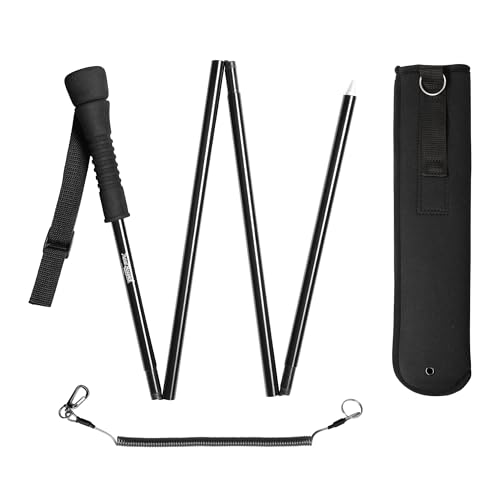
Troutbound Collapsible Aluminium Wading Staff, 55.5in
A third point of contact changes a crossing from balancing on two feet to bracing on three. Collapsible staffs live on a belt holster and deploy one handed.
Best for: Unfamiliar water, freestone rivers with rounded rock, and anyone with a knee or balance issue.

Orvis Clearwater Wading Boots, rubber sole
A rubber sole boot drilled to accept studs, which is the practical compromise in almost every jurisdiction because studded rubber grips well and does not transport organisms between watersheds the way felt does.
Best for: Anglers who fish more than one river system.

Korkers Greenback Wading Boots, felt and rubber soles
Interchangeable soles, so one boot can run rubber where felt is prohibited and felt where it is legal and the rock is genuinely slick. Check the regulations for the water you are fishing before you use the felt plates.
Best for: Anglers who travel between states with different sole rules.
Skip it if: Anyone who will never change the soles. A fixed rubber boot is lighter and simpler.

Bluestorm Cirrus 26 Inflatable PFD, USCG approved
A USCG approved inflatable worn as a slim yoke. Standard equipment for boat fishing, big water and cold conditions, and it does not restrict casting the way a foam vest does.
Best for: Cold water, big rivers, drift boats and anyone wading alone.
Skip it if: Nobody, really, though most river anglers will not wear one on a small summer stream.
Specs are the manufacturer's published figures. Prices and stock change constantly, so confirm on the retailer page. We earn commissions from Backcountry and from qualifying Amazon purchases.
For the gear side of the decision, our waders roundup and the stockingfoot versus bootfoot comparison cover fit and construction. Fit matters here for a safety reason as well as comfort: waders too large in the leg hold more water, and boots too loose over a stockingfoot come off in a swim.
Frequently asked questions
Does a wading belt stop waders from filling with water?
No, and no product makes wading safe. A snug wading belt slows the rate at which water floods the legs of your waders, which preserves your ability to swim and to get to the bank. Water still enters at the top. The belt buys you time and mobility rather than buoyancy, which is exactly why it should be cinched tight at the waist rather than worn loose.
How deep is too deep to wade?
Depth alone is the wrong question, because velocity matters more. Moving water at knee depth can take a strong adult off their feet, and the force on your legs scales with the square of water velocity, so water moving twice as fast pushes roughly four times as hard. Judge the crossing on depth and speed together, and turn back when you are unsure.
Are felt soled wading boots illegal?
In several states, yes. Felt holds water between watersheds and has been shown to transport invasive organisms including didymo and whirling disease, so a number of jurisdictions have banned felt soles outright while others have not. Regulations change, so check the current rules for the specific water you intend to fish before buying boots rather than relying on any list, including this one.
What should I do if I fall in while wading?
Get on your back with your feet pointing downstream so your legs, not your head, hit obstacles. Do not try to stand up in fast water, because a foot wedged between rocks with current pushing your body over is the classic drowning mechanism. Backstroke at an angle across the current toward the nearest bank and stand only in slow, shallow water.
How cold is too cold to wade without a plan?
Cold shock on entry is the immediate danger rather than hypothermia. An involuntary gasp underwater and a rapid loss of breathing control happen in the first minute, and fine motor control degrades within minutes after that, so knots, zips and buckles stop working. In cold water, plan the exit before you enter, fish with a partner, and keep dry clothing in the vehicle.
Do I need a wading staff, or is it overkill?
It is not overkill on freestone rivers with rounded, algae covered rock. A staff turns a two point balance into a three point brace and lets you probe depth ahead of your foot rather than discovering it with your weight already committed. A collapsible model sits in a belt holster until needed. It is genuinely useful for anyone with a knee or balance issue.
How we choose: we compare published manufacturer specifications, line and leader standards, and verified owner reviews across retailers. We do not test gear in person, and every diameter, grain weight and breaking strength quoted here is the manufacturer's published figure unless we say otherwise, so check the spool label before you trust a number. Nothing here is professional instruction. Wading moving water is the real hazard in this sport: wear a snug wading belt, know the water temperature, and turn back rather than push through a crossing you are unsure of.