Felt vs Rubber Wading Boots
Check your local regulations before you compare grip, because felt soles are banned in several states and provinces. Felt grips slick, rounded, algae covered rock better than plain rubber, but it holds water for days and transports invasive organisms including didymo and whirling disease between watersheds. Studded rubber is the practical compromise almost everywhere: it grips close to felt, dries in hours rather than days, and is legal in every jurisdiction.
This is a legal question before it is a grip question, so start there. Felt soles are banned in several states and provinces, and buying a pair for water where they are prohibited is an expensive mistake that no amount of grip makes up for. Once you have checked, the verdict is straightforward: buy studded rubber. It is legal everywhere, it grips close enough to felt on the rock that actually kills people, and it dries in hours rather than days.
Why does the regulation exist at all?
Because of what felt does after you leave the water. Felt is a dense fibrous mat that holds water in its structure for days, and that trapped water can carry living organisms from one river to another. Two are named repeatedly in the regulations: didymo, a stalked diatom that forms thick mats on riverbeds and smothers the invertebrate life trout feed on, and the myxozoan parasite responsible for whirling disease, which deforms the spine and cartilage of young salmonids.
The mechanism is unglamorous and completely plausible. A pair of felt soles goes into a vehicle damp, sits overnight in a boot bag, and gets pulled on at a different river the next morning with the fibres still wet. Anything alive in that water has been given a free ride across a watershed boundary that it could never have crossed on its own. Rubber does not do this to anything like the same degree, because a lug sole holds a film of water rather than a reservoir of it and dries quickly in open air.
That is the whole basis for the bans, and it is worth understanding rather than resenting, because it also tells you what to do if you fish felt legally: the risk lives in trapped moisture, so decontamination is a moisture problem and drying is the fix. The wading safety guide covers the same ground alongside the hazards that come before sole choice.
Which sole actually grips better on slick rock?
Felt, on the specific surface that matters most: wet, rounded, algae covered freestone cobble. That is not a marketing claim, it is why felt was the standard for decades and why anglers who fish genuinely treacherous rivers still argue for it.
The mechanism is conformity. A biofilm of algae on a smooth stone is a thin lubricating layer, and a hard rubber lug presses on it and slides. Felt fibres splay into the irregularities of the stone surface and hold against it, and the mat conforms to a rounded shape rather than balancing on the edges of lugs. On a bedrock ledge with a green sheen on it, the difference between felt and plain rubber is not subtle.
Studs change the comparison completely, and that is the fact the whole page turns on. A carbide or aluminium stud does not press on the biofilm, it punches through it and bites the rock underneath. A rubber sole fitted with roughly 10 to 20 studs concentrated at the ball and the heel grips slick stone far better than plain rubber and close enough to felt that most anglers stop noticing the difference. Boots such as the Orvis Clearwater Wading Boots, rubber sole and the Simms Freestone Wading Boots, rubber sole come drilled for studs from the factory, and studs are cheap and fitted by hand with a hex key.
| Property | Felt | Plain rubber | Studded rubber |
|---|---|---|---|
| Grip on slick rounded rock | Excellent | Fair to poor | Very good |
| Grip on bedrock with algae | Excellent | Poor | Very good |
| Grip on the bank and trail | Poor, slides on wet grass | Good | Good, noisy on hard rock |
| Grip on snow and ice | Very poor, snow balls up | Fair | Good |
| Grip on a boat deck | Fair | Good | Poor, and it damages the deck |
| Time to dry fully | 3 days | Hours | Hours |
| Invasive species risk | Highest, holds water in the fibres | Low | Low |
| Legal status | Banned in several states and provinces | Permitted everywhere | Permitted almost everywhere |
| Weight when soaked | Noticeably heavier | Minimal gain | Minimal gain |
| Sole life | Wears and compresses | Long | Long, studs replaceable |
Read the table as a whole rather than as a grip contest. Felt wins two rows decisively and loses six, and one of the six it loses is the legal one, which is not a row you can trade against the others.
What is the verdict, and who should still buy felt?
Verdict: buy rubber soled boots drilled for studs, and fit the studs. That is the right answer for the overwhelming majority of anglers because it is legal everywhere, grips well enough on the surfaces that cause falls, dries between trips, and walks properly on the bank. If you fish more than one river system, this is not a close call.
Now the honest half. Felt is still the right sole in these specific circumstances, and saying otherwise would be dishonest.
- You fish one home river, felt is legal there, and the rock is genuinely treacherous. Rounded, algae covered freestone cobble is the surface felt was made for, and if that is your only water then the transport risk is largely moot because there is nowhere to transport to.
- You wade a great deal and walk very little. Anglers who step in and stay in, rather than hiking between runs, get all of the felt advantage and very little of the felt penalty, which is mostly a bank and trail penalty.
- You have a balance or mobility issue that makes a fall serious. If the safest possible footing on slick rock genuinely matters more to you than convenience, and felt is legal where you fish, that is a reasonable and defensible priority.
- You already own felt boots and they are legal on your water. There is no reason to bin a working pair. Decontaminate them properly between watersheds and replace them with rubber when they wear out.
And the case against, stated just as plainly: do not buy felt if you travel to fish, if you have not confirmed the regulations for your water, if you hike to your water, or if you fish from a boat. Felt on a wet grass bank is genuinely dangerous, felt in a drift boat is a poor idea, and felt in a jurisdiction that has banned it is not an option at all.
What about interchangeable sole systems?
They are the honest middle path and they exist precisely because of this argument. An interchangeable boot has a chassis that accepts a sole plate, and you carry a felt plate and a rubber plate and fit whichever the water and the law call for. The Korkers Greenback Wading Boots, felt and rubber soles is the common example, and it swaps by hand at the vehicle rather than needing tools.
Be honest with yourself about whether you will use it, because that is where the value lives. An angler who genuinely fishes several states with different rules gets real use out of a swappable sole. An angler who buys the system and then leaves the same plate fitted for three years has paid for a heavier, more complex boot than a fixed rubber sole would have been, with more parts that can wear. The system also does not remove the decontamination obligation: a felt plate that lives in a bag still holds water in its fibres.
Sizing is worth flagging while you are choosing, because it catches people out. Wading boots go over the neoprene bootie of a stockingfoot wader, so you order one to two sizes over your street shoe size depending on sock thickness. Check the wader sizing chart before ordering, and read the stockingfoot against bootfoot comparison if you have not settled that question yet, because bootfoot waders make the sole decision for you.
How do you decontaminate boots properly?
This matters whatever sole you fish, because rubber lugs, laces, gravel guards and the seams of the boot all carry mud and fragments of vegetation between rivers. Felt simply makes it worse.
The routine that agencies publish is clean, drain, dry. Clean means scrub off all visible mud, sand and plant material at the access point, before the boots go in the vehicle. Drain means empty every pocket of standing water, including the inside of the boot and the gravel guards. Dry means fully dry, all the way through, not just dry to the touch.
Where a stronger treatment is called for, the commonly published options are to dry the boots completely for at least 48 hours, to soak them in hot water at about 140 degrees Fahrenheit for 10 minutes, or to freeze them solid for at least 8 hours. Local agencies publish their own protocols and some specify particular disinfectants, so follow the guidance for the water you are fishing rather than a general rule. The practical point for an angler is simple: felt takes roughly 3 days to dry properly and rubber takes hours, so a weekend of fishing two rivers is compatible with rubber and awkward with felt.
What does the sole not do for you?
This is the part that gets skipped, and it is the part that matters most. No sole makes wading safe. Wading is the real hazard in fly fishing, and the sole is a minor factor next to depth, velocity, water temperature and judgement.
A wading belt goes on every time, cinched snug at the waist. It does not make waders unsinkable, and waders full of water do not drag you under like an anchor. What they do is fill the legs with many pounds of water that destroy your ability to kick, swim and climb out. A snug belt greatly slows that flooding and buys you the mobility to reach a bank while you still have it. A Smith Creek Wading Belt, universal costs less than two spools of tippet and it is the single item most often left in the vehicle.
Moving water at knee depth can take a strong adult off their feet. Depth alone is a poor guide, because the force moving water exerts on your legs scales with the square of the water's velocity. Double the current speed and the push is roughly four times greater. That relationship, not your sole compound, is what decides whether a crossing is sensible.
| Current speed | Relative force | What it looks like | Effect at knee depth |
|---|---|---|---|
| 1 ft per second | 1x | A slow walking pace, glassy surface | Easy standing, easy crossing |
| 2 ft per second | 4x | A brisk walk, visible surface texture | Noticeable push, still manageable |
| 3 ft per second | 9x | A fast walk, standing waves forming | Hard to hold position, bracing needed |
| 4 ft per second | 16x | A jog, white water breaking on rocks | A strong adult can be taken off their feet |
| 5 ft per second | 25x | A run, continuous whitewater | Not wadeable at knee depth |
Cold water removes fine motor control within minutes, and cold shock on entry is the immediate danger rather than hypothermia. Sudden immersion triggers an involuntary gasp and a period of uncontrolled breathing, and if that gasp happens with your face underwater the consequences are immediate. After that, fingers stop working before you feel seriously cold, so knots, zips and buckles become impossible. Getting out fast matters far more than swimming well, which means deciding your exit before you enter.
Which boots should you actually buy?
Start from the legal position, then the water, then the walking. If felt is banned where you fish, the decision is made and you are choosing between rubber soled boots on fit and support. If felt is legal, ask whether your rock is genuinely the rounded, algae covered kind, and whether you fish anywhere else. Most people who ask that honestly end up on studded rubber.
For fit, the thing that matters most is not the sole at all. A boot that holds your ankle steady on uneven cobble is doing as much work as the compound underneath it, which is why a stiffer boot like the Simms Freestone Wading Boots, rubber sole is worth the money for long days on freestone rivers and worth nothing to someone wading a sand bottomed pond. The wading boots roundup lists the current picks by tier, and the waders and boots guide covers fit, layering and sizing over a stockingfoot bootie.
Wading boots and the safety kit that goes with them

Orvis Clearwater Wading Boots, rubber sole
A rubber sole boot drilled to take studs, which is the practical answer almost everywhere: it grips well once studded, dries in hours rather than days, walks properly on the bank, and passes inspection in every jurisdiction that has banned felt.
Best for: A first pair of boots for an angler who fishes more than one river system.

Korkers Greenback Wading Boots, felt and rubber soles
Interchangeable soles, so one boot runs rubber where felt is prohibited and felt where it is legal and the rock genuinely demands it. The sole plates swap by hand at the truck rather than needing tools.
Best for: Anglers who cross state lines, or who fish one very slick home river and several others.
Skip it if: Anyone who will realistically never swap a sole. A fixed rubber boot is lighter, simpler and cheaper to live with.

Simms Freestone Wading Boots, rubber sole
A stiffer, better supported boot on a Vibram rubber sole, drilled for studs. The support is the point: a boot that holds your ankle steady on uneven cobble is doing as much for your footing as the sole compound is.
Best for: Long days on freestone rivers, heavy walking, and anyone who has rolled an ankle in a soft boot.
Skip it if: Occasional summer anglers wading gravel and sand, who are paying for support they never load.
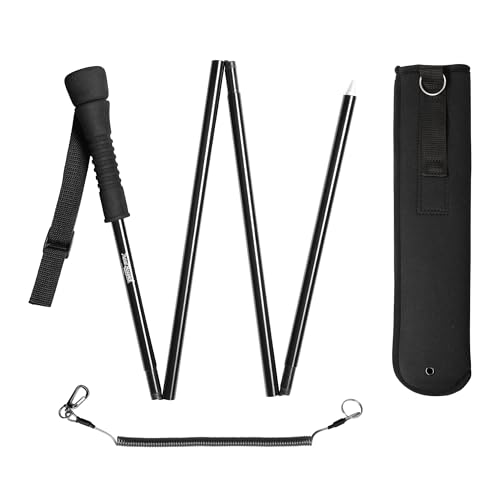
Troutbound Collapsible Aluminium Wading Staff, 55.5in
The cheapest genuine improvement in footing you can buy, and it works on any sole. A staff turns balancing on two feet into bracing on three and lets you probe depth ahead of your weight rather than discovering it with your weight already committed.
Best for: Unfamiliar water, rounded freestone cobble, and anyone with a knee or balance issue.

Smith Creek Wading Belt, universal
A belt does not make waders unsinkable. It slows the flooding that makes swimming difficult, which is the thing that decides how a fall ends. It costs less than two spools of tippet and it is the item most often left in the car.
Best for: Every angler who owns chest waders, on every trip, cinched snug.
Specs are the manufacturer's published figures. Prices and stock change constantly, so confirm on the retailer page. We earn commissions from Backcountry and from qualifying Amazon purchases.
One habit to leave with, whichever sole you buy. Clean and dry your boots between watersheds every single time, not just when you remember. It costs a few minutes at the access point and it is the single most useful thing an angler does for the water they fish. Regulations exist because enough people did not do it.
Two boots are reviewed individually here and they answer this question in opposite ways. The Korkers Greenback ships with both a felt and a sticky rubber sole, so you carry the legal option for whichever state you are in. The Simms Freestone boot takes the fixed rubber route and tunes grip with studs instead, which is fewer parts to fail.
Frequently asked questions
Are felt soled wading boots illegal?
In several states and provinces, yes. Felt holds water in its fibres for days and has been shown to transport invasive organisms between watersheds, including didymo and the parasite responsible for whirling disease, so a number of jurisdictions have banned felt soles outright while others have not. The rules change and they differ by state. Check the current regulations published by the fisheries agency for the specific water you intend to fish before buying boots.
Does felt really grip better than rubber?
On wet, rounded, algae covered rock, yes, and that is not marketing. Felt conforms to an irregular surface and holds against a thin biofilm in a way plain rubber compounds struggle to match, which is why felt was standard on freestone rivers for decades. Add carbide studs to a rubber sole and the gap closes to the point where most anglers cannot tell the difference on the water.
How long does it take to dry felt soles properly?
Longer than most anglers assume. Felt can hold moisture for days rather than hours, and boots left damp in a vehicle stay viable as a transport vector between river systems. Commonly published decontamination guidance is to clean off all mud and vegetation, then either dry the boots completely for at least 48 hours, soak them in hot water at about 140 degrees Fahrenheit for 10 minutes, or freeze them solid overnight.
Are studs worth adding to rubber boots?
Yes, on any river with rounded stone. Studs bite into rock and biofilm where a rubber lug can only press against it, and a typical sole takes roughly 10 to 20 studs concentrated at the ball and heel. They are inexpensive and user fitted with a hex key. The trade offs are noise, which spooks fish in shallow water, and poor grip on wet boat decks and painted ramps.
Can I put felt soles on a boot that came with rubber?
Only on a boot designed for it. Interchangeable sole systems accept a felt or rubber plate that locks to the boot chassis, and that is the sanctioned way to run both. Gluing felt onto a rubber soled boot is a poor idea because the bond fails wet, and a sole delaminating mid river is a real hazard. Buy the interchangeable system if you genuinely need both surfaces.
Which sole should I buy if I fish only one river?
Check whether felt is legal there first, because that decision comes before any grip comparison. If felt is banned, buy studded rubber. If felt is legal and your river is slick, rounded freestone rock, felt is a defensible choice provided you decontaminate between watersheds every time. If your river is sand, gravel or bedrock with good texture, plain rubber is fine and easier to live with.
How we choose: we compare published manufacturer specifications, line and leader standards, and verified owner reviews across retailers. We do not test gear in person, and every diameter, grain weight and breaking strength quoted here is the manufacturer's published figure unless we say otherwise, so check the spool label before you trust a number. Nothing here is professional instruction. Wading moving water is the real hazard in this sport: wear a snug wading belt, know the water temperature, and turn back rather than push through a crossing you are unsure of.