Stockingfoot vs Bootfoot Waders
Buy stockingfoot waders and separate wading boots. The separate boot gives ankle support and a sole matched to the riverbed, which is what decides footing on uneven rock, and it can be replaced without replacing the waders. Order boots one to two sizes over your street shoe to fit the neoprene bootie. Bootfoot waders are still the right choice for very cold water, waterfowl style use and deep mud, where warmth and getting in and out quickly matter more than traction.
Verdict: buy stockingfoot waders with separate boots. For trout fishing it is not close, and the reason is footing rather than fashion. A wading boot is a boot: it supports the ankle, it takes a sole chosen for the rock you actually walk on, and when it wears out you replace a boot rather than a pair of waders. A bootfoot wader is a rubber boot glued to a leg, and everything it gives up, it gives up at the ankle. It remains the right answer in a few specific situations, all of which are covered further down.
The definition first, because the names are unhelpful. A stockingfoot wader ends in a shaped neoprene sock, and you pull a separate wading boot over it. A bootfoot wader has a rubber boot bonded permanently to the end of the leg. Everything else about the two, fabric, chest height, seams, suspenders, can be identical. The entire difference is what happens below the ankle.
Why does the separate boot matter so much?
Because a riverbed is not a floor. Freestone rivers are made of rounded cobble the size of a fist or a football, shifting under your weight, coated in biofilm, at odd angles and under moving water that is already pushing you sideways. Your ankle is doing constant work, and how well it is supported determines whether an awkward step is a stumble or a fall.
Support. A wading boot is built like a hiking boot: a stiff sole plate, a structured upper, a lace system that holds the heel down and the ankle steady. A bootfoot is built like a wellington: soft, unstructured, and free to roll. On flat sand or a soft mud bottom that makes no difference at all. On cobble it makes a great deal of difference, and it makes more of it as the day gets longer and your legs get tired.
Sole choice. With a stockingfoot system, the sole is a decision you get to make. You can buy a rubber sole drilled for studs, fit studs for slick rock, or use an interchangeable system such as the Korkers Greenback Wading Boots, felt and rubber soles where legal. With a bootfoot you take the sole the manufacturer bonded on, and it is usually a plain rubber lug pattern chosen for cost and mould release rather than for grip on algae. The felt against rubber comparison covers why that choice matters and why felt is banned in several states and provinces.
Replacement economics. Boots wear out faster than waders. In a stockingfoot system that costs you a boot. In a bootfoot system a worn sole or a split boot means the whole garment is finished, because the bond between boot and leg is not a serviceable joint. Over ten years of fishing, that is the difference between buying three pairs of boots and buying three pairs of waders.
Fit. Feet and legs are not proportional to each other. A stockingfoot system lets you buy a wader that fits your inseam and a boot that fits your foot. A bootfoot forces one size decision to cover both, and the usual result is a boot that is loose, because manufacturers size up to make sure the wader can be pulled on. A loose boot on a river bottom is exactly the wrong thing.
| Property | Stockingfoot plus boot | Bootfoot | Which wins |
|---|---|---|---|
| Ankle support | Structured boot, laced | Soft, unsupported | Stockingfoot, decisively |
| Sole options | Rubber, studs, interchangeable | Whatever is bonded on | Stockingfoot |
| Fit precision | Two independent sizes | One size covers both | Stockingfoot |
| Warmth in cold water | Neoprene compressed by the boot | Air space around the foot | Bootfoot, clearly |
| Time to put on | 2 to 3 min | Under 1 min | Bootfoot |
| Walking distance to the water | Comfortable for miles | Tiring past a short walk | Stockingfoot |
| Deep soft mud | Boot can be pulled off the foot | Boot stays attached to the leg | Bootfoot |
| Grit and sand ingress | Needs gravel guards | Sealed, nothing gets in | Bootfoot |
| Replacing worn footwear | Buy a boot | Buy the whole wader | Stockingfoot |
| Packing for travel | Two items, boots pack heavy | One bulky item | Draw |
| Entry system price | Under $300 | Often lower | Bootfoot on price alone |
What does a stockingfoot system actually cost?
Two purchases instead of one, and it is worth seeing the real numbers rather than guessing, because the sticker on a pair of waders is only half of the cost of getting into the water.
At the entry level, a Frogg Toggs Hellbender Stockingfoot Chest Waders at under $100 with a pair of Orvis Clearwater Wading Boots, rubber sole at under $250 comes to under $300 for the complete system. Note the ratio: the boots cost roughly twice the waders. That is not a mistake in the shopping list, it is where the value sits, because the boot is doing the work that keeps you upright.
A step up, Orvis Clearwater Chest Waders at under $500 with the same boots comes to under $500. At the hard use end, Simms Freestone Stockingfoot Waders at under $500 with Simms Freestone Wading Boots, rubber sole at under $250 comes to under $750.
If your budget is fixed, put the money into the boots before the waders. Cheap breathable waders keep you dry for a few seasons and then leak, which is annoying. Cheap boots have soft ankles and poor soles, which is how people fall over. The waders roundup and the wading boots roundup list the current picks at each tier.
How do you size boots over stockingfoot waders?
Order one to two sizes over your normal street shoe size. This is the single most common ordering mistake in fly fishing and it is entirely avoidable.
The neoprene bootie on a stockingfoot wader is typically 3 to 4 millimetres thick, wraps the whole foot, and is worn over a wading sock. That is a real volume of material, and a boot sized to your bare foot will crush it. A crushed bootie means cold feet, because compressed neoprene stops insulating, and it means restricted circulation, which in cold water is how people end up unable to feel their footing at all. Size up 1 if you wear a thin sock, 2 if you wear a thick one or fish genuinely cold water.
Sizing is not consistent between brands, so check the manufacturer chart rather than assuming, and the wader sizing chart covers the wader side, where the variables are inseam and chest as well as foot. The waders and boots guide works through trying the system on together, which is the only way to know for certain.
While you are fitting: use the gravel guards. A gravel guard is the fabric cuff on the wader leg that pulls down over the boot top, usually with a lace hook, and it stops sand and small stones falling into the boot. Grit inside a boot grinds against the bootie all day and is one of the two most common ways stockingfoot waders fail. Bootfoot waders have no equivalent problem, which is a genuine point in their favour.
Where does bootfoot still win?
In four situations, and they are real. Anyone who tells you bootfoot waders are obsolete does not fish the water they are made for.
- Very cold water, standing still for hours. This is the strongest argument. A bootfoot has an air space around the foot rather than a boot squeezing a neoprene bootie against it, and trapped air insulates. Winter steelhead anglers and anyone standing in near freezing water through a morning will feel that difference within the first hour.
- Waterfowl style use, in and out repeatedly. If your day involves getting into waders in the dark, out of them at a truck, and back into them an hour later, the difference between under a minute and two or three minutes each time adds up, and lacing boots with cold hands is genuinely unpleasant.
- Deep soft mud. In sucking mud, a laced wading boot can be pulled clean off a stockingfoot bootie, which leaves you standing in a river in a neoprene sock. A bootfoot cannot do this, because the boot is part of the leg. Estuary, marsh and soft bottomed lake margins are bootfoot country.
- Short walks to flat, forgiving bottoms. If you park at the water and wade sand, silt or gentle gravel, you are paying for ankle support you never load. A bootfoot is faster, simpler and usually cheaper.
And plainly the other way: skip bootfoot if you walk any distance to your water, if you wade freestone cobble, if you fish rivers with current, or if you want to choose your own sole. That covers the overwhelming majority of trout fishing, which is exactly why stockingfoot dominates it.
Waders, boots and the belt that goes with them
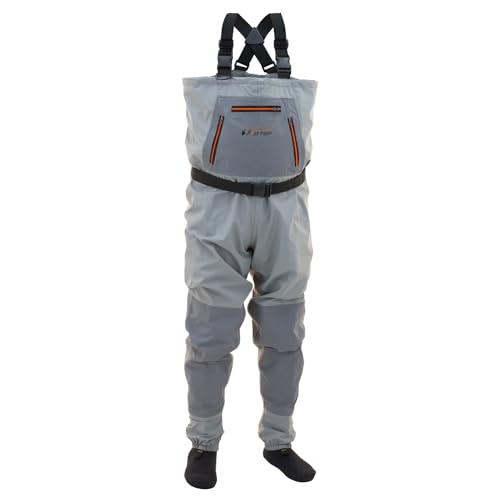
Frogg Toggs Hellbender Stockingfoot Chest Waders
A breathable stockingfoot chest wader at a price that used to buy a rubber bootfoot. Breathable fabric is why stockingfoot took over: you can wear it on a warm day without cooking, and you can layer under it when the water turns cold.
Best for: A first pair of waders, and a spare pair once you own something better.

Bassdash Immerse Women's Breathable Stockingfoot Waders
The same idea cut for a womens frame, which matters more than it sounds. Waders that are too long in the leg and too generous in the seat hold water in a fall and catch current while you wade, so fit is a safety property and not just a comfort one.
Best for: Women buying a first pair rather than sizing down a mens wader.

Orvis Clearwater Wading Boots, rubber sole
The other half of a stockingfoot system, and the half that does the work. A supportive rubber soled boot drilled for studs grips well, dries in hours, and is legal in the jurisdictions that have banned felt.
Best for: Pairing with any stockingfoot wader, ordered one to two sizes over your street shoe.

Orvis Clearwater Chest Waders
Four layer construction with proper neoprene booties, which is the component people ignore and then regret. A well shaped bootie fills a boot evenly instead of bunching, and a bunched bootie is a blister by lunchtime.
Best for: The second pair, bought after a cheap pair has told you what you actually want.

Simms Freestone Stockingfoot Waders
A heavier five layer leg over a four layer upper, which puts the durability where waders actually fail: the knees, the seat and everything that meets brush. This is a buy once wader for anglers who fish a hundred days a year.
Best for: Hard use, long seasons, and anglers who have worn out two cheaper pairs.
Skip it if: Occasional anglers. A wader that lives in a garage for eleven months does not need five layer legs, and the fabric will outlast your interest in it.

Smith Creek Wading Belt, universal
Non negotiable with any chest wader, stockingfoot or bootfoot. It does not make waders unsinkable. It slows the flooding that destroys your ability to swim and climb out, and that is the thing that decides how a fall ends.
Best for: Every trip, cinched snug, without exception.
Specs are the manufacturer's published figures. Prices and stock change constantly, so confirm on the retailer page. We earn commissions from Backcountry and from qualifying Amazon purchases.
How do you make a stockingfoot system last?
Waders fail in predictable places, and almost all of it is preventable. Breathable fabric does not wear out from fishing, it wears out from storage and from grit.
Dry them inside and out after every trip. Hang them upside down until the inside is dry, then the right way up. Sweat and condensation inside the leg are what lift seam tape over a season, and a wader folded damp into a boot bag is the fastest way to ruin one. Never store them in a hot vehicle, because heat is what degrades the adhesive on taped seams.
Use the gravel guards and rinse the booties. Sand that gets past the guard sits between the neoprene and the boot and grinds with every step. A few seconds of rinsing at the end of a day removes it, and that is most of what keeps a bootie intact.
Carry a repair kit and use it early. A pinhole at the knee is a five minute fix with a patch and it becomes a tear if you fish it for a month. Find leaks by turning the waders inside out and wiping the suspect area with rubbing alcohol, which darkens at the hole.
Replace boots on their own schedule. This is the whole structural advantage of a stockingfoot system, so use it. When the sole is polished smooth or the ankle has gone soft, buy boots and keep the waders. A pair of Simms Freestone Wading Boots, rubber sole fitted to a three year old pair of waders is a better outfit than new waders with worn boots, every time.
What does neither type do for you?
Neither type makes wading safe. Wading is the real hazard in this sport, and no wader, boot, sole or price point changes that. The habits below matter more than everything above.
A wading belt goes on every single time, cinched snug at the waist. Understand exactly what it does: it does not make waders unsinkable, and flooded waders do not drag you under like an anchor. What flooded waders do is fill the legs with many pounds of water that destroy your ability to kick, swim and climb out onto a bank. A snug belt greatly slows that flooding and buys you mobility while you still have it. A Smith Creek Wading Belt, universal costs less than two spools of tippet, many waders ship with one, and it is the item most often left in the vehicle.
Moving water at knee depth can take a strong adult off their feet. Depth is a poor guide on its own, because the force the current exerts on your legs scales with the square of water velocity. Double the speed and the push is roughly four times greater.
| Current speed | Relative force | Effect at knee depth |
|---|---|---|
| 1 ft per second | 1x | Easy standing, easy crossing |
| 2 ft per second | 4x | Noticeable push, still manageable |
| 3 ft per second | 9x | Hard to hold position, bracing needed |
| 4 ft per second | 16x | A strong adult can be taken off their feet |
Cold water removes fine motor control within minutes, and cold shock on entry is the immediate danger rather than hypothermia. Sudden immersion triggers an involuntary gasp and uncontrolled breathing, and if that happens with your face underwater the consequences are immediate. Fingers then stop working before you feel seriously cold, so buckles, zips and knots become impossible. Getting out fast matters far more than swimming well, which means knowing which bank you can climb before you enter.
One fit point that belongs in the safety section rather than the comfort one: waders that are much too large in the leg hold more water in a fall and catch more current while you wade, and boots that are too loose over a bootie can come off in a swim. Buying the right size is not vanity, it is part of the same decision as the belt.
If stockingfoot is where you have landed, remember it is half a purchase. The Simms Tributary review and the Simms Freestone review cover the wader half at two price points, and the Simms Freestone boot review covers the boot that has to go over it, including why you size up over a neoprene bootie.
Frequently asked questions
What is the difference between stockingfoot and bootfoot waders?
A stockingfoot wader ends in a neoprene sock, and you wear a separate wading boot over it. A bootfoot wader has a rubber boot bonded permanently to the leg, so the whole thing goes on in one motion. Stockingfoot dominates trout fishing because the separate boot provides ankle support and a proper sole, and because a worn out boot can be replaced without replacing the waders.
What size wading boots do I need over stockingfoot waders?
Order one to two sizes over your normal street shoe size. The neoprene bootie plus a wading sock takes up real volume, and a boot that fits your bare foot will crush your toes and cut circulation in cold water. Size up one if you wear a thin sock and two if you wear a heavy one. Check the manufacturer sizing chart, because wading boot sizing is not consistent between brands.
Are bootfoot waders warmer than stockingfoot?
Yes, meaningfully, and it is their strongest argument. A bootfoot has a large air space around the foot rather than a boot compressing a neoprene bootie against it, and that trapped air insulates. In genuinely cold water, standing still for hours, that difference is the gap between a comfortable morning and a painful one. It is why bootfoot survives in steelhead and waterfowl use.
Do stockingfoot waders need gravel guards?
Yes. A gravel guard is a fabric cuff that pulls down over the top of the boot and stops sand and small stones dropping into it. Without one, grit collects around the bootie, grinds against the fabric with every step and wears through the neoprene, which is one of the two most common ways stockingfoot waders fail. Most breathable waders include them built onto the leg.
Which type is safer to wade in?
Stockingfoot, for one reason: the separate boot gives real ankle support and a sole chosen for the riverbed. Bootfoot waders generally have softer ankles and less aggressive soles, so footing on uneven cobble is worse. No wader of either kind is safe on its own. A snug wading belt, a staff and a willingness to turn back decide far more than the wader style does.
How long do breathable stockingfoot waders last?
It depends far more on care than on price. Most failures are pinholes at the knee and seat from brush and kneeling, seam tape lifting after repeated hot storage, and bootie wear from grit inside the boot. Hang them dry inside and out after every trip rather than folding them damp, use gravel guards, and carry a repair kit. Two to five seasons of regular use is a fair expectation.
How we choose: we compare published manufacturer specifications, line and leader standards, and verified owner reviews across retailers. We do not test gear in person, and every diameter, grain weight and breaking strength quoted here is the manufacturer's published figure unless we say otherwise, so check the spool label before you trust a number. Nothing here is professional instruction. Wading moving water is the real hazard in this sport: wear a snug wading belt, know the water temperature, and turn back rather than push through a crossing you are unsure of.