Wader Sizing Chart and Boot Fit Guide
Stockingfoot chest waders are sized by three measurements together, shoe size plus height and inseam plus chest and waist, rather than by a single number, which is why the size codes read as M, MK and LS. Wading boots then go up one to two sizes over your street shoe because they must fit over a neoprene bootie and a wading sock. Stout sizing adds girth at the same height, king sizing adds height and inseam.
Stockingfoot chest wader sizing is a three dimensional fit rather than a single number: shoe size, plus height and inseam, plus chest and waist, all at once. That is why the size codes on a wader chart read as S, M, MK and LS rather than as a waist measurement, and it is why a wader that fits your chest perfectly can still be unwearable. The bootie is attached to the wader body, so your foot size and your torso size have to be satisfied by the same garment.
The second half of the problem is the boots, and it catches almost everyone once. Wading boots go up one to two sizes over your street shoe, because they fit over a neoprene bootie and usually a wading sock as well. Ordering boots in your street size is the single most common mistake in this category, and the result is cold, numb feet within an hour, which is a stability problem before it is a comfort problem.
What size chest waders should I buy?
The table below is a typical breathable stockingfoot size chart. Read it as a starting point, then check the chart published by the specific maker before you order, because there is no industry standard for wader sizing and cut varies noticeably between brands in the chest, the thigh and the rise.
| Code | Size | Shoe | Height | Chest | Waist | Inseam |
|---|---|---|---|---|---|---|
| S | Small | 7 to 8 | 5 ft 4 in to 5 ft 8 in | 34 to 36 | 30 to 32 | 28 to 30 |
| M | Medium | 8 to 9 | 5 ft 6 in to 5 ft 10 in | 38 to 40 | 32 to 34 | 30 to 32 |
| MS | Medium Stout | 8 to 10 | 5 ft 6 in to 5 ft 10 in | 40 to 43 | 36 to 39 | 30 to 32 |
| MK | Medium King | 9 to 11 | 5 ft 10 in to 6 ft 1 in | 39 to 41 | 34 to 36 | 32 to 34 |
| L | Large | 10 to 11 | 5 ft 10 in to 6 ft 1 in | 42 to 44 | 36 to 38 | 32 to 34 |
| LS | Large Stout | 10 to 12 | 5 ft 10 in to 6 ft 1 in | 45 to 48 | 40 to 43 | 32 to 34 |
| LK | Large King | 11 to 13 | 6 ft 1 in to 6 ft 4 in | 43 to 45 | 38 to 40 | 34 to 36 |
| XL | Extra Large | 12 to 13 | 6 ft 0 in to 6 ft 3 in | 46 to 48 | 40 to 42 | 33 to 35 |
| XLK | Extra Large King | 13 to 14 | 6 ft 3 in to 6 ft 6 in | 47 to 49 | 42 to 44 | 35 to 37 |
Work down the columns rather than across the rows and the logic becomes visible. Large and Large King share a chest measurement and differ by three inches of height and two of inseam. Large and Large Stout share a height and differ by three inches of chest and four of waist. Stout solves girth. King solves length. That is the whole system, and once you know which of the two problems you have, the chart stops being confusing.
A wader that fits your chest but pulls hard when you kneel wants a king cut. A wader that fits your height but is tight around the middle wants a stout cut. Buying a size larger to solve either problem gives you the wrong thing: more of every dimension including the ones that already fitted, which produces baggy legs that trap air and catch on brush.
How do I measure myself for waders?
Six measurements, taken over the layers you actually fish in rather than over a shirt. That last detail matters more than any of the numbers. A wader measured over a t-shirt and then worn over a fleece and a base layer in cold water is a size too small when you need it most.
| Measurement | How to take it | What it decides |
|---|---|---|
| Chest | Around the fullest part of the chest, under the arms, tape level and snug but not tight | Sets the size band on a chest wader, and it must be taken over the layers you actually fish in |
| Waist | Around the natural waist, roughly at the navel, standing relaxed rather than holding your breath | Decides whether you need stout sizing, and whether a wading belt will sit correctly |
| Inseam | From the crotch to the floor, in socks, standing straight against a wall | The measurement most people skip and the one that decides whether you can step up onto a rock |
| Height | Barefoot against a wall | Combined with inseam, it tells you whether you need a king size or a stout one |
| Shoe size | Your normal street shoe size in the same system the maker uses | Wader bootie size is tied to the wader body size on most models, so this can force your size band |
| Thigh | Around the fullest part of the thigh | Worth taking if you are muscular through the legs, because leg cut is where cheap waders fail first |
Inseam is the measurement people skip and the one that decides most of the fit. Wader inseam has to accommodate the crotch riding down when you take a long step, kneel on a bank, or climb over a log. If the inseam is short, every one of those movements pulls the shoulder straps into your shoulders and, more importantly, shortens your stride in current, which is a stability problem rather than a comfort one.
What size wading boots go over stockingfoot waders?
One size up for thin booties and light socks, two sizes up for thick booties, heavy merino socks or cold water. The table gives both, and the honest answer is that you should confirm against the specific boot, because some makers already build extra volume into a wading last and some do not.
| Street shoe | Boot, plus one | Boot, plus two | Note |
|---|---|---|---|
| 8 | 9 | 10 | Light socks, thin booties |
| 9 | 10 | 11 | The most common trout wading size |
| 10 | 11 | 12 | Standard fit with a merino wading sock |
| 11 | 12 | 13 | Standard fit |
| 12 | 13 | 14 | Check the brand, larger sizes vary more |
| 13 | 14 | 15 | Confirm availability before you commit to the waders |
A boot that is too small does three bad things at once. It compresses the neoprene bootie, which removes the insulation you paid for. It restricts circulation, so your feet go numb, and numb feet cannot feel what they are standing on. And it wrinkles the bootie, which produces a blister within an hour and a hole in the bootie within a season. A boot that is too large lets the heel lift on rock, which causes falls, and in a genuine swim a loose boot can come off entirely.
Sole choice is the other half of the boot decision and it carries a legal dimension, so it is covered in the safety section below. Boots such as the Orvis Clearwater Wading Boots, rubber sole and the Simms Freestone Wading Boots, rubber sole come drilled for studs, and an interchangeable sole boot like the Korkers Greenback Wading Boots, felt and rubber soles lets one pair run different soles in different jurisdictions. Our felt against rubber comparison and the wading boot roundup go into the trade off properly.
Waders, boots and the belt, by tier
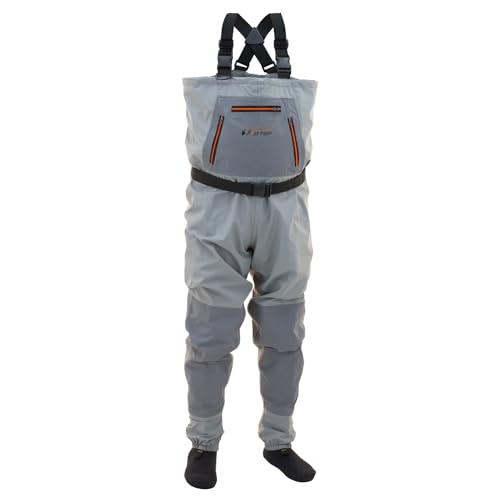
Frogg Toggs Hellbender Stockingfoot Chest Waders
A breathable stockingfoot chest wader at the entry price, which is the correct first purchase because stockingfoot waders let you choose the boot separately and get the sole material right for your water.
Best for: A first season, and anyone who is not yet sure how much they will wade.
Skip it if: Hard year round use. Entry level fabrics abrade faster at the knees and seams.

Bassdash Immerse Women's Breathable Stockingfoot Waders
A women specific breathable stockingfoot cut. Wader fit is genuinely different across hips, inseam and chest, and a mens size that fits the chest will usually be wrong everywhere else.
Best for: Anyone for whom a mens cut has never fitted properly.

Orvis Clearwater Chest Waders
Four layer construction with neoprene booties, in a full run of sizes including stout and king variants, which is what makes a good fit achievable rather than a compromise.
Best for: The buy once wader for someone fishing regularly through the season.

Simms Freestone Stockingfoot Waders
A four layer upper with a five layer leg, which puts the heavier fabric where abrasion actually happens, and a size run deep enough to fit awkward proportions properly.
Best for: Hard use across seasons, brushy banks and cold water.
Skip it if: A first pair. The extra durability is real and a beginner will not reach the failure point of a cheaper wader for several seasons.

Orvis Clearwater Wading Boots, rubber sole
A rubber soled boot drilled to take studs, which is the practical compromise in almost every jurisdiction. Size it one to two sizes over your street shoe to fit over neoprene booties.
Best for: Anglers who fish more than one river system.

Smith Creek Wading Belt, universal
The cheapest safety item in fly fishing and the one most often left in the car. A belt does not make waders unsinkable, it slows the flooding that destroys your ability to swim and climb out.
Best for: Every angler who owns waders, on every single trip, cinched snug.
Specs are the manufacturer's published figures. Prices and stock change constantly, so confirm on the retailer page. We earn commissions from Backcountry and from qualifying Amazon purchases.
How do I check the fit once they arrive?
Put them on over the layers you will fish in, indoors, with the tags on, and run through this list before the waders touch water. Almost every fit failure shows up in movement rather than in a mirror.
- Kneel down fully on both knees. The crotch should not drag the shoulder straps hard into your shoulders.
- Raise one knee to hip height, then higher. If the crotch pulls down or the straps bite, the inseam is too short.
- Step up onto something knee height. This is the single best test, and it is where undersized waders fail.
- Check for roughly 2 to 3 inches of slack around each calf. Waders that grip the leg restrict blood flow and get cold fast.
- Fasten the wading belt. It must sit above the depth you actually wade to and cinch snug without riding up.
- Reach across your body and make a full casting stroke. Shoulder straps should not limit the arc.
- Feel the neoprene booties inside the boot. They must lie flat, because a wrinkle becomes a blister in an hour.
- Check the gravel guard reaches over the boot collar and the lace hook engages.
- Sit down on a chair. If the front panel bunches hard into your stomach, size up or go stout.
The step up test is the one that matters most. Find something roughly knee height, put a foot on it, and transfer your weight up onto it. If the crotch pulls down hard or the straps dig in, the waders are short in the inseam and you will take shorter, less confident steps in current forever. That is precisely the situation in which people fall.
What do the common fit problems actually cost you?
Each one has a comfort cost that people notice and a safety cost that they usually do not. The table pairs them.
| Problem | How it shows | Why it matters in the water | Fix |
|---|---|---|---|
| Waders too small | Crotch pulls down, straps bite, you cannot lift a knee to step up | You take shorter, less stable steps in current, and you cannot climb out of the water easily | Size up, or move to a stout or king cut rather than a bigger overall size |
| Waders too large | Bagging around the legs, fabric flapping, boots feel loose | Excess fabric traps air, which makes you buoyant at the legs and unstable, and it snags on brush | Size down, or choose a maker with a slimmer cut rather than compensating with a tighter belt |
| Boots too small | Toes touching, booties wrinkling, cold feet within an hour | Numb feet mean you cannot feel the bottom, which is a real stability problem in current | Go up one to two sizes over your street shoe |
| Boots too large | Heel lift, the boot swimming on your foot when wet | A loose boot can come off entirely in a swim, and heel lift causes falls on rock | Add a thicker wading sock, or go down a size and confirm the bootie lies flat |
| Right size, wrong cut | Chest fits and legs are baggy, or legs fit and the chest is tight | Chafing, restricted movement and cold spots | Try a stout or king variant, or a different brand. Cut varies more between makers than size labels suggest |
The bagging problem is worth expanding because it is frequently sold as a virtue. Waders that are too large trap air in the legs. Trapped air makes your legs buoyant while your torso is not, which is the least helpful possible distribution if you go in, and it also inflates the profile you present to the current so the water pushes harder on you. Excess fabric is not extra comfort, it is extra surface area.
Wading safety, which is the real reason fit matters
Wading is the genuine hazard in this sport, and the fit decisions above are safety decisions before they are comfort decisions. Nothing on this page is professional instruction and no product makes wading safe. Judgement does that.
Moving water at knee depth can take a strong adult off their feet. The force the current applies scales with the square of water velocity, so water moving twice as fast pushes roughly four times as hard. Depth alone is a poor guide to whether a crossing is safe, and the combination of depth and speed is what decides. A useful field check: if you cannot comfortably hold your position standing still, you cannot recover from a stumble either.
Cold water removes fine motor control within minutes. Cold shock on entry is the immediate danger rather than hypothermia. Sudden immersion triggers an involuntary gasp and a period of uncontrolled breathing, and if that gasp happens underwater the consequences are immediate. Fingers stop working long before you feel seriously cold, so knots, zips and buckles stop being available to you. Getting out fast matters far more than swimming well.
Two more items belong in the same conversation. A Troutbound Collapsible Aluminium Wading Staff, 55.5in turns balancing on two feet into bracing on three and lets you probe depth before committing your weight, which is genuinely useful on freestone rivers with rounded rock and for anyone with a knee or balance issue. A low profile Bluestorm Cirrus 26 Inflatable PFD, USCG approved is standard equipment for boat fishing, big water and cold conditions, and modern inflatable yokes do not interfere with casting.
Where does this chart stop being reliable?
In three places, and the first is the important one.
There is no standard, so brands differ significantly. A Large from one maker can fit like a Medium King from another, particularly through the chest and the rise. The table on this page is a typical composite and it exists to teach you the system rather than to replace the chart on the product page. Always check the maker's own measurements, and where a retailer offers free returns, order the size you calculate and be prepared to exchange once.
Women specific and youth cuts are not scaled down mens sizes. Hip to waist ratio, inseam relative to height and chest shape all differ, and a mens wader sized to fit the chest will usually be wrong at the hip and the inseam. A women specific cut such as the Bassdash Immerse Women's Breathable Stockingfoot Waders exists because the difference is real, not as a colourway.
Bootfoot waders follow different rules entirely. A bootfoot wader has the boot built in, so there is no stockingfoot to size over and you order in your street shoe size, or occasionally one up for a thick sock. They are warmer and faster to put on and they give up ankle support and sole choice. Our stockingfoot against bootfoot comparison covers the decision, and if you are still choosing between models the waders and boots guide and the waders roundup take it from here.
Frequently asked questions
How do I know what size chest waders to buy?
Take three measurements rather than guessing from a single number: your shoe size, your height with inseam, and your chest and waist over the layers you actually fish in. Chest waders are sized by all three together, which is why the size codes look like S, M, MK and LS rather than a simple number. Then check the specific maker chart, because there is no industry standard and cut varies noticeably between brands.
What do stout and king wader sizes mean?
They solve two different problems. Stout adds girth at the chest and waist while keeping the same height and inseam, so it fits a broader build of ordinary height. King adds height and inseam with a modest girth increase, so it fits a taller build. If a size fits your chest but pulls when you kneel, you want king. If it fits your height but is tight around the middle, you want stout.
What size wading boots do I need over stockingfoot waders?
One to two sizes over your normal street shoe. Wading boots go over a neoprene bootie and usually a wading sock as well, which adds real bulk around the foot. Going up one size suits thin booties and light socks, and two sizes suits thick booties, heavy merino socks or cold water fishing. Boots that are too small compress the bootie, restrict circulation and make your feet cold within an hour.
Should waders be tight or loose?
Neither. You want roughly 2 to 3 inches of slack around each calf and enough inseam to kneel fully and step up onto knee height rock. Too tight and you cannot move, cannot climb out and restrict circulation. Too loose and excess fabric traps air, which makes you unstable in current and catches on brush. Fit is checked by movement, not by looking in a mirror.
Does a wading belt need to go over the top of waders?
Yes, over the outside and cinched snug at the waist, high enough to sit above the depth you actually wade to. A belt does not make waders unsinkable, and waders full of water do not pull you under like an anchor. What it does is greatly slow the flooding that fills the legs with pounds of water and destroys your ability to kick, swim and climb out onto a bank.
Should I buy felt or rubber soled wading boots?
Studded rubber is the practical answer almost everywhere. Felt grips slick rounded rock better than plain rubber, but it holds water for days and has been shown to transport invasive organisms including didymo and whirling disease between watersheds. Felt soles are banned in several states and provinces, and the rules change, so check the current regulations for the specific water you intend to fish before you buy.
How we choose: we compare published manufacturer specifications, line and leader standards, and verified owner reviews across retailers. We do not test gear in person, and every diameter, grain weight and breaking strength quoted here is the manufacturer's published figure unless we say otherwise, so check the spool label before you trust a number. Nothing here is professional instruction. Wading moving water is the real hazard in this sport: wear a snug wading belt, know the water temperature, and turn back rather than push through a crossing you are unsure of.