Best Fly Fishing Waders
Buy breathable stockingfoot chest waders, not neoprene bootfoots. The Orvis Clearwater Chest Waders at under $500 are the buy-once pair for most trout anglers, and the Frogg Toggs Hellbender at under $100 is the honest starting point. Whatever you buy, wear a wading belt cinched snug every single time: it does not make waders unsinkable, it slows the flooding that stops you swimming.
A pair of waders is the item that decides whether you fish in cold water or stand on the bank watching it. The decision has four parts and only four: breathable rather than neoprene, stockingfoot rather than bootfoot, the right size in the leg rather than the chest, and a wading belt worn every time. Everything else, the pocket layout, the fabric branding, the colour, is preference. The picks below are separated by how many fabric layers sit between you and a gravel bar and by whether the maker offers a size that actually fits your build, which is the part budget lines quietly skip.
What are breathable waders, and why do they beat neoprene?
A breathable wader is a laminated waterproof garment built from two or more bonded fabric layers, where the membrane blocks liquid water from outside while letting water vapour from your own sweat pass out. Neoprene is a closed-cell foam rubber, the same material as a wetsuit: it insulates well and it breathes not at all.
That difference decides more than comfort. Walk half a mile to a run in neoprene on a warm afternoon and you arrive soaked from the inside, and wet base layers are exactly what makes you cold once you stop moving and stand in a river. Breathable waders move that moisture out, which is why you regulate temperature with what you wear underneath rather than with the wader itself. Fleece leggings and a merino base under a breathable pair covers colder conditions than a bare neoprene wader does, and strips down for a warm evening in a way neoprene never can.
There is a narrow case left for neoprene: sitting still, for hours, in genuinely icy water, typically stillwater from a float tube or a late season steelhead swing where you never walk far. Almost nobody reading a trout gear page is in that case. Buy breathable.
How many fabric layers do you actually need?
Layer count is the honest spec on a breathable wader, and it is the number that separates the price tiers far more than brand does. A layer count describes how many bonded plies make up the laminate. More plies means more abrasion resistance and more weight, and the good makers put the heavy laminate only where it is needed.
The Simms Freestone Stockingfoot Waders is the clearest example of that idea: a four layer upper over a five layer leg. The upper stays lighter and more breathable because nothing scrapes your chest, while the leg takes the gravel, the willow stems and the constant rub of a boot cuff. The Orvis Clearwater Chest Waders uses four layer construction throughout, which is the sensible middle. Budget pairs such as the Frogg Toggs Hellbender Stockingfoot Chest Waders run a lighter laminate everywhere, which is why they weigh less, cost less and wear through sooner.
| Tier | Price | Layers | Seams | Typical service life |
|---|---|---|---|---|
| Budget breathable | Under $100 | 3 | Taped, standard | 1 to 3 seasons |
| Womens specific budget | Under $250 | 3 | Taped, standard | 1 to 3 seasons |
| Mid tier | Under $500 | 4 | Taped, reinforced crotch | 3 to 5 seasons |
| Premium | Under $500 | 4 upper, 5 leg | Taped and reinforced throughout | 5 seasons and up |
The full spread here is 4.5 times from the cheapest pair to the dearest, and that ratio is worth sitting with. If you fish six days a season, a budget pair will not fail from use, it will fail from age and storage, and paying four times as much buys durability you never draw down. If you fish sixty days a season the arithmetic reverses completely, because you will buy three budget pairs in the time one premium pair lasts and spend three afternoons hunting pinholes.
Stockingfoot or bootfoot, and why does almost everyone say stockingfoot?
A stockingfoot wader ends in a closed neoprene sock and requires a separate wading boot worn over it. A bootfoot wader has a rubber boot bonded permanently to the leg.
Stockingfoot wins for three reasons. First, fit: a boot sized to your foot over a snug bootie supports the ankle properly, and ankle support is what keeps you upright on rounded rock. Second, sole choice: you pick rubber, studded rubber or felt to suit the substrate and the local regulations, which a bonded boot never lets you do. Third, failure isolation: when the boot wears out you replace a boot, not the whole system.
Bootfoot keeps two honest advantages. It is faster to put on and take off, which matters if you change access points all day, and there is no bootie and no laces to fill with ice, which is why winter steelhead anglers still buy them. If you want that argument laid out in full, the stockingfoot versus bootfoot comparison goes through it properly. For a first pair, buy stockingfoot and a separate boot.
What size waders should you buy, and what is the stout and king problem?
Wader sizing is not clothing sizing and treating it as such is the most common ordering mistake. Three measurements matter, in this order: inseam, bootie size, then chest.
Inseam is first because the crotch seam is the highest stress point in the garment. Every time you lift a knee onto a rock or step up a bank, that seam takes the load. Waders that are short in the leg keep that seam under permanent tension and it is where the vast majority of premature leaks appear. If you are between sizes, take the longer inseam and accept the slight bag.
Bootie size is second, and it is the spec that silently ruins a wading boot purchase. The bootie is a fixed size tied to the wader size, and your wading boot has to fit over it. If the bootie is a size too big your boot is too tight and your foot goes numb, and if the bootie is too small your heel lifts inside the boot and the bootie wears through at the heel within a season.
Chest is last because a loose chest is only baggy, and a wading belt takes up the slack anyway.
Now the part the marketing pages avoid. Stout and king sizes are cut with additional room through the waist and seat at the same inseam, rather than simply scaling the whole garment up. A larger angler with ordinary length legs needs exactly that, and a great many budget lines do not offer it, so the only way to get waist room is to buy a longer inseam you do not need and end up with a wader that bags at the ankle and fills the bootie with fabric. If the size chart for a pair you are considering shows only S through XXL with a single inseam per size, that is a real limitation and not a detail. Check the numbers against the wader sizing chart before ordering, and if a maker publishes stout, king or a long variant, that flexibility is worth paying for on its own.
What actually fails on a pair of waders?
Almost never the fabric panel. Waders fail at seams, at pinholes and at the bootie heel, in that order, and knowing that changes both what you buy and how you look after them.
Seams. Every seam in a breathable wader is stitched and then covered with heat applied seam tape, because the stitch holes themselves are leaks. Tape lifts over time, especially at the crotch and at the seat where flexing is constant. Better waders use narrower, better bonded tape and add a reinforcing panel over the crotch junction, which is one of the genuine differences between the tiers in the table above.
Pinholes. Thorns, barbed wire, hook points and gravel produce holes far too small to see. The standard field diagnosis is to take the waders into a dark room with a bright torch inside them and look for light, or to turn them inside out, spray the suspect area with rubbing alcohol and watch for a dark spot forming where it wicks through. Both work.
Bootie heel wear. If your boot is loose your heel lifts, and the neoprene bootie abrades against the boot lining until it opens. This is a fit problem masquerading as a durability problem, and it is why the boot and the wader have to be bought as a system. The waders and boots guide covers the pairing.
Why are gravel guards not a nice-to-have?
A gravel guard is the elasticated cuff at the bottom of the wader leg that pulls down over the top of the boot, usually with a lace hook that clips to the boot laces. It exists to stop grit and small stones washing down between the bootie and the boot.
That is not a comfort feature. Grit trapped against a neoprene bootie is an abrasive held under pressure by a laced boot, and it wears the bootie through faster than anything else you can do to a wader. A missing or perished gravel guard is a slow leak in the making. Check that the lace hook is present and intact when the waders arrive, and use it: a gravel guard that is not clipped to the laces rides up and does nothing.
Best fly fishing waders, by tier
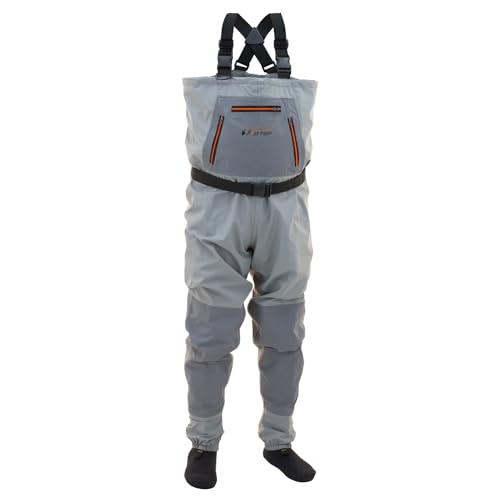
Frogg Toggs Hellbender Stockingfoot Chest Waders
A breathable stockingfoot chest wader at the price a pair of neoprene bootfoots used to cost. The fabric is a lighter denier than the premium pairs and the seams are the part that eventually gives, but it is a genuine breathable wader with a neoprene bootie and a front pocket, and it fishes.
Best for: A first pair, occasional trips, and anyone who is not yet sure how much they will wade.

Bassdash Immerse Women's Breathable Stockingfoot Waders
Cut on a female pattern rather than a scaled down mens pattern, which is the difference between waders that fit and waders that bunch at the hip and gape at the chest. Breathable, stockingfoot, with an adjustable belt and a chest pocket.
Best for: Women who have been fishing in a small mens wader and losing mobility to it.

Orvis Clearwater Chest Waders
Four layer construction with taped seams and a properly shaped neoprene bootie, which is the point where waders stop being a consumable and start being equipment. The bootie shape matters more than the fabric: a bootie that fits the boot stops the heel lift that wears a seam through.
Best for: Anyone fishing twenty or more days a season who is tired of replacing budget waders.

Simms Freestone Stockingfoot Waders
A four layer upper over a five layer leg, so the fabric is heaviest exactly where gravel, brush and boot cuffs abrade it. Reinforced seams, gravel guards and a fit designed around a wading belt rather than around a coat hanger.
Best for: Guides, hard season anglers, and anyone who fishes brushy freestone rivers where the legs take a beating.
Skip it if: Someone who fishes six days a season. You will not out-wear an under-$100 pair in that time, and the extra money buys durability you will never draw down.
Specs are the manufacturer's published figures. Prices and stock change constantly, so confirm on the retailer page. We earn commissions from Backcountry and from qualifying Amazon purchases.
Why is a wading belt non negotiable?
Because waders change what happens when you fall in, and a belt is the only thing that changes it back. This is the part of a waders page that most sites skip, and it is the part that matters most.
Start with what a belt does not do. A wading belt does not make waders unsinkable, and waders full of water do not drag you under like an anchor. That old story is wrong. Water in your waders is roughly neutrally buoyant. The real problem is different and more practical: legs full of many pounds of water cannot kick, cannot balance, and cannot be lifted onto a bank. A belt cinched snug at the waist greatly slows how fast the legs flood, and that delay is the whole margin you get to swim to shore and climb out.
Two more facts belong on this page because they are what actually kills anglers. Moving water at knee depth can take a strong adult off their feet, because the force the current applies scales with the square of its velocity: water moving twice as fast pushes roughly four times as hard. Depth alone is a bad guide, and a familiar crossing at high flow is a different crossing.
And cold water removes fine motor control within minutes. The immediate danger on entry is cold shock, an involuntary gasp and a minute of uncontrolled breathing, not hypothermia. After that your hands stop working before you feel seriously cold, so knots, zips and buckles all fail you. Getting out fast matters more than swimming well. Plan your exit before you enter.
Which boots go with which waders?
Buy the boots at the same time, because sizing depends on the bootie you just chose. A wading boot worn over a stockingfoot neoprene bootie almost always needs to be ordered one to two sizes larger than your street shoe, and the exact figure depends on the bootie thickness and whether you plan to wear a wading sock over it.
Sole choice is the other half. Felt grips slick, rounded, algae covered rock better than plain rubber does, which is why it was standard for decades. But felt holds water in its fibres for days and has been shown to transport invasive organisms between watersheds, including didymo and the parasite behind whirling disease. Felt soles are banned in several states and provinces, and the list changes, so check the current regulations published by the fisheries agency for the specific water you intend to fish before you buy. Studded rubber is the practical compromise almost everywhere: it grips well, dries fast and passes inspection.
The Orvis Clearwater Wading Boots, rubber sole and the Simms Freestone Wading Boots, rubber sole both come drilled to accept studs, and the Korkers Greenback Wading Boots, felt and rubber soles takes interchangeable sole plates so one boot runs rubber where felt is prohibited. Current picks and sizing are on the best wading boots page.
How do you repair waders and make them last?
Waders are repairable, and a repaired wader is not a compromised wader. This is the highest return maintenance in the whole sport.
- Find the leak. Turn the waders inside out, fill the suspect leg loosely with a bright torch in a dark room, or wipe rubbing alcohol over the area and watch for a dark spot as it wicks through a pinhole. Mark it on the inside with a pen while it is visible.
- Dry the area completely. Sealant on damp fabric peels off within a trip.
- Apply a urethane based wader sealant to the inside surface, spread it well past the hole, and let it cure fully overnight rather than the minimum on the tube.
- For a torn seam, seal from the inside over the tape and add a patch if the tape has lifted over any real length.
- Hang them dry after every trip, inside out first so the interior moisture leaves, then right side out. Never store waders wet, folded, or in a hot vehicle. Heat and compression kill laminates faster than fishing does.
Two habits extend any pair further. Rinse mud and vegetation off before you leave the water, which matters for the river as well as the fabric, and never sit down on gravel in them. Most of the abrasion damage on a wader seat happens on the bank, not in the river.
What should you spend, honestly?
If this is your first season, buy a budget breathable pair and put the difference toward boots, because bad boots are dangerous and cheap waders are only inconvenient. If you already know you fish twenty or more days a year, go straight to a four layer pair and skip the intermediate step entirely. And if you are a larger angler, buy from a line that publishes stout or king sizing even if it costs more, because a wader that fits at the waist outlasts a better wader that does not.
None of the pairs here will keep you dry forever, and none of them make wading safe. Fit decides comfort, layer count decides how long they last, and the belt decides what happens on the one day it matters.
The two Simms options are reviewed individually now: the Simms Tributary at under $500 and the Simms Freestone at under $500. Both pages make the same uncomfortable point, which is that breathable waders are a wearing part rather than a lifetime purchase at any price.
Frequently asked questions
Do I need breathable waders or neoprene waders?
Buy breathable unless you sit still in freezing water. Breathable waders let sweat vapour escape, which keeps you dry from the inside on a walk in, and you add warmth underneath with fleece layers when it gets cold. Neoprene is a wetsuit fabric that insulates but does not breathe, so it is miserable on a hike and only makes sense for stillwater duck-blind conditions or late season steelhead sitting.
Should I get stockingfoot or bootfoot waders?
Stockingfoot for almost everyone. A stockingfoot wader ends in a snug neoprene sock and you wear a separate wading boot over it, which gives you real ankle support, a sole you can choose, and a much better fit. Bootfoot waders have the boot bonded on, which is faster to put on and warmer in ice, but the boot fit is fixed, the support is poor and one failure ends both parts.
What size waders should I buy if I am between sizes?
Size up, and pay more attention to inseam and bootie size than to the chest measurement. Waders that are slightly large in the body are merely baggy, while waders that are short in the inseam pull the crotch down every time you lift a leg over a rock and put the seam under constant load. That crotch seam is the most common failure point on every price tier.
What is a stout or king size wader and do I need one?
Stout and king sizes are cut with more room through the waist and seat at the same inseam, rather than simply scaling the whole garment up. If a regular large fits your legs but binds at the waist, that is the size you want. Budget lines often skip these sizes entirely, which is the single most common reason a cheaper pair does not work for a larger angler.
Do I really need a wading belt with waders?
Yes, every trip, cinched snug. A belt does not make waders unsinkable, and waders do not pull you under like an anchor. What a belt does is slow the flooding of the legs, which is what destroys your ability to kick, swim and climb out on a bank. It costs under $25 and it is the cheapest safety item in the sport.
How long should a pair of waders last?
A budget breathable pair fished hard usually starts seeping at a seam or a pinhole within one to three seasons, while a four or five layer pair from a premium line commonly runs five seasons or more with repairs. Leaks are almost always pinholes and seam tape rather than fabric failure, so a repair kit and an evening with seam sealant extends any pair considerably.
How we choose: we compare published manufacturer specifications, line and leader standards, and verified owner reviews across retailers. We do not test gear in person, and every diameter, grain weight and breaking strength quoted here is the manufacturer's published figure unless we say otherwise, so check the spool label before you trust a number. Nothing here is professional instruction. Wading moving water is the real hazard in this sport: wear a snug wading belt, know the water temperature, and turn back rather than push through a crossing you are unsure of.