How to Choose Waders and Boots
Buy breathable stockingfoot waders and size the boots one to two full sizes above your street shoe to fit over the neoprene booties. Choose studded rubber soles rather than felt: felt grips slick rock better but holds water and transports invasive organisms including didymo and whirling disease, and felt soles are banned in several states and provinces, so check the current local regulations before buying. An entry pair of waders and boots together runs under $250.
Waders and boots are bought as one system and priced as two, which is why so many people end up with decent waders and boots that do not fit over them. The default answer for river trout fishing is a breathable stockingfoot wader paired with a studded rubber soled boot ordered one to two sizes above your street shoe. That combination works in almost every jurisdiction, on almost every substrate, across almost the whole season. An entry pairing lands under $250, a mid pairing under $500, and the buy-once tier under $750, and the extra money buys durability rather than performance.
Should you buy breathable or neoprene waders?
A breathable wader is a multi layer waterproof laminate that passes water vapour outward while blocking liquid water inward, so your own sweat escapes and you regulate temperature with the clothes you wear underneath. A neoprene wader is closed cell foam rubber, which insulates by trapping gas in the material itself and does not breathe at all.
Breathable is right for the large majority of anglers. Its insulation is whatever you put on under it, which means one pair covers cold early season water over a fleece base and warm late season water over shorts. Walk half a mile to the river in neoprene in warm weather and you arrive soaked from the inside, which is both miserable and genuinely a cold hazard later when the sun drops.
Neoprene still wins in specific conditions: standing still in genuinely cold water for hours, winter steelhead, and duck marsh work where you are wading through vegetation that would abrade a laminate. Its thickness is quoted in millimetres, typically 3mm to 5mm for fishing use, and thicker means warmer and less mobile.
| Water condition | Typical water temp | Better choice | What to wear underneath |
|---|---|---|---|
| Warm season, walking between pools | 60 to 70°F | Breathable | Quick dry trousers only |
| General trout season, mixed weather | 50 to 60°F | Breathable | Light fleece leggings |
| Early season, snowmelt and runoff | 40 to 50°F | Breathable | Heavy fleece and a wader sock |
| Winter, long static sessions | 33 to 40°F | Neoprene or heavily layered breathable | Full base and mid layer |
| Marsh, heavy vegetation, cold | 33 to 45°F | Neoprene, 4 to 5mm | Base layer only |
| Warm shallow bass water | 70°F and above | Wet wading, no waders | Quick dry trousers and boots |
Stockingfoot or bootfoot, and why does it matter?
A stockingfoot wader ends in a shaped neoprene sock at the ankle. You pull a separate wading boot on over that sock. A bootfoot wader has a rubber boot moulded permanently onto the leg.
For moving water, stockingfoot is the correct default, and the reason is ankle support and sole choice. A dedicated wading boot laces tight over the ankle and holds your foot in place on uneven rock, which is the single most useful thing footwear can do in a river. It also lets you choose the sole, add studs, and replace the boot when it wears out without replacing the waders. A boot such as the Orvis Clearwater Wading Boots, rubber sole comes drilled for studs from the factory precisely because that choice matters.
Bootfoot waders are warmer, because there is air space around the foot rather than a compressed sock inside a laced boot, and they go on and off far faster, which is genuinely nice in cold weather and in a drift boat. The trade is loose ankle support and no sole options. If your fishing is mostly static, cold and on soft bottoms, bootfoot is a reasonable choice, and the stockingfoot versus bootfoot comparison works through the rest of it.
What size wading boots do you need over waders?
This is the question that produces the most returns in the category, and the answer is simple: order one to two full sizes above your normal street shoe size.
The reason is volume. A stockingfoot bootie is neoprene roughly 3 to 5mm thick wrapped around your entire foot, and most people add a wading sock over it for warmth and to stop the bootie abrading. That is a lot of material inside a boot that was lasted for a bare foot in a thin sock. Cram it in and two things happen: your toes go numb within minutes in cold water because you have cut off circulation, and the boot loses its ability to flex, which makes it worse on rock rather than better.
Practical sizing rules that follow from that:
- One size up if you have a narrow foot, wear a thin sock and the brand does not already build in an allowance.
- Two sizes up if you have a wide foot, plan to wear a heavy wader sock, or fish cold water where you want circulation space.
- Check the brand's own chart first. Some manufacturers already size their wading boots to account for a bootie, in which case sizing up twice leaves you swimming.
- Lace them and walk before the water. A boot that slips at the heel on dry ground will slip badly on wet rock.
Wader sizing itself is a different problem: it is driven by inseam and chest height as much as by shoe size, and a wader that is too long in the leg bunches at the knee and wears through there first. The wader sizing chart lays out how the stated sizes map to height, inseam and shoe. Women in particular should look at a wader cut on a women's pattern such as the Bassdash Immerse Women's Breathable Stockingfoot Waders rather than a small men's size, because the difference is in the hip and the inseam, not the overall length.
Felt or rubber soles, and where is felt actually banned?
This is the decision with a legal dimension attached, and it needs stating carefully rather than as a preference.
Felt grips slick, rounded, algae covered rock better than plain rubber does. That is not marketing. Felt fibres key into the microtexture of wet stone in a way a moulded rubber lug cannot, which is why felt was standard on freestone rivers for decades and why experienced anglers on those rivers still miss it.
The problem is what felt does out of the water. Felt holds water in its fibres for days, and a damp felt sole in a car boot overnight is a viable transport vector for invasive organisms between river systems, including didymo and the parasite responsible for whirling disease. Rubber dries quickly and carries far less.
Studded rubber is the practical compromise almost everywhere. Carbide or aluminium studs screwed into a rubber sole grip slick rock far better than plain rubber, dry quickly, pass inspection where felt is prohibited, and walk far better on a bank than felt does. Studs are inexpensive, user fitted, and replaceable when they wear down. Boots like the Simms Freestone Wading Boots, rubber sole and the Orvis Clearwater Wading Boots, rubber sole come drilled for exactly this.
If you genuinely fish across a felt ban boundary, an interchangeable sole boot such as the Korkers Greenback Wading Boots, felt and rubber soles lets one pair run rubber in one state and felt in another. That flexibility only earns its extra cost if you will actually change the plates. Most people do not, and a fixed studded rubber boot is lighter and simpler. The felt versus rubber comparison goes deeper into the grip trade on specific substrates.
| Sole | Slick rock grip | Bank and trail | Dry time | Legal status |
|---|---|---|---|---|
| Felt | Excellent | Poor on wet grass | Days | Banned in several states, check locally |
| Plain rubber | Fair to poor | Good | Hours | Permitted everywhere |
| Studded rubber | Very good | Good, noisy on rock | Hours | Permitted almost everywhere |
| Studded felt | Excellent | Fair | Days | Follows the felt rules where they apply |
| Interchangeable | Depends on plate fitted | Depends on plate fitted | Varies | Legal if the rubber plate is fitted |
Whichever you buy, clean and dry your boots between watersheds. Rinse off mud and vegetation and let them dry fully before fishing a different river system. That is standard practice regardless of sole material.
What construction details decide how long waders last?
Waders fail in predictable places, and the price difference between tiers is almost entirely about reinforcing those places rather than about performance.
Layer count. Breathable waders are described as three, four or five layer laminates. More layers means more abrasion resistance and more weight. The better pattern is mixed: a four layer upper where abrasion is low with a five layer leg where you kneel and push through brush, which is how the Simms Freestone Stockingfoot Waders is built.
Seam taping. Every seam is a set of needle holes, and the tape over it is what keeps them dry. Look for fully taped seams rather than partially taped, and understand that seam tape is the most common failure point in cheap waders. It fails from repeated flexing and from being stored damp and folded on the same crease.
Gravel guards. These are the elasticated cuffs that pull down over the top of the boot to stop grit getting between bootie and boot. They matter more than they sound, because trapped gravel abrades the neoprene bootie from the inside and a bootie leak means new waders. Check the guard has a functional lace hook so it stays down.
Bootie quality and shape. The bootie should be anatomically shaped with left and right feet, not a symmetrical tube. A shaped bootie sits flat inside the boot instead of wrinkling, and wrinkles are where wear starts.
The belt loops. Check they exist and are properly positioned at the waist. A wading belt is not optional and the loops are what keep it where it needs to be.
What does a full pairing cost at each level?
Budget for both halves at once. The most common expensive mistake in this category is spending the whole budget on waders and then discovering that boots are a separate purchase.
| Level | Waders | Wader budget | Boots | Boot budget | Pair budget |
|---|---|---|---|---|---|
| Entry | Frogg Toggs Hellbender | Under $100 | Korkers Greenback | Under $250 | Under $250 |
| Mid | Orvis Clearwater | Under $500 | Orvis Clearwater | Under $250 | Under $500 |
| Buy once | Simms Freestone | Under $500 | Simms Freestone | Under $250 | Under $750 |
If your budget is fixed, put the money into the boots before the waders. Cheap breathable waders keep you dry for a season or two and then leak. Cheap boots with poor soles and a floppy ankle are a footing problem every single day you wear them, and footing is a safety issue rather than a comfort issue. The waders roundup and the wading boots roundup compare the options within each tier.
What are the wading safety rules that come with the gear?
Buying waders means taking on the single real hazard in this sport. Wading is what injures and kills fly anglers, not hooks and not weather, and the equipment decisions above only matter inside a set of habits.
Judge a crossing on velocity, not depth. Moving water at knee depth can take a strong adult off their feet. The drag force the current puts on your legs scales with the square of water velocity, so a modest increase in speed is a large increase in force.
| Current speed | Relative force | What it looks like |
|---|---|---|
| 1 ft per second | 1x | A slow walking pace, glassy surface |
| 2 ft per second | 4x | Brisk walk, visible surface texture |
| 3 ft per second | 9x | Fast walk, standing waves forming |
| 4 ft per second | 16x | A jog, white water on rocks |
| 5 ft per second | 25x | Running pace, continuous whitewater |
Cold water removes fine motor control within minutes. The immediate danger on going in is cold shock, not hypothermia: an involuntary gasp and a period of uncontrolled breathing in the first minute. After that, your fingers stop working before you feel seriously cold, so knots, zips and buckles become impossible. Getting out fast matters far more than swimming well, which is why you decide your exit before you enter.
Use a third point of contact. A Troutbound Collapsible Aluminium Wading Staff, 55.5in turns balancing on two feet into bracing on three and lets you probe depth ahead of your foot rather than discovering it with your weight already committed. Shuffle your feet along the bed rather than lifting them, face slightly upstream, and move diagonally rather than square to the flow.
Waders and boots by tier
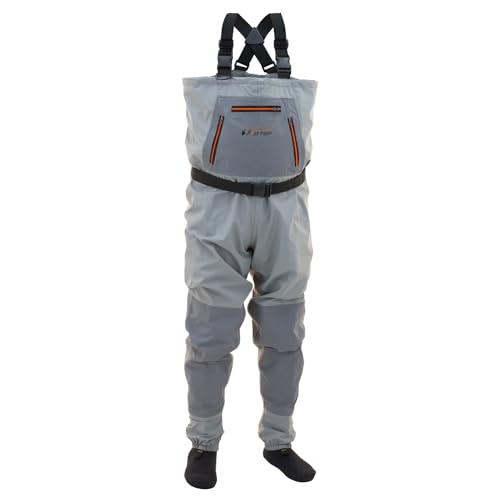
Frogg Toggs Hellbender Stockingfoot Chest Waders
Breathable stockingfoot chest waders at the price most bootfoot waders sell for. Neoprene booties, so they pair with a proper wading boot, which is the configuration worth learning in rather than growing out of.
Best for: A first pair, three season trout water, and anyone who wants to spend the saved money on better boots.

Orvis Clearwater Wading Boots, rubber sole
A rubber soled boot drilled to take studs, which is the practical compromise almost everywhere: studded rubber grips slick rock well, dries fast, and does not carry organisms between watersheds the way felt does.
Best for: Anglers who fish more than one river system, and anyone travelling to a state with a felt ban.

Orvis Clearwater Chest Waders
A four layer breathable wader with neoprene booties and the seam taping and reinforcement that decides how long a pair lasts. The step up from entry level is mostly durability at the knee and the seat, which is exactly where waders fail.
Best for: Anyone fishing 30 or more days a season who has already worn out one cheap pair.

Korkers Greenback Wading Boots, felt and rubber soles
Interchangeable soles, so one boot runs rubber where felt is prohibited and felt where it is legal and the rock is genuinely slick. Check the current regulations for the water you are fishing before you fit the felt plates.
Best for: Anglers who cross state lines and need to comply with two different sole rules.
Skip it if: Anyone who will never actually swap the soles. A fixed rubber boot is lighter, simpler and cheaper.

Bassdash Immerse Women's Breathable Stockingfoot Waders
A breathable stockingfoot wader cut on a women’s pattern rather than a small men’s pattern, which changes the inseam, the hip and the chest height. Fit is the whole game in waders and a unisex cut is not a fit.
Best for: Women who have been fishing a small men’s wader and putting up with a bad inseam.

Simms Freestone Stockingfoot Waders
A four layer upper with a five layer leg, which puts the extra material exactly where waders wear through. This is the durability tier, not the performance tier, and it is bought by people who fish enough days to justify it.
Best for: High day count anglers, guides, and anyone who has replaced budget waders twice already.
Skip it if: A first pair. Nobody needs five layer legs to find out whether they like standing in a river, and the money is better spent on boots and a belt.
Specs are the manufacturer's published figures. Prices and stock change constantly, so confirm on the retailer page. We earn commissions from Backcountry and from qualifying Amazon purchases.
Frequently asked questions
What size wading boots do I need over stockingfoot waders?
Order one to two full sizes above your street shoe size. A stockingfoot wader ends in a neoprene bootie roughly 3 to 5mm thick, and that bootie plus a wading sock takes up real volume inside the boot. Sizing up is not about comfort, it is about circulation: a boot that compresses your foot in cold water makes your toes numb fast. Check the manufacturer’s own guidance, since some brands already build the allowance in.
Are felt soled wading boots banned?
In several states and provinces, yes, and the list changes. Felt holds water in its fibres for days and has been shown to transport invasive organisms between watersheds, including didymo and the parasite responsible for whirling disease. Some jurisdictions ban felt outright and others do not. Check the current regulations published by the fisheries or wildlife agency for the specific water you intend to fish before buying boots, and check again before you travel.
Should I buy breathable or neoprene waders?
Breathable for almost everyone. A breathable wader lets you add or remove insulating layers underneath, so one pair works from cold water in early season through to warm weather, where neoprene becomes unbearable. Neoprene earns its place in genuinely cold conditions, in a duck marsh, or for anyone standing still in cold water for hours. Its insulation is fixed, which is exactly its problem the rest of the year.
Are stockingfoot or bootfoot waders better?
Stockingfoot for river fishing, bootfoot for cold and convenience. Stockingfoot waders pair with a separate wading boot that supports the ankle, grips properly and can be re-soled or studded, which matters on uneven rock. Bootfoot waders have the boot built in, so they go on faster and stay warmer because there is air space around the foot, but the ankle support and the grip options are far more limited.
Do I really need a wading belt if I only fish shallow water?
Yes, every time, and shallow water is exactly where people go in. A snug belt does not make waders unsinkable, it slows the flooding that fills the legs with many pounds of water and destroys your ability to swim or climb a bank. It costs a small fraction of the wader and boot pairing and it is the single cheapest safety item in the sport. Cinch it at the waist, not loose.
How long should a pair of breathable waders last?
Anywhere from one season to many, and the variable is care rather than price. Waders fail at the seams, at the knees from kneeling on gravel, and at the seat from sitting on rock. Hang them to dry fully inside and out rather than stuffing them wet in a bag, wash the outside occasionally so the fabric can still breathe, and patch small leaks immediately rather than letting a pinhole grow.
How we choose: we compare published manufacturer specifications, line and leader standards, and verified owner reviews across retailers. We do not test gear in person, and every diameter, grain weight and breaking strength quoted here is the manufacturer's published figure unless we say otherwise, so check the spool label before you trust a number. Nothing here is professional instruction. Wading moving water is the real hazard in this sport: wear a snug wading belt, know the water temperature, and turn back rather than push through a crossing you are unsure of.