Fly Line Taper Chart and AFFTA Standard
The AFFTA fly line standard defines a line class by the mass in grains of its first 30 feet, excluding any level tip: 5 weight is 140 grains with a tolerance of plus or minus 6 grains, so 134 to 146 grains all count as a 5. Many modern lines are deliberately built half a size to a full size heavy so that fast rods load at the short ranges where most fish are actually hooked.
A fly line's weight class is defined by the AFFTA standard as the mass in grains of its first 30 feet, excluding any level tip section. A 5 weight is 140 grains, a 3 weight is 100, an 8 weight is 210. That is the entire definition, and it is worth noticing what it does not include: nothing in the standard says anything about the shape of the taper, how long the head is, or how the mass is distributed inside those 30 feet. Two lines can both measure exactly 140 grains and behave nothing alike.
That gap between what the standard specifies and what the line actually does is the reason this page exists. The grain table below is the part everyone quotes. The taper tables underneath are the part that decides whether a given line will make your rod feel alive or dead.
What is the full AFFTA line weight standard?
The complete standard, class by class, with the tolerance permitted at each. A grain is 1/7000 of a pound, or about 0.0648 grams, which is a fine enough unit to give useful resolution across the range.
| Class | Grains | Tolerance | Legal range | Grams | Step from previous | Half size heavy |
|---|---|---|---|---|---|---|
| 1 | 60 | ±6 | 54 to 66 | 3.9 | n/a | 70 |
| 2 | 80 | ±6 | 74 to 86 | 5.2 | +20 | 90 |
| 3 | 100 | ±6 | 94 to 106 | 6.5 | +20 | 110 |
| 4 | 120 | ±6 | 114 to 126 | 7.8 | +20 | 130 |
| 5 | 140 | ±6 | 134 to 146 | 9.1 | +20 | 150 |
| 6 | 160 | ±8 | 152 to 168 | 10.4 | +20 | 170 |
| 7 | 185 | ±8 | 177 to 193 | 12.0 | +25 | 198 |
| 8 | 210 | ±8 | 202 to 218 | 13.6 | +25 | 223 |
| 9 | 240 | ±10 | 230 to 250 | 15.6 | +30 | 255 |
| 10 | 280 | ±10 | 270 to 290 | 18.1 | +40 | 300 |
| 11 | 330 | ±12 | 318 to 342 | 21.4 | +50 | 355 |
| 12 | 380 | ±12 | 368 to 392 | 24.6 | +50 | 405 |
The tolerance column matters more than people expect. A 5 weight is legal anywhere from 134 to 146 grains, which is a spread of roughly 9 percent, and that is enough to feel. Two lines from different makers, both marked 5 weight, both perfectly within specification, can sit at opposite ends of that window. The tolerance widens further up the scale in absolute terms, reaching plus or minus 12 grains at 11 and 12 weight, though the percentage stays broadly similar.
The step column shows the shape of the ladder. Classes 1 through 6 step up in even 20 grain increments. From 6 upward the steps widen to 25, then 30, then 40, then 50, because the flies being cast get much larger much faster than the classes advance. That is also why an angler moving from a 5 to a 6 notices a modest change while an angler moving from a 9 to a 10 notices a different rod entirely.
Why do modern fly lines run heavy?
Because the standard measures 30 feet and rods got stiffer. A fast action blank needs a certain mass outside the rod tip before it bends and loads, and at 20 to 35 feet, which is where the majority of fish are actually hooked, a true to standard line does not supply it. Line makers responded by building many lines half a size to a full size over the standard, so a line sold as a 5 weight can genuinely measure 150 or 160 grains at 30 feet.
This is a deliberate design decision and it is usually the right one, but it produces genuine confusion. A slower rod paired with a heavy running line feels mushy and takes too long to recover. A fast rod paired with a true to standard line feels dead until you have 45 feet out. Neither is a fault in the rod or the caster.
| Pairing | Verdict | Why |
|---|---|---|
| True to standard line on a slow or fibreglass rod | Correct pairing | A slow blank loads on the standard mass and is overwhelmed by more |
| True to standard line on a fast rod at 20 to 30 feet | Feels dead | Not enough mass outside the tip to bend a stiff blank at short range |
| Half size heavy line on a fast rod at short range | Usually the right answer | This is the specific problem the half size heavy convention was invented to solve |
| Half size heavy line on a fast rod at 60 feet | Slightly heavy | Once the whole head is out there is more mass than the rod needs |
| Full size heavy line on any rod | A deliberate choice | Overlining by a full class is a legitimate short range fix and a distance penalty |
A line such as the Scientific Anglers Frequency Boost Fly Line, WF5F is explicitly built half a size heavy, and that is exactly the fix for a fast rod that has felt lifeless since the day you bought it. If you are unsure which direction your rod needs, the line weight calculator asks about action rather than simply repeating the number printed on the blank, which is the question that actually decides the answer.
What are the parts of a fly line taper?
A weight forward line is five sections that each do one job. Knowing the names turns a manufacturer's taper diagram from decoration into information.
| Section | Typical length | Typical diameter | What it does |
|---|---|---|---|
| Level tip | 6 to 12 in | 0.028 to 0.035 in | A short parallel section, usually welded into a loop, that the leader attaches to. Excluded from the AFFTA measurement |
| Front taper | 2.5 to 8 ft | Tapering up from the tip | Controls how the loop unrolls at the fly. Long and gradual presents delicately, short and steep turns big flies over |
| Belly | 18 to 35 ft | The thickest part of the line | The mass reservoir. This is where most of the grain weight lives and what loads the rod |
| Rear taper | 3 to 14 ft | Tapering down to running line | Sets how smoothly the line transitions to running line, and how far you can carry line in the air |
| Running line | 45 to 60 ft | 0.029 to 0.038 in | Thin, light shooting line that follows the head through the guides with minimal drag |
| Total length | 80 to 100 ft | n/a | 90 feet is the near universal trout line length, and 100 feet is common in saltwater |
Two of those sections do most of the work you actually feel. The front taper decides presentation. A long gradual front taper, say 6 to 8 feet, bleeds energy out of the loop gradually so the leader settles rather than kicks, which is what you want with a size 18 dry fly on flat water. A short steep front taper, say 2.5 to 4 feet, dumps energy fast and hard, which is what turns a weighted nymph rig or a deer hair bug over.
The head length decides how much line you can carry. Once the rear taper has passed the rod tip and thin running line is in the guides, the cast has nothing left to load with, and adding another false cast makes things worse rather than better. A 45 foot head can be carried and mended at distance. A 30 foot head loads faster, shoots further off a single haul, and stalls sooner. Neither is better; they suit different fishing.
The line tip diameter also sets what leader butt you should be tying on. The convention is a leader butt at about two thirds of the line tip, so a 0.030 inch tip wants roughly a 0.020 inch butt. Get that wrong in either direction and the leader either lands in a pile or kicks over hard, and no amount of casting practice fixes it.
Which taper profile should I actually buy?
Seven profiles cover the market, and most anglers only ever need two of them. The table gives the full set so you can read a line box, then the prose narrows it down.
| Code | Profile | Head length | Best at | Strength | Weakness |
|---|---|---|---|---|---|
| WF | Weight forward | 32 to 45 ft typical for trout | Almost everything. The default profile in the modern market | Concentrates mass in a head that loads the rod quickly, then shoots thin running line for distance | Once the head is outside the tip you cannot carry more line in the air, so long false casts stall |
| DT | Double taper | Symmetrical, no head as such | Roll casting, mending at range, delicate short game, small streams | Identical taper at both ends, so it can be reversed when one end wears out. Mends beautifully because the diameter stays constant far back | Shoots poorly at distance because the thick belly drags through the guides |
| ST | Shooting head | 27 to 38 ft | Maximum distance, stillwater, some saltwater and two handed work | All the mass in a short head attached to a thin dedicated running line, which shoots further than anything else | Poor at short range, poor at mending, and the head to running line junction is a hinge you have to manage |
| L | Level | None, constant diameter throughout | Panfish on a budget, and some specialist applications | Cheapest line made, and simple | No taper means no controlled turnover. The leader does not straighten and presentation is poor |
| BBT | Bass or bug taper | 25 to 32 ft, very aggressive | Deer hair bugs, poppers, pike flies, anything with huge air resistance | Very short steep front taper puts maximum mass right behind the fly, which is what turns a wind resistant bug over | Lands hard. Useless for delicate trout presentation |
| WF, presentation | Trout presentation taper | 38 to 48 ft, long front taper | Spring creeks, flat water, dry flies, slower rods | A 5 to 8 foot front taper dissipates energy gradually so the fly settles rather than lands | Struggles to turn over weighted rigs and struggles in wind |
| WF, all round | Trout all round or distance taper | 34 to 40 ft, shorter front taper | General river work, indicator rigs, small streamers, wind | Enough front taper for dries and enough mass forward to punch a nymph rig out | Not as delicate as a presentation taper on genuinely flat water |
| WF, nymph or indicator | Nymph and indicator taper | 36 to 44 ft, thick tip | Indicator nymphing with split shot and two flies | Heavier tip and short front taper turn a hinged multi fly rig over without collapsing | A poor dry fly line. Everything lands with a thump |
For a general trout angler, buy a weight forward all round taper and stop. A RIO Premier Gold Fly Line, WF5F or a Orvis Clearwater Fly Line, WF floating does dries, nymphs and small streamers competently, and the compromise costs you almost nothing you would notice. The specialist tapers earn their keep once you know which specific job your current line is failing at.
Double taper is a real choice, not a nostalgic one. On small streams, where casts are short, roll casts are constant and mending at 30 feet matters, a double taper genuinely outperforms a weight forward line, and you get two lines out of it because it can be reversed. What it will not do is shoot line at distance. Our weight forward against double taper comparison works through when each one wins.
Ignore level lines. A level line has no taper, so it cannot deliver a controlled turnover, and the money saved is not worth what it does to your casting. It is the single worst place to economise in the whole outfit.
Fly lines by taper and tier

Orvis Clearwater Fly Line, WF floating
An honest weight forward floating line with welded loops at both ends, which removes the two knots most likely to defeat a new angler. Nothing exotic about the taper, which is the point at this price.
Best for: A first line, or replacing the tired line that came on a boxed outfit.
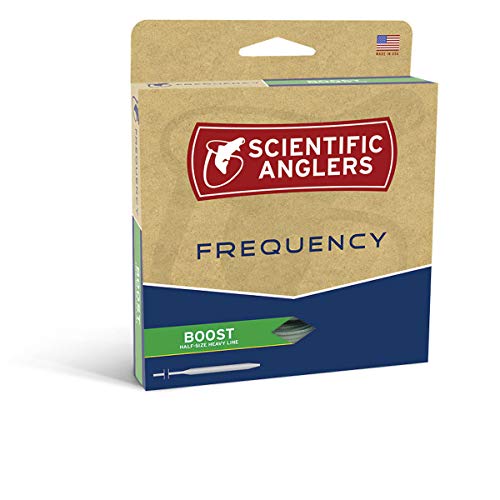
Scientific Anglers Frequency Boost Fly Line, WF5F
Built half a size heavy on purpose. If your rod is a modern fast blank and feels dead at 25 feet, this taper is the specific fix, because the extra mass loads the rod at the distances people actually fish.
Best for: Fast action rods fished at short to medium range.
Skip it if: Slow fibreglass or full flex rods, where the extra mass simply overloads the blank.

RIO Premier Gold Fly Line, WF5F
A long head all round trout taper with a front taper gentle enough for dry flies and enough mass behind it to carry an indicator rig. The most quoted general purpose trout profile in the market.
Best for: One line to do dries, nymphs and small streamers on a 5 weight.

Scientific Anglers Amplitude Smooth Infinity, WF5F
A textured surface line with a slick coating package, which reduces friction through the guides and holds up to hard use. The taper is a modern all round profile rather than a specialist one.
Best for: Anglers who fish a lot and want the line to still shoot well in its third season.
Skip it if: Anyone on a first outfit. The performance difference is real and it is smaller than the difference a casting lesson makes.
Specs are the manufacturer's published figures. Prices and stock change constantly, so confirm on the retailer page. We earn commissions from Backcountry and from qualifying Amazon purchases.
How do I read the code on a fly line box?
Every line carries a short code that gives profile, class and density in that order. Once you can read it, the wall of boxes in a shop becomes navigable.
| Code | Reads as | Typical use |
|---|---|---|
| WF5F | Weight forward, 5 weight, floating | The default trout line |
| DT4F | Double taper, 4 weight, floating | Small stream and roll casting |
| WF8F | Weight forward, 8 weight, floating | Bonefish, redfish, bass |
| WF7F/S3 | Weight forward, 7 weight, floating body with a Type 3 sinking tip | Streamers on rivers |
| WF6I | Weight forward, 6 weight, intermediate | Stillwater just under the surface |
| WF7S6 | Weight forward, 7 weight, Type 6 full sinking | Deep stillwater and reservoirs |
| ST9F | Shooting taper, 9 weight, floating | Distance work, usually with dedicated running line |
| L5F | Level, 5 weight, floating | Budget lines only. There is no taper to speak of |
The density letters after the class number are where a lot of fishing decisions live. F is floating, I is intermediate, S is sinking, and a compound code such as F/S3 means a floating body with a sinking tip. A Scientific Anglers Sonar Titan Sink Tip, WF7F/S3 in WF7F/S3 is exactly that: a line you can mend like a floater with a 15 foot tip that takes a streamer down at roughly 3 to 4 inches per second. The sink rate chart covers what those type numbers mean in depth, and the floating against sinking comparison covers when to reach for each.
Do specialist tapers matter, or is it marketing?
Both, honestly, and the split is fairly clean. The differences between a presentation taper, an all round taper and a nymph taper in the same class are real and measurable in front taper length and mass distribution. Whether you can perceive them depends entirely on what you are fishing.
Where taper genuinely changes the outcome. Turning over a deer hair bass bug or a two fly rig with split shot is a job an ordinary trout taper does badly, and a dedicated bass taper or nymph taper fixes it immediately. Delivering a size 20 dry fly onto glassy water without a shockwave is a job an aggressive taper does badly, and a presentation taper fixes that. Both of those are single fly, single situation problems with a single obvious symptom.
Where taper matters much less than the marketing says. On average river trout fishing at 25 to 50 feet with an unweighted or lightly weighted fly, the difference between two good all round tapers is smaller than the difference a windy day makes. Coating quality, slickness and durability, which are what a line such as the Scientific Anglers Amplitude Smooth Infinity, WF5F is actually selling, will affect your fishing over three seasons more than taper geometry will.
Saltwater is the exception where a purpose built line stops being optional. RIO Elite Bonefish Fly Line, 8wt and lines like it use a stiffer, tropical core that stays manageable in heat, because a cold water core goes limp and wiry in the tropics and coils on the deck. That is a materials difference rather than a taper difference and it is not marketing at all.
Where does the AFFTA standard stop being useful?
In three specific places, and knowing them prevents most of the arguments people have about what a line really weighs.
The 30 foot measuring point flatters short head lines. The standard measures a fixed 30 feet, which was a sensible choice when almost every line had a long gentle taper. A modern short head line concentrates most of its mass inside 30 feet, so it can measure inside class while feeling much heavier at short range and much lighter once you have 45 feet in the air. Two lines with identical AFFTA figures can be a full class apart in how they feel to cast.
The standard says nothing about diameter or coating. Grain weight is mass, not volume. A dense core with a thin coating and a light core with a thick, buoyant coating can weigh the same and behave differently, particularly in how well they float and how they shoot. That is a large part of why premium lines cast better while measuring the same.
Two handed rods use a separate convention entirely. Spey and switch rods are sold with a grain window printed on the blank, often something like 450 to 550 grains, and that figure describes the head being cast rather than the AFFTA single hand class. Buy to the grain window, not to the class number, and ignore this whole table when you do.
If you are choosing a line rather than settling an argument, the line choosing guide works through the decision in order, and the trout line roundup covers the specific tapers worth the money.
Frequently asked questions
What does the AFFTA fly line standard actually measure?
It measures the mass in grains of the first 30 feet of the line, excluding any level tip section. A 5 weight is 140 grains with a tolerance of plus or minus 6, so anything from 134 to 146 grains can legitimately be sold as a 5. The standard describes the line rather than the rod, and rod makers then build blanks to load correctly under each figure. It says nothing about taper shape, which is why two 5 weights can feel completely different.
Why do modern fly lines run heavy?
Because rods got faster and casting distances did not. A stiff modern blank needs a certain mass outside the rod tip to bend and load, and at the 20 to 35 feet where most fish are hooked a true to standard line does not provide it. Building the line half a size to a full size over the standard fixes that, so many nominal 5 weights measure closer to a 6. It is a deliberate design choice, not a defect.
What is the difference between weight forward and double taper?
Weight forward concentrates most of its mass in a head of roughly 32 to 45 feet and then runs thin shooting line behind it, which loads the rod quickly and shoots well. Double taper is symmetrical, with a long constant belly and identical tapers at both ends, which mends and roll casts better and can be reversed when one end wears. Weight forward is the better default for most anglers.
How long is the head on a fly line and why does it matter?
Trout weight forward heads usually run 32 to 45 feet, saltwater heads run shorter and more aggressive, and shooting heads run 27 to 38 feet. Head length sets how much line you can carry in the air before the thin running line reaches the tip and the cast stalls. A long head carries and mends better, a short head loads faster and shoots further from a single haul.
What does WF7F/S3 mean on a fly line box?
Weight forward taper, 7 weight, floating body with a Type 3 sinking tip. The letters before the number give the profile, the number gives the AFFTA class, and the letters after give the density. F is floating, I is intermediate, S is sinking, and a code such as S3 gives the sink rate type, which in that case is roughly 3 to 4 inches per second.
Should I match my line exactly to my rod rating?
Start there, then adjust for how the rod actually feels. If a fast rod feels dead at 25 feet, a line built half a size heavy usually fixes it. If a slow or fibreglass rod feels mushy and slow to recover, a true to standard line is likely the better match. The rod rating is a starting point rather than a specification the line must obey, because taper shape changes the feel as much as grain weight does.
How we choose: we compare published manufacturer specifications, line and leader standards, and verified owner reviews across retailers. We do not test gear in person, and every diameter, grain weight and breaking strength quoted here is the manufacturer's published figure unless we say otherwise, so check the spool label before you trust a number. Nothing here is professional instruction. Wading moving water is the real hazard in this sport: wear a snug wading belt, know the water temperature, and turn back rather than push through a crossing you are unsure of.