Fly Line Sink Rate Chart
Fly line sink rate is published in inches per second in still water, and the type number broadly tracks it: intermediate is roughly 1 to 2 ips, Type 3 is roughly 3 to 4 ips, Type 6 is roughly 6 to 7 ips and Type 8 is roughly 8 to 9 ips. Depth equals sink rate multiplied by sink time only in still water. In current that calculation overstates depth, because a moving line is being dragged toward the surface the whole time it sinks.
Sink rate is the speed at which a sinking fly line descends through still water, published in inches per second. The type numbers on a line box broadly track that figure, which is the most useful piece of naming in fly fishing: a Type 3 sinks at roughly 3 to 4 inches per second, a Type 6 at roughly 6 to 7, and a Type 8 at roughly 8 to 9. An intermediate, which is the slowest sinking density, runs about 1 to 2 inches per second.
What are the sink rates by line type?
The table below gives the published band for each density along with the depth that band produces at three common count downs. Ranges rather than single figures, because published rates vary between manufacturers and even between line classes inside one family: a heavier class carries more mass per foot of line and therefore sinks a little faster than a lighter class of the same nominal type.
| Density | Code | Inches per second | Feet at 10 sec | Feet at 20 sec | Feet at 30 sec | What it is for |
|---|---|---|---|---|---|---|
| Floating | F | Floats | 0 | 0 | 0 | Dry flies, nymphs under an indicator, anything you need to mend |
| Intermediate | I | 1.0 to 2.0 | 0.8 to 1.7 | 1.7 to 3.3 | 2.5 to 5.0 | Just under the surface, wind lanes, stillwater in the top few feet |
| Type 2 | S2 | 2.0 to 3.0 | 1.7 to 2.5 | 3.3 to 5.0 | 5.0 to 7.5 | Shallow stillwater, slow rivers, keeping a fly at 3 to 6 feet |
| Type 3 | S3 | 3.0 to 4.0 | 2.5 to 3.3 | 5.0 to 6.7 | 7.5 to 10.0 | The most useful all round sinking density for rivers and lakes |
| Type 4 | S4 | 4.0 to 5.0 | 3.3 to 4.2 | 6.7 to 8.3 | 10.0 to 12.5 | Faster water, deeper runs, moderate stillwater depths |
| Type 5 | S5 | 5.0 to 6.0 | 4.2 to 5.0 | 8.3 to 10.0 | 12.5 to 15.0 | Deep runs and reservoir work in the 10 to 20 foot band |
| Type 6 | S6 | 6.0 to 7.0 | 5.0 to 5.8 | 10.0 to 11.7 | 15.0 to 17.5 | Deep stillwater, big rivers, getting down fast in current |
| Type 7 | S7 | 7.0 to 8.0 | 5.8 to 6.7 | 11.7 to 13.3 | 17.5 to 20.0 | Reservoir boat fishing at depth, heavy current |
| Type 8 | S8 | 8.0 to 9.0 | 6.7 to 7.5 | 13.3 to 15.0 | 20.0 to 22.5 | The deepest common density. Specialist reservoir and saltwater work |
Notice how quickly the deep densities get you down and how that changes the fishing rather than just the depth. A Type 8 reaches roughly 13 to 15 feet in 20 seconds, which is fast enough that you can fish a 20 foot deep reservoir shelf on a manageable count. But it also means the line is diving away from you the instant it lands, so mending is impossible and any hesitation costs you several feet. Faster is not better, it is a different tool with a shorter usable window.
The intermediate row is the one most people underuse. At 1 to 2 inches per second it takes about a minute to reach 6 feet, which sounds useless until you realise that a great deal of stillwater fishing happens in the top 5 feet and that an intermediate keeps a fly at a constant shallow depth through a whole retrieve, which a floating line with a weighted fly cannot do.
How do I use a count down to reach a specific depth?
Cast, let the line land, and count in seconds before you begin the retrieve. The count is the only depth control you have with a full sinking line, and it is repeatable in a way that guessing is not: when you find fish at a count of 25, you can go back to 25 all afternoon.
| Count, seconds | Intermediate at 1.5 ips | Type 3 at 3.5 ips | Type 5 at 5.5 ips | Type 6 at 6.5 ips |
|---|---|---|---|---|
| 5 | 0.6 ft | 1.5 ft | 2.3 ft | 2.7 ft |
| 10 | 1.3 ft | 2.9 ft | 4.6 ft | 5.4 ft |
| 15 | 1.9 ft | 4.4 ft | 6.9 ft | 8.1 ft |
| 20 | 2.5 ft | 5.8 ft | 9.2 ft | 10.8 ft |
| 30 | 3.8 ft | 8.8 ft | 13.8 ft | 16.3 ft |
| 45 | 5.6 ft | 13.1 ft | 20.6 ft | 24.4 ft |
| 60 | 7.5 ft | 17.5 ft | 27.5 ft | 32.5 ft |
Use it as a search pattern rather than a target. Start at a count of 10, fish the retrieve, add ten seconds each cast, and keep going until you find fish or find the bottom. Then repeat the count that worked. The sink rate and depth calculator will run any combination of rate and count for you, including rates that fall between the published types.
Two adjustments belong with any count down. A weighted fly adds to the rate and an unweighted buoyant fly subtracts from it, sometimes substantially: a large deer hair or foam bodied pattern on a Type 3 can hold the tip of the line up for several seconds. And the retrieve itself lifts the fly, so a fast strip fished on a count of 30 is not fishing at the depth of 30, it is fishing a rising line from that depth back toward the surface.
Why does current break the sink rate calculation?
Because sink rate is measured in a tank with no flow, and a river is not a tank. Three things happen at once in moving water, and all three push the fly higher than the arithmetic predicts.
The line is dragged. Current pushes on the whole length of line and leader, and that push has a horizontal component that translates into an upward one as soon as the line is not hanging perfectly slack. The longer the line in the water, the larger the effect.
Tension planes the line. This is the big one. Any tension between rod tip and fly turns the line into something closer to a water ski. A tight line does not sink, it planes toward the surface, and it does so no matter what density is printed on the box. Slack, not counting, is what actually gets a fly down in a river.
Turbulence lifts. Water in a riffle or over a boulder field is not moving in one direction. Upwelling currents will lift a sinking line and hold it, which is why the deepest looking water is often the hardest to fish deep.
| Water | Effect on calculated depth | What to do about it |
|---|---|---|
| Still water, a lake or a reservoir with no wind drift | The arithmetic broadly holds | Use the calculated depth as your starting count |
| Very slow flow, a deep frog water pool | Slight reduction | Expect a little less than calculated, and add a few seconds |
| Moderate river current, a walking pace run | Substantial reduction | Expect noticeably less than calculated. Mend upstream to buy sink time |
| Fast current, a riffle or a heavy run | Large reduction | The calculation is of very limited use. Add weight or a faster density rather than counting |
| Fast current with the line under tension | The fly can barely sink at all | A tight line planes toward the surface. Slack, not counting, is what gets a fly down |
The practical answer in moving water is not a longer count. It is an upstream mend the moment the line lands, which throws slack into the system and lets the fly sink instead of swing, and then more weight or a faster density if that is not enough. Anglers who fish streamers well spend far more attention on the first two seconds after the cast than on any number printed on a box.
What about sink tips and poly leaders?
A sink tip is the compromise that solves the river problem. The body of the line floats, so you can mend it and see it, and only a short section at the front sinks, so the fly gets down without the whole system diving. The tip section carries its own density rating and sinks at that rate.
| Item | Sink rate | Realistic fishing depth | Where it fits |
|---|---|---|---|
| 5 ft sink tip | Matches the tip density, roughly 1.5 to 7 ips | Shallow, 2 to 4 ft in current | Small rivers, shallow runs, keeping a streamer just under the surface |
| 10 ft sink tip | Matches the tip density | Moderate, 3 to 6 ft in current | The general purpose river sink tip length |
| 15 ft sink tip | Matches the tip density | Deeper, 4 to 8 ft in current | Big rivers and heavier flows, and the length on most factory sink tip lines |
| Poly leader, floating | Effectively none | Surface | Improving turnover on a floating line without changing lines |
| Poly leader, intermediate | Roughly 1 to 2 ips | 1 to 3 ft | Fishing just subsurface with a floating line |
| Poly leader, fast sinking | Roughly 4 to 7 ips | 3 to 6 ft | Turning a floating line into a short sink tip system for a day |
| Weighted fly alone | Slow and highly variable | Depends entirely on current and leader | Most river nymphing, where the fly does the sinking rather than the line |
A line such as the Scientific Anglers Sonar Titan Sink Tip, WF7F/S3 in WF7F/S3 is a 15 foot Type 3 tip on a floating body, which puts a streamer somewhere in the 4 to 8 foot band in ordinary river current while leaving you a mendable floating line. That configuration answers more river streamer problems than any full sinking line does. The floating against sinking comparison works through the choice, and the fly line taper chart explains how to read the density codes on the box.
Poly leaders are the cheap way to test whether you need a sinking line at all. They are a monofilament core in a polymer coating, sold in densities from floating to fast sinking, and they loop onto the end of any floating line. Keep the tippet short below one, usually 2 to 4 feet, because a long leader below a sinking tip lets the fly ride back up above the depth the tip worked to reach.
Depth control gear worth owning
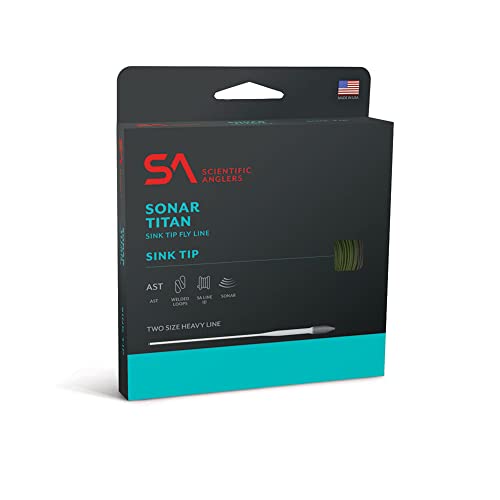
Scientific Anglers Sonar Titan Sink Tip, WF7F/S3
A floating body with a 15 foot Type 3 sinking tip, which is the single most useful sinking configuration on a river. You can still mend the floating portion while the tip carries the fly down at roughly 3 to 4 inches per second.
Best for: Streamers and wet flies on medium to large rivers.
Skip it if: Dry fly fishing. The sinking tip drags a dry fly under and makes a delicate presentation impossible.

SF Micro Removable Split Shot, 112 pieces in 4 sizes
Removable split shot in four sizes, which is how most river anglers actually control depth. Adding a single shot 8 to 12 inches above the fly does more for your nymph fishing than any line purchase.
Best for: River nymphing, where the fly and the shot do the sinking rather than the line.

New Zealand Strike Indicator Wool, bulk
Wool indicators sit in the surface film rather than on top of it, so they register a soft take that a hard plastic indicator misses. They also let you set depth precisely, which is the point of all the arithmetic on this page.
Best for: Indicator nymphing where depth control matters more than casting distance.

Aventik Fly Fishing Stream Thermometer
Water temperature tells you where in the column fish are likely to be holding, which is the question sink rate exists to answer. It also tells you when water is too warm to fish trout responsibly.
Best for: Anyone deciding whether to fish deep, shallow, or go home.
Skip it if: Nobody, though plenty of anglers get by without one.
Specs are the manufacturer's published figures. Prices and stock change constantly, so confirm on the retailer page. We earn commissions from Backcountry and from qualifying Amazon purchases.
How much depth do weighted flies and split shot add?
On rivers, more than the line does, and this is where most trout anglers actually control depth. An indicator rig with a weighted nymph and one or two shot sinks fast, adjusts in seconds, and leaves you a floating line you can mend, which is a better system than any sinking line for ordinary nymph fishing.
| Hook size | Typical bead | Sink contribution |
|---|---|---|
| 18 to 20 | 2.0 to 2.3 mm | Barely more than a visual trigger. Sink contribution is small |
| 16 | 2.4 to 2.8 mm | The standard small nymph bead |
| 14 | 3.0 to 3.3 mm | The most used size in a general nymph box |
| 12 | 3.3 to 3.8 mm | Where a tungsten bead starts to sink a fly meaningfully on its own |
| 10 | 3.8 to 4.0 mm | Heavy nymphs and small streamer heads |
| 8 and larger | 4.0 to 4.6 mm | Streamer and stonefly nymph territory |
Material matters more than size on small flies. Tungsten alloys used for fly tying beads are roughly twice as dense as brass, so a tungsten bead of a given diameter carries roughly twice the mass of a brass bead the same size. On a size 18 nymph, where there is no room to go up a bead size, that is the only lever available.
| Size | Typical mass, grams | Typical mass, grains | When to use it |
|---|---|---|---|
| BB | 0.35 to 0.45 | 5.4 to 6.9 | Deep fast runs, or a single shot on a heavy rig |
| No. 1 | 0.25 to 0.35 | 3.9 to 5.4 | General river nymphing in moderate depth |
| No. 4 | 0.15 to 0.25 | 2.3 to 3.9 | The most commonly used trout size |
| No. 6 | 0.08 to 0.15 | 1.2 to 2.3 | Shallow riffles and fine tuning |
| No. 8 | 0.04 to 0.08 | 0.6 to 1.2 | Adding a touch of weight without killing the drift |
A set of removable shot such as the SF Micro Removable Split Shot, 112 pieces in 4 sizes in four sizes is the cheapest depth control in fly fishing and the most adjustable. Place it 8 to 12 inches above the fly rather than right on the eye, so the fly still moves naturally, and add or remove one shot at a time rather than jumping sizes. The split shot calculator will suggest a starting weight for a given depth and current, and the nymph rigging guide shows how the whole rig goes together with an indicator such as the New Zealand Strike Indicator Wool, bulk setting the depth above it.
How do you know what depth to fish in the first place?
Depth arithmetic is only useful once you have a target depth, and the target comes from water temperature, light and season rather than from any chart. Cold water pushes fish down and slows them, warm water pushes them toward oxygen, which is often shallower and faster than you expect. A streamside thermometer such as the Aventik Fly Fishing Stream Thermometer costs very little and answers the question directly.
Water temperature also decides whether you should be fishing for trout at all. Warm water holds less dissolved oxygen and a fought fish in warm water often does not recover, so many fisheries publish a temperature above which anglers are asked to stop. That is a conservation call rather than a tackle one and it belongs on any page about fishing deep.
The other honest input is simply the bottom. Fish your count down until you touch bottom, note the count, then subtract a few seconds. That gives you a real depth for that specific spot rather than an estimate, and it takes one cast.
Where do these numbers stop being reliable?
In four places, and the first has already been said twice because it is the one that matters.
Current invalidates the arithmetic. Depth equals rate multiplied by time is a still water relationship. In moving water it is an upper bound and in fast water it is barely even that. Anyone quoting a precise river depth from a count down is quoting a number that does not exist.
Published rates vary between makers and between classes. A Type 3 from one manufacturer is not necessarily the same rate as a Type 3 from another, and a Type 3 in an 8 weight will generally sink a little faster than a Type 3 in a 5 weight because it carries more mass per foot. That is why every figure here is a band.
The fly changes the rate. A buoyant deer hair head, a foam bodied pattern, or a large unweighted streamer can slow the front of a sinking line noticeably, while a heavy tungsten nymph speeds it up. The line rating describes the line alone.
Salt water is denser than fresh water, so lines sink a little slower in it than the published freshwater figure suggests. The effect is modest and it is real, and it is one more reason to treat a count down as something to calibrate on the day rather than something to trust from a table.
Frequently asked questions
What is a Type 3 fly line sink rate?
Roughly 3 to 4 inches per second in still water, which is where the type number comes from. Type numbers broadly track inches per second, so Type 6 is about 6 to 7 ips and Type 8 about 8 to 9. Published figures vary by manufacturer and even between line classes within one family, because a heavier class carries more mass per foot, so treat the type number as a band rather than an exact rate.
How do I calculate how deep my fly is?
Multiply the sink rate in inches per second by the number of seconds you count down, then divide by twelve for feet. A Type 3 line at 3.5 ips counted for 20 seconds gives 70 inches, which is about 5.8 feet. That arithmetic holds in still water only. In current it overstates depth, sometimes badly, because a moving line is being dragged toward the surface the whole time it is sinking.
Why does my sinking line not reach the depth the maths says?
Because the maths assumes still water. In a river the current pushes against the line and the leader, and any tension from the rod planes the whole system toward the surface, so the fly rides much higher than a count down suggests. The fix is not a longer count, it is more slack, more weight, or a faster density. Mending upstream immediately after the cast buys real sink time.
Should I use a sinking line or split shot?
On rivers, split shot and weighted flies usually win, because you can adjust depth cast by cast and still mend a floating line. On stillwater a full sinking or intermediate line wins, because you need the entire line at depth rather than a single point, and a count down system gives repeatable results once you have found the fish. Sink tips are the compromise for streamers on moving water.
How much does a tungsten bead help a fly sink?
A good deal more than brass at the same size, because tungsten alloys are roughly twice as dense as brass, so the same diameter bead carries roughly twice the mass. That matters most on small flies where there is no room for a larger bead. It still sinks far slower than a split shot, so on deep fast water the shot is doing the work and the bead is mostly holding the fly down once it gets there.
What sinking line should I own first?
A floating line with a sinking tip, usually a Type 3 in a 10 or 15 foot length, if you fish rivers. It gets a streamer down while leaving you a floating body you can still mend, which is the single most useful compromise in moving water. If you mostly fish stillwater, an intermediate at roughly 1 to 2 inches per second is the more useful first purchase.
How we choose: we compare published manufacturer specifications, line and leader standards, and verified owner reviews across retailers. We do not test gear in person, and every diameter, grain weight and breaking strength quoted here is the manufacturer's published figure unless we say otherwise, so check the spool label before you trust a number. Nothing here is professional instruction. Wading moving water is the real hazard in this sport: wear a snug wading belt, know the water temperature, and turn back rather than push through a crossing you are unsure of.