Floating vs Sinking Fly Line
Buy a floating line first and fish it about 80 percent of the season, adding split shot to reach depth in rivers. Add a sinking line when depth in stillwater or a fast swung streamer defeats that. Sink rates are published in inches per second: a Type 3 sinks at roughly 3 to 4 ips and a Type 6 at roughly 6 to 7. Depth equals sink rate multiplied by time only in still water, and that formula overstates depth in current.
Verdict: buy a floating line, and keep buying floating lines until a specific problem forces your hand. A floating line mends, lifts off cleanly, shows a take through the line itself, and can be made to fish deep by putting the weight on the leader instead of on the line. A sinking line is a specialist tool that solves two problems very well and makes every other part of fishing harder. Most trout anglers should own one floating line before they own any sinking line at all, and many will never need one.
The definition that makes the rest of the page usable. A sinking line's rate is published in inches per second, and the type number is that rate. A Type 3 sinks at roughly 3 to 4 inches per second, a Type 6 at roughly 6 to 7, and an intermediate at roughly 1 to 2. A floating line does not sink at all, by design, because its coating contains microspheres that make the finished line less dense than water.
Lines and weight for controlling depth

Orvis Clearwater Fly Line, WF floating
A floating weight forward line is the one line you can fish everywhere. It mends, it lifts off the water cleanly for the next cast, it shows a take through the line itself, and it can be made to fish deep by adding weight to the leader rather than to the line.
Best for: A first and only line, and the line that stays on the reel roughly 80 percent of the season for most trout anglers.

SF Micro Removable Split Shot, 112 pieces in 4 sizes
The cheapest depth control in fly fishing. Removable shot in four sizes lets you tune how deep a nymph rides without buying a second line or a second spool, and you can strip it off in seconds when the water shallows.
Best for: Getting nymphs down under a floating line, which is how most subsurface trout are caught.

New Zealand Strike Indicator Wool, bulk
Wool indicators sit in the film, register a soft take that a line tip never would, and let you set depth precisely by sliding them up or down the leader. That adjustability is the reason a floating line beats a sinking line in current so often.
Best for: Indicator nymphing in rivers, and anyone learning to read a take before they can feel one.
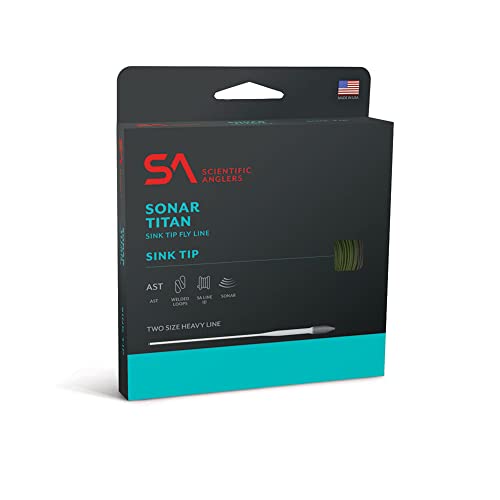
Scientific Anglers Sonar Titan Sink Tip, WF7F/S3
A sink tip is the honest compromise: a sinking front section that takes the fly down while the rest of the line floats, so you keep some ability to mend and a workable pickup. The S3 designation means the tip sinks at roughly 3 to 4 inches per second.
Best for: Swinging streamers in rivers, and stillwater fishing where you still want to mend.
Skip it if: Small stream trout fishing and dry fly water, where the sinking tip is dead weight you will spend the day fighting.

Scientific Anglers Amplitude Smooth Infinity, WF5F
Before buying a sinking line, buy a better floating line. A slick coating and a well judged taper improve every cast you make all season, where a sinking line improves the fraction of the season you actually fish deep.
Best for: Anglers upgrading the line they use most rather than adding a line they use rarely.
Skip it if: A new caster, who will not perceive the coating difference and would get more out of a second spool of tippet and more time on the water.
Specs are the manufacturer's published figures. Prices and stock change constantly, so confirm on the retailer page. We earn commissions from Backcountry and from qualifying Amazon purchases.
What are the four line densities and what is each one for?
Floating. The whole line rides on the surface. This is the default and it is the default for good reasons: you can see it, you can mend it, you can lift the whole thing off the water for the next cast without a roll cast first, and it holds a leader and indicator in position. It fishes dry flies by definition and nymphs by adding weight below it.
Intermediate. Sinks slowly and evenly at roughly 1 to 2 inches per second, so it settles just under the surface film. Its real purpose is not depth, it is getting under a chop on stillwater so wind does not drag a bow into the line and pull the fly. Many stillwater anglers who think they need a sinking line actually need an intermediate.
Sink tip. A sinking front section, typically 10 to 15 feet, joined to a floating body. The compromise that works: the fly gets down, the rest of the line stays visible and mendable, and the pickup is manageable because most of the line is on the surface. The Scientific Anglers Sonar Titan Sink Tip, WF7F/S3 is built this way, with the S3 rating describing the tip.
Full sink. The entire line sinks, at whatever rate the type number describes. This is a stillwater tool first and foremost, because it lets the whole line reach a depth and then track horizontally through it on the retrieve, rather than the fly climbing toward the surface the moment you start stripping.
| Line | Sink rate | Depth at 20 s, still water | Best use |
|---|---|---|---|
| Floating | 0 ips | 0 ft | Dries, nymphs under an indicator, everything in rivers |
| Intermediate | 1 to 2 ips | 2.5 ft | Under a stillwater chop, slow retrieves near the surface |
| Type 3 | 3 to 4 ips | 5.8 ft | General stillwater depth, swung streamers in rivers |
| Type 6 | 6 to 7 ips | 10.8 ft | Deep stillwater, fast current, getting down quickly |
How deep does a sinking line really get?
Less deep than the arithmetic suggests, and understanding why is the most useful thing on this page. The formula is depth equals sink rate multiplied by sink time, and it holds in still water only. In current it overstates depth, often badly.
In a lake, a Type 3 line at about 3.5 inches per second reaches roughly 5.8 feet on a twenty count, and a Type 6 at about 6.5 inches per second reaches roughly 10.8 feet, which is about 1.9 times as deep in the same time. Those numbers are reliable enough to fish by, which is exactly why stillwater anglers count their sink and why the count is the single most important habit in lake fly fishing.
| Line | Rate used | 10 s | 20 s | 30 s |
|---|---|---|---|---|
| Intermediate | 1.5 ips | 1.3 ft | 2.5 ft | 3.8 ft |
| Type 3 | 3.5 ips | 2.9 ft | 5.8 ft | 8.8 ft |
| Type 6 | 6.5 ips | 5.4 ft | 10.8 ft | 16.3 ft |
Now put the same line in a river and the table stops being true. Three things work against it. The current carries the line downstream while it falls, so the fly travels a long diagonal rather than dropping vertically. Drag on the line and leader resists the fall, and the faster the water the more it resists. And any tension you apply, including simply holding the rod, lifts the whole system. In a moderate riffle a Type 3 might reach half the still water figure on the same count, and in a fast run considerably less.
Work a few real combinations through the sink rate and depth calculator and the relationship becomes intuitive quickly. The sink rate chart lists the published rates by type so you can compare lines before buying rather than guessing from the box.
When does a floating line plus split shot beat a sinking line?
In rivers, most of the time, and the reasons are worth listing because they are the same reasons river nymphing has settled on floating lines almost universally.
Control. With a floating line, the only part of the system that is deep is the part you want deep: the fly. Everything else is on the surface where you can see it and move it. With a full sink, the line is down in the current too, and it is being pushed by water moving at a different speed from the water at the surface, which drags your fly out of the lane you put it in.
Mending. You cannot mend a line that is underwater. Mending is what buys a drag free drift, and a drag free drift is what catches trout on nymphs. This alone decides the argument for most river fishing.
Lift off. A floating line picks up off the surface in one motion. A full sinking line has to be stripped back and rolled to the surface before you can recast, which costs you time on every cast and turns an efficient morning into a tiring one.
Adjustability. Depth is set by the weight on the leader and the indicator position, so you change it in seconds without changing lines. Add a shot for the deep run, take it off for the shallow tailout, slide the indicator up a foot. A SF Micro Removable Split Shot, 112 pieces in 4 sizes set in four removable sizes gives you that range for less than the cost of a leader, and a New Zealand Strike Indicator Wool, bulk gives you the depth setting. Work out how much weight a given depth and current actually needs with the split shot calculator, and the nymph rigging guide shows the full assembly.
Take detection. A floating line and an indicator show a take you would never feel. On a sinking line you are relying on feel through a bow of line that the current is already tensioning, and soft takes disappear into it.
When will nothing but a sinking line do?
Three situations, and they are real rather than theoretical.
Stillwater at depth. This is the strongest case. On a lake there is no current to ruin the arithmetic, fish hold at a particular depth, and a countdown with a known sink rate lets you fish that depth deliberately and repeat it when you find fish. A floating line with weight cannot do this, because on the retrieve the fly immediately climbs toward the surface and spends most of the cast in the wrong water. A full sink keeps the fly tracking at depth for the whole retrieve.
Depth in current beyond what shot can reach. There is a limit to how much lead you can hang on a leader before the rig becomes uncastable and dangerous. Deep, fast river runs, big tailwaters and steelhead water exceed that limit, and a sinking line or a sink tip does the job that a leader full of shot cannot.
Swung streamers. When the presentation itself requires the fly to be down and moving across the current on a tight line, a sink tip is the correct tool. You are not trying for a drag free drift, so losing the ability to mend costs you nothing, and the sinking section holds the fly at a consistent depth through the swing. This is also the honest answer for bass fly fishing around deep structure, where a slow sinking line and a big fly cover water that a floating line simply cannot reach.
What is the verdict, and who should buy the sinking line first?
Verdict: floating line first, and for most river trout anglers, floating line only. Reach depth with split shot and an indicator, not with the line. A Orvis Clearwater Fly Line, WF floating covers a whole season of trout fishing, and the money that would have gone on a sinking line is better spent on a better floating line, on tippet, and on flies.
Buy the sinking line first if this is your fishing.
- You fish lakes and reservoirs more than rivers. Stillwater is where sinking lines are not a compromise but the correct tool, and where the countdown method genuinely works. An intermediate and a Type 3 covers most lake fishing between them.
- You fish streamers as your primary method. A sink tip on a 6 or 7 weight, swinging or stripping a weighted fly, is a completely different sport from indicator nymphing and it needs the tip.
- You fish big, deep, fast water. Tailwaters below dams, large western rivers and steelhead runs put fish in water that a leader full of shot cannot reach at a fishable pace.
- You fish from a boat or float tube on still water. Depth control matters more, wind drift on a floating line is a constant nuisance, and an intermediate line solves both.
And plainly the other way: skip the sinking line if you fish small to medium rivers, if you fish dry flies at all, if you nymph under an indicator, or if you are in your first two seasons. It will spend the year on a shelf, and the fishing it does enable will feel clumsy compared to what you already know how to do with a floating line.
What leader goes on a sinking line?
A much shorter one than you are used to, and this catches out almost everyone who buys their first sinking line. The standard trout leader is 9 feet, tapered, roughly 60 percent butt, 20 percent mid taper and 20 percent tippet, with the butt about two thirds the diameter of the fly line tip. That leader exists to transfer casting energy smoothly and to keep a floating line away from a fish looking up.
On a sinking line, neither job applies in the same way. The line is already below the fish rather than silhouetted above it, so the concealment argument mostly disappears. More importantly, a long leader actively works against you: the leader material is less dense than the line, so a 9 foot leader lets the fly ride well above the depth the line has reached, which is precisely the depth you paid for. The usual answer is a short level or lightly tapered leader of about 3 to 5 feet, and on a fast sinking line some anglers go shorter still.
The reverse holds for a floating line fished deep. There, the leader is the entire depth mechanism, so it wants to be long, and the shot and indicator positions do the tuning. That is the clean way to hold the whole subject in your head: with a sinking line the line sets the depth and the leader should get out of the way, and with a floating line the leader sets the depth and the line should stay out of the way.
How does the countdown method actually work?
It is the reason stillwater anglers care about published sink rates at all, and it is simple enough to describe in a paragraph. Cast, let the line land, and count seconds before you begin the retrieve. Fish the retrieve. If nothing happens, cast again and add five seconds to the count. Keep stepping down until you find fish, then repeat that count exactly.
The published rate turns each count into a depth. On a Type 3 at about 3.5 inches per second, a ten count is roughly 2.9 feet, a twenty count roughly 5.8 feet, and a thirty count roughly 8.8 feet. So a fish found on a twenty five count is a fish found at a depth you can return to tomorrow, on a different part of the lake, with the same line. That is real information, and it is the closest thing to a fish finder that a fly angler gets.
None of that transfers to a river, which is the point the whole page keeps returning to. The countdown works because still water does not push back. Add current and the count tells you how long the fly has been drifting, not how deep it is.
How should you carry both without buying two reels?
A spare spool, not a second reel. Most trout reels sell a spare spool for a fraction of the reel price, and swapping one takes under a minute at the bank. Load it with backing and your second line, and use the welded loops at each end to transfer a leader across in seconds.
Label the spools, because a floating and a sinking line of the same colour family look identical once they are on a reel, and discovering the difference by casting is a wasted twenty minutes. A strip of tape with the line type and class written on it is enough.
One more habit that matters more than most anglers expect: keep the floating line clean. A floating line collects dirt, sunscreen and algae, and a dirty line sinks. Anglers regularly conclude that their floating line has failed when it has simply gone unwashed for two seasons. Wipe it down and dress it a few times a season and it will float as designed. The trout fly line roundup covers which families hold their coating longest and which sink tips are worth owning when you get to that point.
If a floating line is where you have landed, the RIO Elite Gold review covers what a flagship floater actually buys you, including a MaxFloat tip that floats high without adding diameter, and where a premium line stops being worth it.
Frequently asked questions
What does Type 3 or Type 6 actually mean on a sinking line?
The number is the nominal sink rate in inches per second. A Type 3 sinks at roughly 3 to 4 inches per second and a Type 6 at roughly 6 to 7. Manufacturers publish these as averages for the whole line, so the tip usually sinks faster than the belly and the real profile is a curve rather than a flat plane. Treat the number as a comparison between lines rather than a promise about depth.
How deep will my fly actually be after a ten count?
In still water, a Type 3 at about 3.5 inches per second reaches roughly 2.9 feet in ten seconds, and a Type 6 at about 6.5 inches per second reaches roughly 5.4 feet. In current it will be shallower, often much shallower, because the water is pushing the line downstream as well as letting it fall. Use the still water figure as a ceiling rather than an estimate.
Is a floating line with split shot as good as a sinking line?
In rivers, usually better. Weight on the leader sinks the fly while the line stays on the surface, so you can mend, you can see the drift, you can adjust depth in seconds by moving the shot or the indicator, and you can lift off for the next cast. A sinking line takes everything down including your ability to control the drift, which is why river nymphing is dominated by floating lines.
When is a full sinking line genuinely necessary?
Stillwater, mainly. Lakes and reservoirs where the fish are holding at a specific depth and you need the whole line down at that level so the fly tracks horizontally rather than swinging up on the retrieve. It is also the right tool for fast swung streamers in deep river runs, and for any situation where the depth you need is beyond what a leader full of shot can reach.
Can I switch between floating and sinking lines easily?
Yes, if you buy a spare spool for your reel rather than a second reel. Loading a spare spool with backing and a second line costs a fraction of a new outfit and swaps in under a minute at the bank. Most modern lines have welded loops at both ends, so the leader transfers across in seconds. Label the spools, because a sinking line and a floating line look identical on the reel.
What sinking line should I buy first if I only buy one?
A sink tip rather than a full sink, unless you fish lakes. A sink tip puts a sinking section of roughly 10 to 15 feet at the front and floats the rest, so you retain some mending ability and a workable pickup. That makes it far more useful across a mixed season than a full sinking line, which is a specialist tool that is genuinely awkward in a river.
How we choose: we compare published manufacturer specifications, line and leader standards, and verified owner reviews across retailers. We do not test gear in person, and every diameter, grain weight and breaking strength quoted here is the manufacturer's published figure unless we say otherwise, so check the spool label before you trust a number. Nothing here is professional instruction. Wading moving water is the real hazard in this sport: wear a snug wading belt, know the water temperature, and turn back rather than push through a crossing you are unsure of.