Weight Forward vs Double Taper Fly Line
Buy weight forward. It concentrates its mass in a head of roughly 30 to 40 feet and then runs thin shooting line, which is what lets you cast further with less effort. A double taper is symmetrical, can be reversed when one end wears out, and mends and roll casts better beyond the head. Both weigh 140 grains in the first 30 feet in a 5 weight, so they are the same line class and load the same rod identically at short range.
Verdict first: buy a weight forward line. It is the right taper for almost everyone, almost all of the time. A double taper is not obsolete and it is not a gimmick, but the situations where it genuinely wins are narrower than its reputation, and one of its two big advantages has quietly been engineered into modern weight forward tapers anyway. Buy weight forward, and read the second half of this page to find out whether you are one of the anglers who should own a double taper as well.
The definition that makes everything else obvious. A fly line taper describes how the diameter, and therefore the mass, is distributed along the length of the line. A weight forward line concentrates its mass in a head at the front, roughly 30 to 40 feet long, and then drops to thin, light running line for the rest of the 90 feet. A double taper is symmetrical: it tapers up from a fine tip, holds a constant belly through the middle, and tapers back down to an identical fine tip at the other end.
Are they even the same line class?
Yes, and this is the fact that resolves most of the confusion. Under the AFFTA standard, a line's weight class is set by the mass in grains of the first 30 feet, excluding any level tip. A 5 weight is 140 grains with a tolerance of plus or minus 6, and that applies to a weight forward and a double taper identically. A WF5F and a DT5F both put 140 grains outside your rod tip at 30 feet, so both load a 5 weight rod correctly at the distance most trout are caught.
That means the taper argument is not an argument about whether your rod is over or under loaded at normal fishing range. It is an argument about what happens beyond 30 feet, and about what the back two thirds of the line is doing while the front third does the work. If you are unsure what your rod needs in the first place, run it through the line weight calculator before you worry about taper at all.
What does the mass distribution actually do?
Think of a fly cast as loading a spring with a moving mass and then releasing it. The head of the line is the mass. Everything behind the head is payload that has to be dragged along.
On a weight forward, the head carries essentially all of the useful mass in roughly 35 feet, and the remaining 55 feet is thin running line with very little mass and very little air resistance. When you stop the rod on the forward stroke, the head has enough momentum to tow that light running line out through the guides. That is shooting line, and it is why a weight forward casts further with less false casting.
On a double taper, the belly diameter continues well past the head length of a weight forward, so at 50 feet you are trying to accelerate significantly more mass and more air resistance with the same stroke. It does not shoot well, because there is no light section for the head to tow. What it does instead is stay connected: the line has the same body all the way back to your hand, so energy travels along it in both directions.
That single structural difference explains every other row in the comparison. Shooting, mending, roll casting, delicacy and reversibility are all consequences of where the mass sits.
| Property | Weight forward | Double taper | Why |
|---|---|---|---|
| AFFTA mass, first 30 ft, 5 weight | 140 gr | 140 gr | Same standard, same class, same rod |
| Head length | 30 to 40 ft | Full belly | The head is where the usable mass lives |
| Running line | About 55 ft | None | Thin, light, almost frictionless to tow |
| Shooting distance | Excellent | Poor | The head tows the running line, nothing tows a belly |
| Roll casting past 40 ft | Poor | Excellent | Roll casts need mass on the water to load against |
| Mending past the head | Poor | Excellent | Running line has no mass to reposition |
| Delicacy under 30 ft | Good | Excellent | A long symmetrical front taper unrolls progressively |
| Wind and heavy flies | Better | Worse | Concentrated mass drives through air resistance |
| Reversible when worn | No | Yes | Symmetry means both ends are identical |
| Cost per usable end, same line price | Full price | Half | Reversing gives a second working front end |
| Availability in shops | Everywhere | Limited | Most families offer few double taper sizes |
Which taper casts further?
The weight forward, decisively, and the margin grows the further you go. Past roughly 45 feet a double taper becomes hard work for most casters and a weight forward is still comfortable, because one of them is dragging a full diameter belly through the air and the other is towing a thin string.
Be careful about what that means though, because distance in fly casting is far more about loop shape and line speed than about taper. A caster with a tight, well timed loop will out-fish a caster with a wide arc using either line. What the weight forward taper actually buys you is distance per unit of effort, which shows up as fewer false casts, less arm fatigue over a day, and the ability to pick up, make one backcast and shoot. On a long day that is a bigger practical difference than the maximum distance figure suggests.
Head length within the weight forward category matters as much as the WF against DT choice. A shorter, more front loaded head of around 30 feet loads a rod quickly at close range and punches into wind, which is what the Scientific Anglers Frequency Boost Fly Line, WF5F is built for. A longer head of around 40 feet carries more line in the air, mends better and presents more delicately, which is closer to what a double taper does. The fly line taper chart lists head lengths by family, and the guide to choosing a fly line works through which one suits which rod.
Which taper mends and roll casts better?
The double taper, and this is its genuine, unarguable advantage.
A roll cast works by loading the rod against the resistance of line lying on the water, then rolling that line over into a forward loop. It needs mass on the water to load against. A double taper has full diameter line out to 60 feet and beyond, so it roll casts at any distance you can physically manage. A weight forward roll casts beautifully within its head length and then falls apart: once the join between head and running line passes the rod tip, there is nothing on the water with enough mass to load the rod, and the cast collapses in a heap.
Mending has the same mechanism. A mend is a repositioning of line already on the water, and it only works if the line you are flicking has enough mass to actually move. Flick a 55 foot length of running line and you move the leader, not the belly, which is exactly the opposite of what a mend is for. This matters most to long line nymphing and to anglers fishing wide rivers with conflicting currents, and it matters not at all to someone fishing a 25 foot cast on a small stream.
The honest caveat: most trout fishing happens inside the head. If your typical cast is 25 to 40 feet, a weight forward mends and roll casts perfectly well, because you are working entirely within the section that has mass. The double taper advantage is real and it only starts where most anglers stop.
Is a double taper genuinely more delicate?
A little, at short range, and much less than the folklore claims. The mechanism is the front taper: a longer, more gradual taper unrolls with the energy bleeding away progressively, so the leader straightens and settles rather than being driven into the water.
The reason this is less decisive than it used to be is that line makers copied it. A modern presentation weight forward has a front taper section built the same way, and beyond the first dozen feet of line the reader cannot tell which taper is in the air. The RIO Premier Gold Fly Line, WF5F is a good example of a weight forward built around a long progressive front taper, and it lands a leader as softly as most anglers can perceive.
So the delicacy argument narrows to genuinely short range: under about 30 feet, on flat water, with small flies, where the whole front taper is doing the work and none of the head is. That is a real kind of fishing. It is spring creek fishing, small stream fishing and technical still water edges. It is not most fishing.
What is the verdict, and who should buy the double taper?
Verdict: buy a weight forward floating line in your rod's line class. It shoots line better, handles wind and weighted flies better, is stocked everywhere, and matches how almost all boxed outfits are built. A Orvis Clearwater Fly Line, WF floating at under $50 is an honest starting point and a RIO Premier Gold Fly Line, WF5F at under $100 is the taper most trout anglers should end up on.
Now the case for the loser, which is stronger than the verdict makes it sound. Buy a double taper if you are one of these anglers.
- You fish small streams almost exclusively. Casts under 30 feet, brushy banks, constant roll casting because there is no room for a backcast. Every double taper advantage applies and no weight forward advantage does, because you never shoot line in the first place.
- You fish dry flies to rising fish on flat water. Spring creeks, tailwater flats, still water margins. The delicacy at short range is genuine, and so is the ability to roll cast a long line without spooking a pod.
- You mend constantly at range. Long line nymphing and swinging soft hackles across conflicting currents, where the ability to move the belly rather than the leader is worth real fish.
- You are cost conscious and fish hard. Reversibility is a genuine financial argument. A line that cracks at the front end after a heavy season can be turned round and fished as new, so any double taper effectively costs half its price per usable end, whether it is a premium line or a budget one. Nothing about a weight forward can match that.
- You fish a slow fibreglass or cane rod. Slow blanks are happiest with a long progressive taper feeding them steadily, and a double taper is a natural partner to them in a way an aggressive short head line is not.
And plainly the other way: do not buy a double taper as a first line, do not buy one if you fish big water, and do not buy one if wind is part of your normal day. It will make your casting harder while you are still learning, and it will not shoot the line you need to cover a wide river.
Weight forward floating lines by tier

Orvis Clearwater Fly Line, WF floating
An honest weight forward floating line with welded loops at both ends, which removes the two fiddliest connections in the whole outfit. Nothing about it is exotic, and nothing about it will hold back a caster in their first several seasons.
Best for: A first line, or a replacement for whatever came coiled on a boxed outfit.
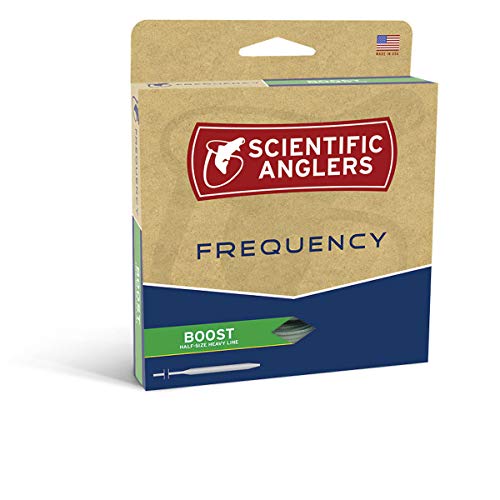
Scientific Anglers Frequency Boost Fly Line, WF5F
Built half a size heavy on purpose, with the mass pushed forward. That is the taper answer to a fast rod that feels dead at short range, and it is a far cheaper fix than a different blank.
Best for: Fast action rods, close quarters fishing, and anyone whose casts are mostly under 35 feet.

RIO Premier Gold Fly Line, WF5F
A longer, more progressive front taper that lands a leader straight instead of dumping it, with enough mass behind it to still carry a dry dropper. This is the taper most trout anglers should own if they own one good line.
Best for: All round trout fishing where presentation matters as much as distance.

Scientific Anglers Amplitude Smooth Infinity, WF5F
A slick textured coating and a taper aimed at carrying a long line with less effort. The difference is real and it shows up mostly at distance and over a long day, which is precisely where a developing caster is not yet operating.
Best for: Anglers who already carry 50 feet in the air comfortably and want less friction doing it.
Skip it if: A new caster. You will pay roughly twice a budget line for gains you cannot yet produce, and the money does more good spent on a leader supply and more time on the water.
Specs are the manufacturer's published figures. Prices and stock change constantly, so confirm on the retailer page. We earn commissions from Backcountry and from qualifying Amazon purchases.
Where do shooting heads and level lines fit?
They are the two ends of the same spectrum, and seeing them makes the weight forward against double taper argument easier to hold in your head. A level line has no taper at all: the same diameter from end to end, which turns a leader over badly and presents like a thrown rope. It survives only as cheap backing material and as a euro nymphing line where the line is never actually cast in the conventional sense.
A shooting head is a weight forward taken to its logical extreme. All of the mass is packed into a head that can be as short as 20 feet, joined to a very thin running line or a monofilament shooting line. It shoots enormous distances for the effort involved, at the cost of almost every other quality: it lands hard, it mends poorly, and the join between head and running line clicks through the guides on every retrieve. Two handed and saltwater anglers accept that trade because distance is the whole job. Trout anglers rarely do.
Line the four up by head length and the pattern is obvious. A shooting head concentrates mass in about 20 feet, a short head weight forward in about 30 feet, a long head weight forward in about 40 feet, and a double taper never stops. As the mass spreads out, shooting distance falls and mending, roll casting and delicacy rise. There is no free taper. Every foot of head you add is a foot of shooting you give up, which is why the middle of that spectrum, a weight forward with a 35 foot head, is where almost all trout fishing has settled.
How much does the taper matter next to everything else?
Less than line class, less than head length, and much less than whether the line is clean. That is worth saying because taper is the most argued about specification and the least important of the three.
Line class comes first: put 140 grains on a 5 weight rod and it works, put a 6 weight line on it and it loads early and feels heavy at distance. Head length comes second, because a 30 foot head and a 40 foot head behave more differently from each other than a 40 foot head does from a double taper. Taper family comes third. And a dirty, ungreased line of any taper casts worse than a clean line of the wrong one, because dirt on the coating increases friction through the guides and kills shooting distance faster than any design choice.
If you want the practical version: buy a weight forward in the right class, keep it clean, replace it when the front end cracks, and spend your remaining attention on your leader. The trout fly line roundup has the current picks by price, and the floating against sinking comparison is the next line decision most anglers face after this one.
Two weight forward lines built on opposite philosophies are reviewed individually here. The RIO Elite Gold uses a long head and a long back taper for loop stability at distance, and the Scientific Anglers Amplitude MPX is built half a size heavy on purpose to load fast rods at short range. Same taper family, very different rods.
Frequently asked questions
Do a weight forward and a double taper weigh the same?
In the first 30 feet, yes, and that is the whole point of the AFFTA standard. A 5 weight of either taper carries 140 grains in the first 30 feet excluding any level tip, with a tolerance of plus or minus 6 grains. They are the same line class and both load the same rod correctly at short range. The difference is entirely in where the mass sits beyond that first 30 feet.
Is a double taper better for delicate presentation?
Slightly, and less than its reputation suggests. A double taper has a long front taper that unrolls progressively, so it can lay a leader down softly at short range. Modern weight forward presentation tapers copy that front section almost exactly, so the delicacy gap at typical trout distances is now small. Where the double taper still wins clearly is at very short range on small water, under about 30 feet.
Can you really reverse a double taper line?
Yes, and it is the strongest practical argument for the taper. Because a double taper is symmetrical, you can strip it off, turn it round and reload it when the front end cracks or wears, which gives you a second working line for the price of one. A line reversed once costs about half as much per usable end, which changes the value calculation for anglers who fish hard.
Which taper roll casts better?
The double taper, on paper, because a roll cast is driven by the mass of line already on the water and a double taper keeps its full diameter well past 40 feet. A weight forward with a 35 foot head still roll casts perfectly well within that head length, which covers most trout fishing. Past the head, roll casting a weight forward becomes difficult because the thin running line carries no energy.
Which taper should a beginner buy?
A weight forward, without hesitation. It is what every shop stocks, what every boxed outfit ships with, what shoots line more easily when your loops are still imperfect, and what handles a wind resistant fly better. Double taper is a considered second purchase for a specific kind of small water fishing, not a first line, and buying one first makes casting harder rather than easier.
Does a weight forward line mend worse than a double taper?
Only beyond the head. Mending moves line by lifting and repositioning it, and thin running line has almost no mass to move, so a long mend at 55 feet with a weight forward tends to move the leader rather than the belly. Within the head length, roughly the first 30 to 40 feet, a weight forward mends as well as anything. Long line nymphing is where the difference is felt.
How we choose: we compare published manufacturer specifications, line and leader standards, and verified owner reviews across retailers. We do not test gear in person, and every diameter, grain weight and breaking strength quoted here is the manufacturer's published figure unless we say otherwise, so check the spool label before you trust a number. Nothing here is professional instruction. Wading moving water is the real hazard in this sport: wear a snug wading belt, know the water temperature, and turn back rather than push through a crossing you are unsure of.