Best Fly Reel for Trout
The best all round trout fly reel is the Redington Behemoth 5/6 at under $250, a die-cast large arbor reel with a carbon drag that far exceeds anything trout fishing demands. For most anglers on a 5 weight the reel is a line holder, so a machined 5/6 like the Piscifun Sword at under $100 is enough, and the money is better spent on fly line.
Here is the uncomfortable truth about trout reels: on a 5 weight, the reel does almost nothing. Most trout are landed on line stripped in by hand, which means the drag is never engaged and the reel is a spool that stops the line blowing away. That does not make reels unimportant, it makes them the last place to spend money rather than the first. The picks below are graded on the two things that genuinely differ, drag behaviour and arbor size, using published specifications and verified owner reviews.
What does a fly reel actually do on a trout river?
Three jobs, in descending order of how often they happen.
It stores the line. Ninety percent of the reel's working life. It holds roughly 90 feet of fly line and 100 yards of backing, and the shape it holds them in determines how badly the line coils. A reel with a large arbor winds the line at a wider diameter, so it comes off in gentler loops and straightens faster in cold weather. That is a small daily quality of life difference that adds up over a season.
It recovers slack. When a hooked fish turns and runs at you, slack line is how you lose it. Retrieve rate is a function of arbor diameter, and a large arbor reel picks up noticeably more line per handle turn than a standard arbor of the same capacity. This is the single most defensible argument for large arbor on a trout reel.
It applies drag. The rarest job and the one marketing talks about most. A trout on 5X tippet at roughly 4.5 to 5 pounds of breaking strength will never test a drag rated for twenty. What matters is not maximum drag, it is startup inertia: the amount of force needed to get a stationary spool turning. A drag that sticks then releases is what breaks a light tippet on the first surge, and that is a real difference between a cheap reel and an expensive one.
Click and pawl or disc drag: which do you need?
A click and pawl reel uses a spring-loaded pawl bearing against a gear inside the spool. Resistance is light, adjustable across a narrow range, and audible, which is why they sing. On a 2, 3 or 4 weight rod that is exactly right, because the tippet you are fishing is so fine that any real drag pressure would break it, and you regulate a running fish by palming the exposed rim. The Redington Zero Fly Reel, 2/3 at under $250 in 2/3 is the clean version of this idea.
A disc drag clamps friction washers, cork or carbon fibre, against a plate. Range is far wider and startup is smoother. On a 5 weight and up this is the default, and every other reel on this page uses one. The Redington Behemoth Fly Reel, 5/6 at under $250 uses a carbon stack with a genuinely large maximum, which is overkill for trout and useful if the same reel visits carp or pike.
Sealed against unsealed is the other axis. A sealed drag keeps grit out of the friction stack. In fresh water the enemy is fine silt and sand rather than salt, and it gets in every time you dunk the reel landing a fish. The Ross Reels Animas Fly Reel, 5/6 at under $500 is fully sealed and machined, and it is also a reel almost no trout angler needs.
How do you match reel size to rod weight?
Match the reel's published line rating to the rod's line rating and you are done. Every manufacturer marks reels in ranges, 2/3, 5/6, 7/9, because a spool that holds a 5 weight line plus backing holds a 6 weight line plus slightly less backing. The table below is the practical mapping.
| Rod | Reel size | Backing, 20lb | Drag type | Pick |
|---|---|---|---|---|
| 7'6" to 8' 2wt to 3wt | 2/3 | 50 yd | Click and pawl | Redington Zero |
| 8'6" 4wt small stream | 4/5 | 75 yd | Light disc | Step down a size |
| 9' 5wt all round trout | 5/6 | 100 yd | Disc | Piscifun Sword |
| 9' 6wt streamers and wind | 5/6 | 90 yd | Disc | Orvis Clearwater |
| 9' 7wt bass and carp | 7/9 | 150 yd | Sealed disc | Echo Bravo |
| 9' 8wt salt and pike | 7/9 | 200 yd | Sealed disc | Echo Bravo |
Backing capacity figures are the manufacturer's published numbers and they vary with backing diameter, so treat them as a guide rather than a promise. Check the spool before you wind on 150 yards of anything. The RIO Dacron Fly Line Backing, 20lb 100yd at under $25 for 100 yards of 20 pound Dacron is the standard for a 5/6.
Which trout reel should you buy at each price?
The Piscifun Sword Fly Reel, 5/6 at under $100 is the value answer and it is not close. Machined from bar stock rather than die-cast at a price where die-cast is the norm, with a sealed disc drag and a large arbor. On a 9 foot 5 weight it does everything a trout reel needs to do. If you are building a first outfit from parts, this is the reel that lets you put the savings into a better line.
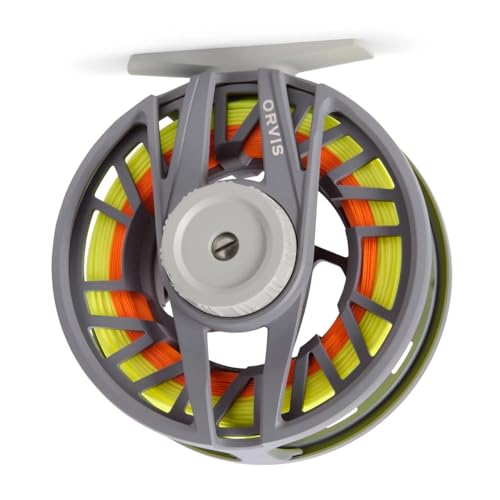
The Orvis Clearwater Fly Reel, 5-7wt at under $250 is the sensible mainstream choice. Rated 5 to 7 weight, so it covers a trout rod and a streamer rod, and, importantly, spare spools for a mainstream Orvis reel will still be available years from now. That matters more than people expect: a spare spool loaded with a sink tip turns one reel into two setups.
The Redington Behemoth Fly Reel, 5/6 at under $250 gives you drag range far beyond trout requirements in a die-cast body. If your 5 weight reel will also see carp, bass or the occasional pike, this is the one that never becomes the weak link. On a 3 weight it is too heavy and will make the rod feel butt heavy.
The Ross Reels Animas Fly Reel, 5/6 at under $500 is a genuinely excellent reel and the place to stop and be honest. It is fully sealed, machined in the United States, and beautifully smooth off the mark. On a trout river it will spend its life as an expensive line holder. Buy it if you want it, not because you have been told a trout will find out the difference.
For anything bigger, the Echo Bravo Fly Reel, 7/9 at under $250 in 7/9 has the backing capacity and the sealed drag that a bass, pike or bonefish rod actually needs, and it is a very different job from trout fishing.
Best trout fly reels, by tier

Piscifun Sword Fly Reel, 5/6
Machined from bar stock aluminium at a price that normally buys a die-cast reel. The drag is a simple sealed disc with more range than a trout will use, and the large arbor picks line up quickly when a fish runs toward you.
Best for: A first 5 weight reel, or a spare spool body for a sinking line.
Orvis Clearwater Fly Reel, 5-7wt
The default large arbor trout reel. Rated 5 to 7 weight, so one reel covers a 5 weight trout rod and a 6 or 7 weight streamer rod, and spare spools are easy to find years later, which is the quiet argument for buying a mainstream model.
Best for: One reel that will still be serviceable in a decade.

Redington Behemoth Fly Reel, 5/6
Far more drag than trout fishing requires, in a die-cast body that costs less than the machined competition. If you also chase carp, pike or bass on the same reel, this is the one that will not be the weak link.
Best for: Anglers who fish a 5 weight for trout and a 6 or 7 weight for anything that pulls harder.
Skip it if: Small stream anglers on 3 and 4 weights, where the extra body weight makes a light rod feel butt heavy.

Redington Zero Fly Reel, 2/3
A click and pawl reel in 2/3, which is the correct answer on a light small stream rod. There is no disc drag because there does not need to be: on a 3 weight you palm the rim, and the lower body weight balances a short blank properly.
Skip it if: Any 5 weight setup. A 2/3 reel will not hold a 5 weight line plus useful backing.

Ross Reels Animas Fly Reel, 5/6
A fully sealed drag machined in the United States, with the kind of startup smoothness that matters when a big fish bolts against 6X tippet at 3.5 pounds of breaking strength. Sealed means grit and salt never reach the drag stack.
Skip it if: Almost every trout angler. On a 5 weight this reel will spend its life as a very expensive line holder, and the money buys more fishing as a line, waders and a guided day.
Specs are the manufacturer's published figures. Prices and stock change constantly, so confirm on the retailer page. We earn commissions from Backcountry and from qualifying Amazon purchases.
How much backing does a trout reel really need?
Around 100 yards of 20 pound Dacron on a 5/6 reel, and the reason is not the fish. Backing fills the spool so the fly line sits near the rim at a large diameter. That does two useful things: it reduces memory coils in the fly line, which is a real annoyance in cold water, and it increases how much line comes back per handle turn.
Fill until the fly line sits roughly a quarter inch below the frame and stop. An overfilled spool is worse than an underfilled one, because the line rubs the frame and can jam solid at the exact moment a fish runs. If you are unsure, wind the fly line on first, then the backing, then reverse the whole lot onto the spool. It is fiddly once and correct forever.
Attach backing to the arbor with an arbor knot, and backing to fly line either with a nail knot or, far better, a loop-to-loop if your line has a welded rear loop. Lubricate every knot before you seat it: a dry knot generates friction heat as it tightens and fails well below its rated strength. The knot strength chart gives typical retained-strength ranges, and the knot strength calculator converts those percentages into real pounds for your tippet.
Should you buy a spare spool instead of a second reel?
Almost always yes, if the reel offers one. A spare spool costs roughly half to two thirds of the reel and gives you a second complete line system. The classic pairing for trout is a floating line on the main spool and a sink tip on the spare, so you can switch from drifting dries to swinging streamers in two minutes on the bank.
That is the practical reason to prefer a mainstream reel over an obscure one at the same price. A spare spool is only useful if it exists, and the range of a discontinued budget reel disappears quickly. Orvis, Redington, Ross and Echo all keep spools available for their current lines.
If you go the sink tip route, understand what you are buying. Sink rates are published in inches per second: a Type 3 sinks roughly 3 to 4 ips and a Type 6 roughly 6 to 7 ips. Depth equals sink rate times sink time only in still water, and in current that formula overstates depth substantially, because the current lifts the line as it moves. The sink rate and depth calculator handles that, and the sink rate chart lists the standard types.
How do you look after a trout reel?
Very little, done consistently, beats a deep clean once a decade. Rinse the reel in fresh water after any trip where it was submerged or dunked in silt, and dry it with the drag backed off. Leaving a drag clamped down under tension compresses the friction washers over months, which is the most common cause of a drag that suddenly feels grabby.
Strip the fly line off the spool once a season, wipe it with a damp cloth and dress it. A dirty line sinks at the tip, shoots badly and wears the guides. The RIO Fly Line Cleaning Kit with Dressing at under $25 is a cloth plus dressing and takes about five minutes, and it recovers more casting performance than any reel upgrade will. The gear checklist lists the cleaning kit alongside everything else worth carrying.
Check the reel foot in the seat before every trip. A reel that works loose in the seat during a day of casting is the most common source of the mysterious rattle people blame on ferrules. If you are still assembling the whole outfit, the rod setup guide covers seating, threading and leader attachment in order, and the 5 weight rod roundup covers the blank that goes with any of these reels. Choose the line before the reel and you will be happier with both: the RIO Premier Gold Fly Line, WF5F on a Piscifun Sword Fly Reel, 5/6 outfishes the reverse arrangement every day, on the same Redington Path Fly Rod, 9ft 5wt 4pc .
Three of these reels are reviewed individually now. The Lamson Liquid is the sealed drag pick, the Redington Behemoth has more drag than trout fishing will ever use and publishes its backing capacities, and the Orvis Clearwater reel is the sealed carbon option in a 5 to 7 size band.
Frequently asked questions
Does a fly reel matter for trout fishing?
Less than any other item in the outfit. Most trout are landed by stripping line in by hand, so the drag is never engaged and the reel is a line holder. Where it starts to matter is fish that run more than the 20 or 30 feet of line at your feet, and light tippet, where a smooth startup keeps a 6X knot from breaking on the first surge. Spend your money on line first, reel second.
What size fly reel do I need for a 5 weight rod?
A reel marked 5/6. That rating means the spool holds a 5 or 6 weight fly line plus roughly 100 yards of 20 pound Dacron backing without crowding the arbor. Undersize it and the line coils tightly and holds memory kinks; oversize it and the reel is heavier than the rod deserves. Manufacturers publish backing capacity per line size, and that figure is more useful than the size marking on its own.
What is the difference between a click drag and a disc drag?
A click and pawl reel uses a spring-loaded pawl against a gear to create resistance, which is light, audible and adjustable only across a narrow range. A disc drag presses friction washers, usually cork or carbon, against a plate, giving far more stopping power and a smoother startup. Click drags suit 2 to 4 weight rods where you palm the rim. Disc drags suit 5 weight and up.
Is a large arbor reel better for trout?
Usually yes. A large arbor winds more line per turn of the handle, which matters when a fish runs toward you and you need to recover slack fast. It also coils the fly line in a wider diameter, so the line holds fewer memory kinks and straightens more readily in cold conditions. The trade is a slightly larger, sometimes heavier reel body for the same line capacity.
How much backing does a trout reel need?
Around 100 yards of 20 pound Dacron on a 5/6 reel. Trout will almost never take you into backing, so the real job is filling the spool so the fly line sits at a large diameter near the rim. That reduces memory coils and increases retrieve rate per handle turn. Fill until the fly line sits roughly a quarter inch below the frame, then stop, because an overfilled spool jams.
Does a sealed drag matter in fresh water?
It matters more than most freshwater anglers expect, though not for the reason they assume. Sealing keeps out fine silt and sand, which are what actually degrade a drag stack on a river, not salt. An unsealed reel will still last years with occasional cleaning. If your reel goes in the water when you land fish, or you fish sandy tailwaters, sealing is a genuine durability upgrade.
How we choose: we compare published manufacturer specifications, line and leader standards, and verified owner reviews across retailers. We do not test gear in person, and every diameter, grain weight and breaking strength quoted here is the manufacturer's published figure unless we say otherwise, so check the spool label before you trust a number. Nothing here is professional instruction. Wading moving water is the real hazard in this sport: wear a snug wading belt, know the water temperature, and turn back rather than push through a crossing you are unsure of.