Large Arbor vs Standard Arbor Reel
Buy a large arbor reel. Retrieve per turn is the circumference of whatever the line sits on, so a 2.5 inch large arbor recovers about 7.9 inches per handle turn against about 3.1 inches for a 1 inch standard arbor, and the wider core stores line in wider coils with far less memory. Standard and mid arbor reels are still right on very small light rods where balance decides the feel of the outfit, and on click and pawl reels where sound and simplicity are the point.
Verdict: buy a large arbor reel. For almost every angler, on almost every rod, it is the better tool and it has been for two decades. The advantages are measurable rather than marketed, and one of them, reduced line memory, improves every single day you fish rather than the handful of days you hook something that runs. There is a genuine exception, covered in full further down, and it is narrower than people who dislike modern reels would like it to be.
The definition first, because the marketing has muddied it. The arbor is the central hub of the spool, the core that the backing winds onto, and arbor size is simply the diameter of that core. A standard arbor is around an inch, a mid arbor somewhere near an inch and three quarters, and a large arbor two and a half inches or more. There is no governing standard here in the way there is for line weights, so one maker's mid arbor is another's large. Compare the actual diameters rather than the words.
How much faster does a large arbor actually retrieve?
This is arithmetic rather than opinion. The line you recover in one handle turn is the circumference of whatever the line is currently sitting on, which is pi multiplied by that diameter. Nothing else about the reel changes it, because a fly reel is direct drive with no gearing.
On a bare arbor, a 1.00 inch standard core recovers about 3.1 inches per turn and a 2.50 inch large core recovers about 7.9 inches, which is 2.5 times as much. With both spools full, the gap collapses: a full standard arbor at 3 inches gives about 9.4 inches per turn against about 10.7 inches for a full large arbor, a gain of only around 13 percent.
That pattern is the whole story and it is usually told wrong. The large arbor advantage is not a flat percentage, it is a guarantee that your worst case is still fast. A standard arbor is fast when the spool is full, which is when you do not need speed, and slow when the spool is empty, which is precisely when a fish has run 60 yards and is now swimming back at you faster than you can recover line.
| Arbor | Bare diameter | Bare retrieve | Full diameter | Full retrieve | Speed swing |
|---|---|---|---|---|---|
| Standard arbor | 1.00 in | 3.1 in | 3.0 in | 9.4 in | 3.0x |
| Mid arbor | 1.75 in | 5.5 in | 3.2 in | 10.1 in | 1.8x |
| Large arbor | 2.50 in | 7.9 in | 3.4 in | 10.7 in | 1.4x |
Read the last column. A standard arbor retrieves 3.0 times faster full than empty, so its speed changes dramatically through a fight. A large arbor varies by only 1.4 times, so it behaves consistently. Consistency, not top speed, is the honest headline.
Why does line memory matter more than retrieve rate?
Because you meet it on every cast of every day, whereas you meet retrieve rate on the days a fish runs into the backing, and for most trout anglers that is a handful of days a year at most.
Fly line and backing take the shape they are stored in. Wound on a 1.00 inch arbor, the line sets into coils about 3.1 inches around. Wound on a 2.50 inch arbor, it sets into coils about 7.9 inches around. Tight coils spring off the spool as a bundle of loops that tangle in the guides, catch on the reel foot, and take several casts to stretch out. Wider coils relax almost immediately.
This is worst exactly when fishing is hardest: a cold morning, a stiff line and a spool that has been sitting all winter. It affects shooting distance too, because a coiled line drags through the guides rather than flowing. A modern coating helps and stretching the line by hand at the start of a session helps more, but the storage diameter is doing the underlying work either way. If you are unsure how to stretch and load line correctly, the rod setup guide covers it.
What does a large arbor give up?
Two things, and it is worth being precise rather than pretending the trade does not exist.
Storage capacity for the same size. A wide hub occupies the space that backing would otherwise fill. At an outside diameter of 3.4 inches, a standard arbor offers about 8.3 square inches of cross section for line and backing, and a large arbor about 4.2 square inches, which is roughly 50 percent of it. Makers solve this by building the frame bigger, which is why a modern large arbor 5 weight reel looks and feels larger than a reel of the same line class from thirty years ago.
Weight and balance. A bigger frame is a heavier frame, and on a light rod that matters. A fly outfit balances near the front of the grip, and hanging a large diameter reel on a 2 or 3 weight rod pulls the balance point back into your hand and makes the rod feel tip heavy in use, which is the opposite of what it sounds like. That is not a small aesthetic complaint, it changes how the rod casts over a long day.
| Property | Standard arbor | Large arbor | Which wins |
|---|---|---|---|
| Retrieve on a bare spool | 3.1 in per turn | 7.9 in per turn | Large arbor, 2.5x |
| Retrieve on a full spool | 9.4 in per turn | 10.7 in per turn | Large arbor, by about 13% |
| Stored coil diameter | 1.00 in | 2.50 in | Large arbor, much less memory |
| Storage cross section at 3.4 in | 8.3 sq in | 4.2 sq in | Standard arbor |
| Frame size for equal capacity | Smaller | Larger | Standard arbor |
| Weight for equal capacity | Lighter | Heavier | Standard arbor |
| Balance on a 2 or 3 weight rod | Good | Poor | Standard arbor |
| Balance on a 5 to 8 weight rod | Light in the hand | Good | Large arbor |
| Drag consistency through a run | Rises as line leaves | Stays near the setting | Large arbor |
| Line pickup after a run at you | Slow | Fast | Large arbor, decisively |
How does arbor size change the drag?
This is the argument most anglers have never heard and it is the one with real consequences for light tippet.
A reel drag applies a braking torque at the spool, but what the fish feels is a force at the line, and force equals torque divided by the radius at which the line leaves the spool. Set a drag with a full spool and it feels right. Let a fish take 50 yards off a standard arbor and that radius has shrunk substantially, so the same torque now produces a much higher force on the tippet. The drag you carefully set for 5X has effectively tightened itself during the run, at the exact moment the fish is furthest away and the line has the least stretch left to give.
A large arbor reduces that effect because the radius changes proportionally much less between full and empty. It does not eliminate it, but it makes the drag behave closer to the number you set. On a trout river this is a nice property. On a bonefish flat or with a big fish on light tippet it is the difference between landing and losing, and it is a large part of why large arbors took over the saltwater market first. The rod weight by species chart is a reasonable proxy for where this starts to matter: broadly, 8 weight and above.
How much backing should go under the line?
Enough that the fly line finishes near the rim of the spool, which is the number that actually matters and the one nobody prints on a box. Arbor size is only half of the retrieve equation: the other half is how close to full you keep the spool, and a large arbor reel with too little backing behind the line throws away most of its own advantage.
For trout, roughly 100 yards of 20 pound dacron under a 5 weight line is the conventional amount, and the honest reason is not that a trout will take you into it. It is that backing fills the spool. A fly line wound onto a bare or half filled arbor sits on a small effective diameter, so it retrieves slowly and comes off in tight springs, which is the standard arbor problem recreated on a reel that did not need to have it.
Check it after the line is on. The finished wind should sit a few millimetres below the rim: any higher and the line rubs the frame and the reel jams under load, any lower and you have given up retrieve rate for no reason. If it comes out wrong, strip the whole thing off, adjust the backing length and rewind. It is a fifteen minute job that improves every retrieve for the life of the line.
What is the verdict, and who should buy a standard arbor?
Verdict: buy a large arbor. It retrieves consistently rather than only when full, it stores line in wide coils that behave on cold mornings, and it holds a drag setting closer to what you set. On a 5 weight and up there is no meaningful counter argument. The Piscifun Sword Fly Reel, 5/6 is the cheapest honest version and the Orvis Clearwater Fly Reel, 5-7wt is the sensible middle.
Now the case for the other side, which is real. A standard or mid arbor is still the right reel here.
- Very small, very light rods. On a 2 or 3 weight, balance decides how the outfit feels far more than retrieve rate does, and the fish those rods catch will never test a drag. A light reel like the Redington Zero Fly Reel, 2/3 keeps the balance point where it belongs and the outfit feels alive rather than nose heavy.
- Click and pawl reels. A click and pawl is a spring and a gear, not a disc brake, and the sound and simplicity are the point. Applying large arbor thinking to it misses what it is for. These reels are chosen deliberately by people who are palming the rim to slow a fish anyway.
- Cane and fibreglass rods. A traditional rod balances with a traditional reel, and a wide anodised frame on a bamboo rod looks and feels wrong in a way that is not purely aesthetic. The rods are heavier in the tip and want the mass distributed differently.
- Maximum backing in a small frame. If you genuinely need a lot of backing and cannot carry a bigger reel, the standard arbor stores roughly twice the cross section for the same outside diameter. This is rare in freshwater and occasionally decisive elsewhere.
- You already own one and it works. A trout is landed on the rod and the line hand, not on the reel, and a standard arbor reel that has been catching fish for twenty years will keep doing it. Buy line before you buy a reel.
And plainly the other way: skip the standard arbor if you fish 5 weight and up, if you fish anything that runs, if you fish cold mornings, or if you own one reel. Those cover almost everybody, which is why the verdict is what it is.
Trout reels by tier

Piscifun Sword Fly Reel, 5/6
A machined aluminium large arbor reel at a price that used to buy a die cast one. For trout, a reel is mostly a line holder with a brake attached, and this holds line on a wide arbor and brakes adequately, which is the whole job.
Best for: A first 5 weight reel, or a spare spool platform for a second line.

Redington Zero Fly Reel, 2/3
A light click drag reel for small rods, and the honest case for not chasing arbor diameter. On a 2 or 3 weight the reel is there to balance the rod and make a noise, and adding mass and diameter to win a retrieve rate contest ruins the feel of the outfit.
Best for: Small stream 2 and 3 weight rods where balance matters more than retrieve rate.
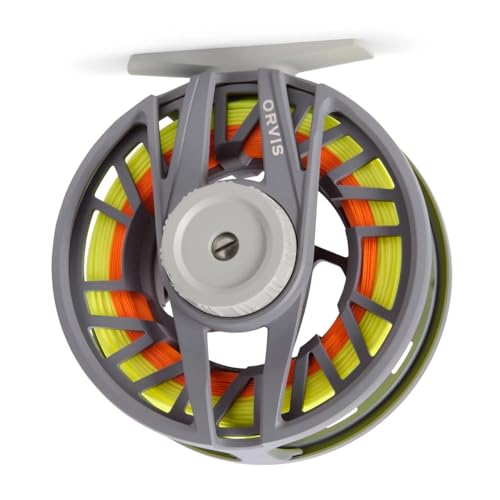
Orvis Clearwater Fly Reel, 5-7wt
A conventional large arbor trout reel sized to cover 5 through 7 weight, which is the range most anglers stay in. The wide arbor is doing real work here: less line memory off the spool and a retrieve that keeps up with a fish running at you.
Best for: A 5 or 6 weight rod, and anyone who wants one reel to serve two rods.

Redington Behemoth Fly Reel, 5/6
Far more drag than a trout will ever ask for, on a large arbor frame, at a price that makes it a favourite for anglers who also fish bass and pike. Drag range is the specification people overbuy, and this is the honest place to overbuy it.
Best for: Anglers crossing between trout and warmwater with one reel.

Ross Reels Animas Fly Reel, 5/6
A sealed drag in a machined large arbor frame, which is what you pay for once grit, sand and repeated immersion enter the picture. A sealed system keeps working when an open drag has started to grind.
Best for: Hard use, salt exposure, and anglers who fish enough days that maintenance time has a cost.
Skip it if: Trout anglers on small rivers. A trout is landed on the rod and the line hand, and this drag will never be asked to do anything a 60 dollar reel could not.
Specs are the manufacturer's published figures. Prices and stock change constantly, so confirm on the retailer page. We earn commissions from Backcountry and from qualifying Amazon purchases.
How much should the reel cost at all?
Less than most buyers expect, and this is the honest closing point. For trout, a reel is mostly a line holder with a brake attached. Trout are landed by the rod and the line hand. The drag is used to stop a spool overrunning and to apply gentle, consistent pressure, and almost any machined reel does that adequately.
Spend real money on a reel when one of three things is true: the fish run far enough that the drag is doing continuous work, the environment is abrasive enough that a sealed drag pays for itself, or you need a specific weight to balance a rod you already love. A Ross Reels Animas Fly Reel, 5/6 is a genuinely better instrument than a Piscifun Sword Fly Reel, 5/6 , and on a small trout river neither of them will be asked to prove it.
Size the reel to the rod rather than to the arbor argument: a 5/6 reel on a 5 weight rod, and enough backing under the line that the fly line sits near the rim. A Redington Behemoth Fly Reel, 5/6 covers trout and warmwater on one frame if you want one reel to do two jobs. If you are buying a whole system, the intermediate setup build puts the matched parts on one page, and the trout reel roundup has the current picks by tier. Whatever you choose, spend the marginal dollar on the line first: the fly line guide explains why that is the upgrade that changes casting, and the reel is the component that changes it least.
Two large arbor reels are reviewed individually here and they show how differently the same idea gets executed. The Redington Behemoth publishes its backing capacities by size, which is unusually useful, and carries a drag far stronger than trout fishing needs. The Orvis Clearwater reel takes the sealed drag route in a 5 to 7 weight size band.
Frequently asked questions
What is a large arbor fly reel?
A reel whose spool has a wide central hub, so the line and backing sit on a large diameter core rather than winding down to a narrow one. Retrieve per turn is simply the circumference of whatever the line is sitting on, so a 2.5 inch bare arbor recovers about 7.9 inches per handle turn against about 3.1 inches for a 1 inch standard arbor. The wide core also stores line in wider, flatter coils.
Does a large arbor really retrieve faster?
Yes, and the difference is largest exactly when it matters. On a bare arbor a large arbor recovers roughly two and a half times as much line per turn. With both spools full the gap narrows to around 13 percent, because a full standard arbor spool is nearly as wide as a full large arbor one. The advantage appears after a fish has run and taken line off, which is when you need it.
Does a large arbor reduce line memory?
Yes, and this is the benefit anglers feel every single day rather than occasionally. Line takes the shape it is stored in, so a 1 inch arbor produces tight coils about 3.1 inches around and a 2.5 inch arbor produces coils about 7.9 inches around. Wider coils relax faster and tangle less on the first casts of a cold morning, which is a real everyday improvement rather than a specification.
Do large arbor reels hold less backing?
For the same outside diameter, yes, because the wide hub occupies space the backing would otherwise fill. At a 3.4 inch outside diameter a large arbor offers roughly half the storage cross section of a standard arbor. Manufacturers compensate by increasing frame diameter or spool width, which is why a modern large arbor trout reel is physically bigger and slightly heavier than an old standard arbor of the same line class.
Does the arbor size change how the drag works?
Indirectly but genuinely. Drag is applied at the spool, and the resistance a fish feels depends on the radius at which the line leaves the spool. On a standard arbor, that radius shrinks a lot as line goes out, so the effective drag increases during a long run, which is exactly when tippet is most at risk. A large arbor keeps the radius more constant, so the drag stays closer to what you set.
When is a standard or mid arbor still the right choice?
On very small, light rods where balance decides how the outfit feels, and on click and pawl reels where simplicity and sound are the point rather than performance. A 2 or 3 weight rod is thrown out of balance by a large diameter reel, and the fish it catches never test a drag. Classic and cane rod anglers also choose standard arbors deliberately, and that is a legitimate preference.
How we choose: we compare published manufacturer specifications, line and leader standards, and verified owner reviews across retailers. We do not test gear in person, and every diameter, grain weight and breaking strength quoted here is the manufacturer's published figure unless we say otherwise, so check the spool label before you trust a number. Nothing here is professional instruction. Wading moving water is the real hazard in this sport: wear a snug wading belt, know the water temperature, and turn back rather than push through a crossing you are unsure of.